Chemistry 9701/52 — February/March 2018
Cambridge A-Level · Planning, Analysis and Evaluation · worked solutions for every part, with the mark scheme
Topics Planning · Analysis, Conclusions and Evaluation
When a solute is added to a solvent the freezing point of the solution is lower than that of the pure solvent.
The lowering of freezing point is very small. A chemist called Beckmann invented a thermometer capable of measuring these small temperature changes accurately. The Beckmann thermometer must be calibrated at the start of the experiment.
An incomplete diagram of the Beckmann apparatus is shown containing pure liquid cyclohexane, an organic solvent with a freezing point of about . The diagram does not show how the cyclohexane could be frozen.
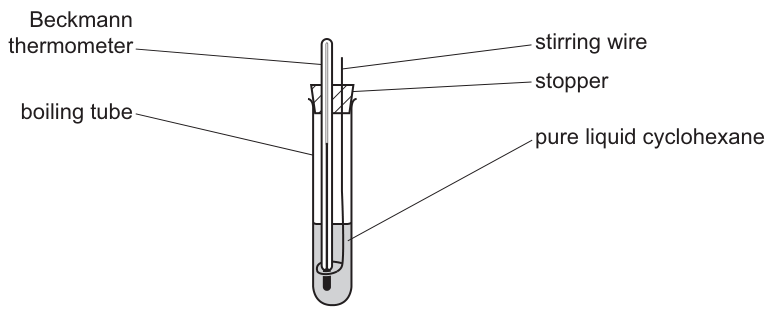
Complete the diagram to show how the pure liquid cyclohexane could be frozen using simple laboratory apparatus.
Answer
Place the boiling tube inside a larger surrounding vessel (e.g. a polystyrene/styrofoam cup or plastic beaker) containing a mixture of ice and water (a freezing mixture).
Surrounding vessel of polystyrene/styrofoam/plastic containing water and ice within the cooling mixture
Background Concept
To freeze a liquid in a laboratory, it must be placed in contact with something colder than its freezing point. Cyclohexane freezes at about 6.5 °C, so a freezing mixture of ice and water (which reaches approximately 0 °C) provides a sufficiently low temperature to remove heat from the cyclohexane and cause it to solidify. A polystyrene cup or plastic beaker acts as the surrounding vessel, providing insulation and containing the ice-water mixture.
Understanding the Question
The question asks the candidate to complete the given diagram (Fig. 1.1) to show how the pure liquid cyclohexane could be frozen using simple laboratory apparatus. The key requirement is to show a cooling arrangement that can bring the cyclohexane below its freezing point.
Approach
Identify a simple cooling method: an ice-water mixture (freezing mixture) in a larger vessel surrounding the boiling tube. The vessel should be made of a material that provides some insulation (polystyrene) or is at least chemically compatible (plastic). Draw or describe this arrangement around the existing boiling tube.
Step-by-Step Reasoning
- The cyclohexane has a freezing point of ~6.5 °C. To freeze it, the surrounding temperature must be below this.
- A mixture of ice and water reaches 0 °C, which is below 6.5 °C — sufficient to freeze cyclohexane.
- The boiling tube is placed inside a larger vessel (polystyrene cup or plastic beaker) containing the ice-water mixture.
- The mark scheme requires both elements: the surrounding vessel (polystyrene/styrofoam/plastic containing water) AND ice within the cooling mixture.
Key Takeaways
- A freezing mixture of ice and water can cool substances below 0 °C to approximately 0 °C.
- Simple laboratory apparatus for cooling includes a surrounding vessel with ice-water mixture.
- The vessel material (polystyrene, plastic) should be chemically compatible with the solvent.
Common Mistakes
- Only mentioning ice without the water/cooling mixture context.
- Suggesting a refrigerator or dry ice (not 'simple laboratory apparatus' in the context of this question).
- Forgetting to include both the vessel AND the ice in the answer.
Things to Be Careful About
- The mark scheme requires BOTH the surrounding vessel (polystyrene/styrofoam/plastic containing water) AND ice within the cooling mixture. One without the other does not earn the mark.
The method for determining the lowering of freezing point is as follows.
step 1 Add of pure liquid cyclohexane to a clean dry boiling tube.
step 2 Place the stopper containing the Beckmann thermometer and stirring wire into the boiling tube.
step 3 Cool the pure cyclohexane. When it starts to freeze, set the Beckmann thermometer to to calibrate it.
step 4 Allow the pure cyclohexane to melt. Remove the stopper from the boiling tube. Add of an organic solid X to the pure cyclohexane and replace the stopper. Stir the solution to dissolve X and refreeze the solution. Record the new freezing point.
step 5 Allow the solution to melt. Remove the stopper from the boiling tube. Add a further known mass of X to the solution and replace the stopper. Stir the solution to dissolve X and refreeze the solution. Record the new freezing point.
step 6 Repeat step 5 until sufficient readings are obtained.
In step 1, the cyclohexane can be measured using an electronic balance, a beaker and a clean dry boiling tube as shown.
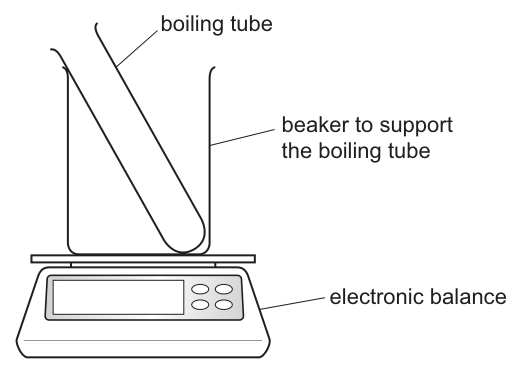
Describe a suitable method to add precisely of cyclohexane to the boiling tube.
Assume that the balance is accurate to two decimal places and that common laboratory apparatus is available.
Answer
Place the boiling tube (supported in the beaker) on the electronic balance and tare/zero the balance. Add cyclohexane dropwise (using a dropper/pipette) until the balance reads exactly .
Add dropwise around the 20.00 g mark
Background Concept
An electronic balance accurate to two decimal places can measure masses to . To achieve a precise target mass of a liquid, the technique involves placing the container on the balance, taring it, and then adding the liquid carefully — especially near the target — using a method that allows fine control (dropwise addition via a dropper or pipette).
Understanding the Question
The question asks for a suitable method to add precisely of cyclohexane to the boiling tube, given that the balance is accurate to two decimal places. The key word is 'precisely', meaning the final reading must be exactly .
Approach
The standard technique is: place the container on the balance, tare it, then add the substance. For a liquid, the critical step is adding it dropwise as the reading approaches the target, to avoid overshooting.
Step-by-Step Reasoning
- Place the boiling tube (in the beaker) on the electronic balance.
- Tare/zero the balance so it reads .
- Pour cyclohexane from a beaker or add it with a dropper, watching the display.
- As the reading approaches , switch to adding the liquid dropwise to achieve exactly .
- The mark scheme specifically rewards 'add dropwise around 20.00 g mark' — this demonstrates awareness of the need for fine control near the target.
Key Takeaways
- When measuring a precise mass on an electronic balance, the final approach to the target must be done carefully (dropwise for liquids) to avoid overshooting.
- Taring the balance with the container first means the displayed reading equals the mass of the substance alone.
Common Mistakes
- Simply saying 'pour until 20.00 g' without mentioning dropwise addition — this lacks the precision required.
- Forgetting to mention taring the balance first.
- Suggesting use of a measuring cylinder instead of the balance (the question specifies using the balance).
Things to Be Careful About
- The balance is accurate to two decimal places, so the reading can be set to exactly .
- The key marking point is 'dropwise' — this shows understanding of how to achieve precision with a liquid.
Alternatively in step 1, the volume of cyclohexane with a mass of exactly can be measured and added to the boiling tube.
Calculate the volume of cyclohexane with a mass of precisely .
The density of cyclohexane is .
Give your answer to two decimal places.
volume of cyclohexane = ..............................
Explain whether a burette is suitable for measuring this volume.
Working
Answer
Volume of cyclohexane =
A burette is not suitable because a burette can only measure to (it cannot measure to ), so the volume cannot be determined to the required precision of two decimal places.
25.64 cm³; No, a burette can only measure ±0.05 cm³
Background Concept
Density relates mass and volume: , so . A burette is a piece of volumetric apparatus typically graduated in divisions, with readings estimated to . This means it can measure volumes to one decimal place (or half a division), but NOT to two decimal places.
Understanding the Question
Two tasks: (1) calculate the volume of cyclohexane with mass given density , to two decimal places; (2) explain whether a burette is suitable for measuring this volume to the required precision.
Approach
- Use for the calculation.
- Compare the precision of a burette () with the required precision (two decimal places, i.e. ).
Step-by-Step Reasoning
- (to 2 d.p.).
- The question requires the volume to be measured precisely to two decimal places (matching the precision).
- A burette has graduations of and can be read to — this is only to one decimal place at best.
- Therefore a burette CANNOT measure to and is not suitable.
Key Takeaways
- Always check whether the precision of the chosen apparatus matches the precision required by the question.
- A burette reads to , not .
Common Mistakes
- Saying 'yes' because a burette is a precise instrument — it is precise for titration volumes but not to two decimal places.
- Incorrect calculation (e.g. multiplying instead of dividing by density).
- Not stating the answer to exactly two decimal places.
Things to Be Careful About
- Give the volume to exactly two decimal places as instructed.
- The explanation must explicitly state WHY the burette is unsuitable (its precision limit of ).
In step 4 the mass of X is measured on an electronic balance accurate to three decimal places before adding it to the cyclohexane.
A student suggests the following technique.
- An empty container is placed on the electronic balance.
- The mass of the empty container is recorded to three decimal places.
- of X is added to the container.
- X is tipped from the container into the cyclohexane.
Explain why this technique would not be accurate for adding of X to the cyclohexane.
Answer
When X is tipped from the container into the cyclohexane, some of the solid may remain in the container (adhere to the walls), so the actual mass added to the cyclohexane would be less than .
(This is not 'weighing by difference' — the mass actually transferred is unknown.)
Some of X may remain in the container when transferring, so the mass actually added is less than 0.250 g
Background Concept
In analytical chemistry, when a solid must be transferred from a weighing container to a reaction vessel, the correct technique is 'weighing by difference': weigh the container with the substance, transfer the substance, then weigh the container again. The difference gives the exact mass transferred. If instead you weigh the empty container, add the substance to get the target mass, then tip it out, you have no way of knowing how much actually left the container.
Understanding the Question
The student's technique is: weigh empty container, add X to reach 0.250 g, tip X into cyclohexane. The question asks why this is not accurate.
Approach
Identify the flaw: when tipping a solid from a container, some particles inevitably adhere to the container walls or base, meaning not all 0.250 g actually enters the cyclohexane.
Step-by-Step Reasoning
- The balance shows 0.250 g of X is in the container.
- When X is tipped into the cyclohexane, some solid remains stuck to the container.
- The mass actually added to the cyclohexane is therefore LESS than 0.250 g.
- Since the true mass added is unknown, the calculation of B and ultimately will be in error.
- The correct method would be weighing by difference: weigh container + X, transfer, weigh container again, and the difference is the true mass transferred.
Key Takeaways
- Weighing by difference is essential when transferring solids to ensure the actual mass added is known.
- Any transfer technique that does not account for residue introduces a systematic error.
Common Mistakes
- Saying 'the balance is not accurate enough' — the balance IS accurate to three decimal places; the problem is the transfer method.
- Saying 'X might evaporate' — this is not the issue for a solid.
Things to Be Careful About
- The answer must specifically address the transfer step and the loss of material remaining in the container.
The freezing points of the solutions are lower than the freezing point of pure cyclohexane.
For the experiment described in (b) the values of are recorded in the table.
A ratio, B, is calculated as follows.
Complete the table by calculating B for each reading. Give your answers to three significant figures.
| reading number | total mass of X added to 20.00g of cyclohexane / g | B | |
|---|---|---|---|
| 1 | 0.250 | 1.35 | |
| 2 | 0.400 | 2.20 | |
| 3 | 0.500 | 2.75 | |
| 4 | 0.800 | 4.40 | |
| 5 | 0.950 | 5.30 | |
| 6 | 1.150 | 6.40 | |
| 7 | 1.300 | 7.25 | |
| 8 | 1.400 | 8.50 |
Working
Answer
| Reading | Mass of X / g | B |
|---|---|---|
| 1 | 0.250 | 0.0125 |
| 2 | 0.400 | 0.0200 |
| 3 | 0.500 | 0.0250 |
| 4 | 0.800 | 0.0400 |
| 5 | 0.950 | 0.0475 |
| 6 | 1.150 | 0.0575 |
| 7 | 1.300 | 0.0650 |
| 8 | 1.400 | 0.0700 |
B values: 0.0125, 0.0200, 0.0250, 0.0400, 0.0475, 0.0575, 0.0650, 0.0700 (all to 3 s.f.)
Background Concept
The ratio B represents the mass of solute per unit mass of solvent. It is a dimensionless quantity (g/g) that is directly proportional to the concentration of the solution in molality terms. In freezing point depression, is proportional to B (for dilute solutions), so plotting against B should give a straight line through the origin.
Understanding the Question
The candidate must calculate B = mass of X / mass of solvent for each of the 8 readings, where the mass of solvent (cyclohexane) is always . Answers must be given to three significant figures.
Approach
Divide each mass of X by 20.00. Express the result to exactly three significant figures.
Step-by-Step Reasoning
- Reading 1: (3 s.f.)
- Reading 2: (3 s.f.)
- Reading 3: (3 s.f.)
- Reading 4: (3 s.f.)
- Reading 5: (3 s.f.)
- Reading 6: (3 s.f.)
- Reading 7: (3 s.f.)
- Reading 8: (3 s.f.)
Note: trailing zeros after the decimal point are significant, so 0.0200 has three significant figures (the trailing zeros count).
Key Takeaways
- When expressing to significant figures, trailing zeros after a decimal point ARE significant.
- The mass of solvent remains constant throughout the experiment (20.00 g).
Common Mistakes
- Writing 0.02 instead of 0.0200 (only 1 s.f. instead of 3).
- Dividing by the wrong value (e.g. dividing by total mass of solution).
- Not giving all values to exactly 3 s.f.
Things to Be Careful About
- Three significant figures means 0.0200 (not 0.02) and 0.0700 (not 0.07). The trailing zeros are essential.
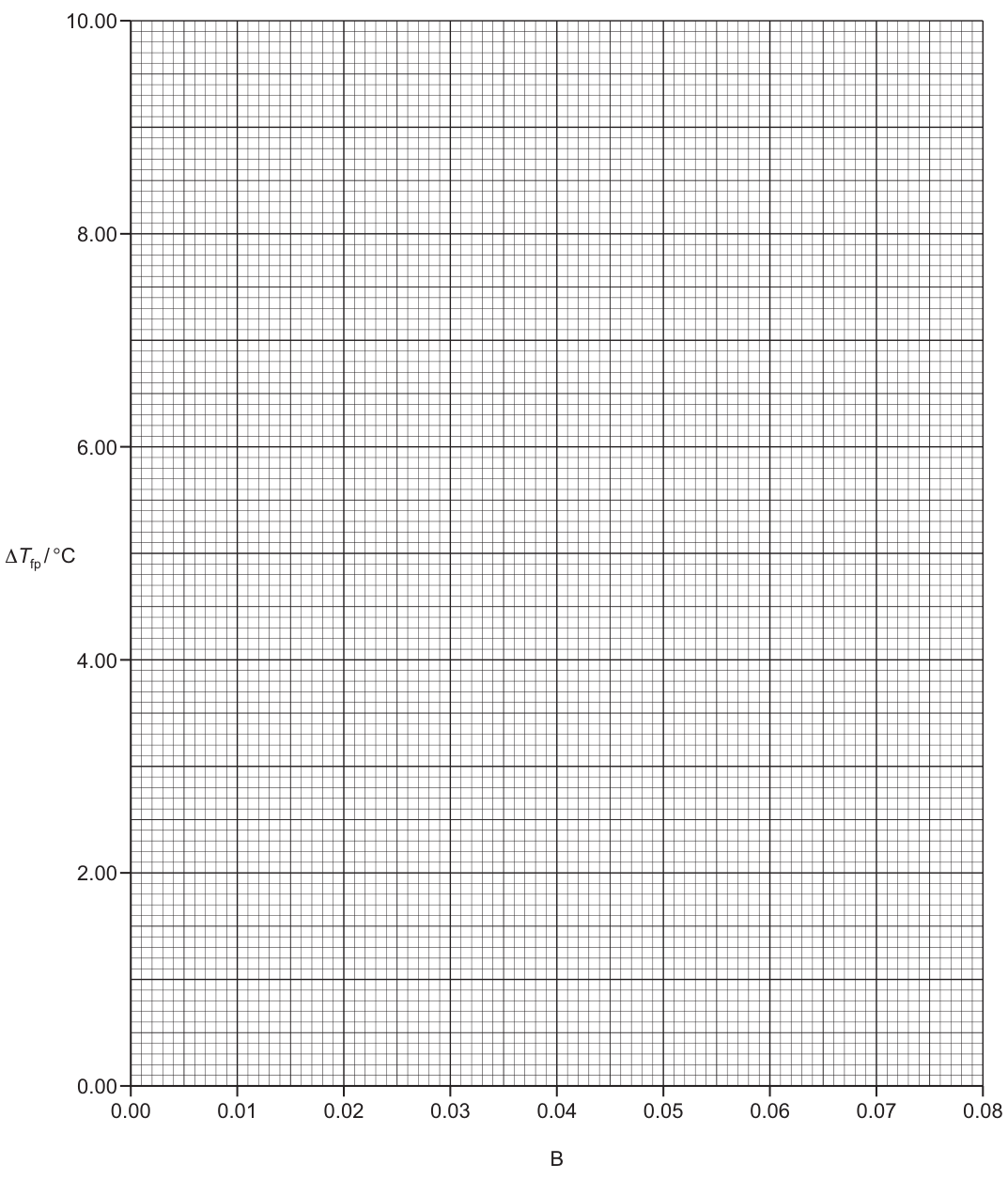
Plot a graph on the grid to show the relationship between B and . Draw the line of best fit.
Answer
Plot all 8 points on the grid with B on the x-axis and on the y-axis. Draw a straight line of best fit passing through the origin and through the cluster of points, with the anomalous point (reading 8) excluded from the line.
Straight line of best fit through origin and points 1-7 (excluding anomalous point 8)
Background Concept
Freezing point depression is directly proportional to the molality of the solute (for dilute ideal solutions). Since B is proportional to molality (mass of solute per mass of solvent), a plot of against B should give a straight line through the origin. The gradient of this line equals .
Understanding the Question
The candidate must plot the calculated B values against the given values on the provided grid (Fig. 1.3) and draw a line of best fit. The axes are already labelled: y-axis is (0 to 10) and x-axis is B (0 to 0.08).
Approach
- Plot each (B, ) pair as a point on the grid.
- Observe the trend — points 1-7 should fall approximately on a straight line through the origin.
- Point 8 (B = 0.0700, = 8.50) will be anomalous (too high for the line).
- Draw a straight line of best fit that passes through the origin and the majority of points, ignoring the outlier.
Step-by-Step Reasoning
The points to plot are:
- (0.0125, 1.35), (0.0200, 2.20), (0.0250, 2.75), (0.0400, 4.40), (0.0475, 5.30), (0.0575, 6.40), (0.0650, 7.25), (0.0700, 8.50)
Points 1-7 lie approximately on a straight line through the origin with gradient ≈ 110-112 °C. Point 8 deviates significantly above this line. The line of best fit should pass through the origin and through points 1-7, with point 8 clearly above the line.
Key Takeaways
- A line of best fit for a proportional relationship must pass through the origin.
- Anomalous points should be identified and excluded from the line.
- Points should be plotted to within half a small square of accuracy.
Common Mistakes
- Drawing a curve instead of a straight line.
- Including the anomalous point in the line of best fit.
- Not passing the line through the origin.
- Plotting points inaccurately (more than half a small square off).
Things to Be Careful About
- The line must be straight (ruler) and pass through the origin.
- Use small, neat crosses or dots for plotting points.
Identify, by the reading number, the single most anomalous point. Suggest what error in the experiment could have caused this anomaly.
reading number ..................................................................................................................
reason .................................................................................................................................
Answer
Reading number: 8
Reason: A greater mass than was actually added (the mass recorded was too low compared to the true mass added), causing a larger than expected for the stated B value.
Reading 8; a greater mass than 1.40 g was added
Background Concept
An anomalous point is one that deviates significantly from the expected linear trend. In this experiment, should be directly proportional to B. If a point lies well above the line, it means the actual is larger than predicted by the recorded B value — suggesting more solute was actually present than the recorded mass indicates.
Understanding the Question
The candidate must identify which reading is most anomalous (furthest from the line of best fit) and suggest an experimental error that could explain it.
Approach
From the graph, reading 8 (B = 0.0700, = 8.50) lies clearly above the line of best fit through points 1-7. The expected for B = 0.0700 from the line would be approximately 7.7-7.8 °C, but the actual value is 8.50 °C — too high. This means the true mass of X was greater than 1.40 g (so the true B was higher than recorded).
Step-by-Step Reasoning
- Points 1-7 lie approximately on a straight line through the origin.
- Point 8 deviates significantly above this line.
- If the true mass of X added was greater than the recorded 1.40 g, then the true B would be higher than 0.0700, and the higher would be consistent with a higher B value.
- This could happen if the student misread the balance or added too much X.
Key Takeaways
- An anomalous point above the line in a proportional graph suggests the independent variable was underestimated (true value higher than recorded).
- Always check whether the deviation direction is consistent with a plausible error.
Common Mistakes
- Identifying the wrong point as anomalous.
- Suggesting 'human error' or 'reading error' without specifying the direction of the error.
- Suggesting the freezing point was misread (this would affect but not explain why it is specifically high relative to B).
Things to Be Careful About
- The reason must specifically explain WHY is too high for the given B — i.e. more solute was actually present than recorded.
In another experiment, a student added an unknown mass of X to of cyclohexane and measured as .
Use your graph to determine the mass of X used in this experiment.
mass of X = .............................. g
Working
From the graph, when :
Answer
Mass of X =
0.90 g
Background Concept
Reading a value from a graph involves locating the given value on one axis, drawing a horizontal (or vertical) line to the line of best fit, then reading the corresponding value on the other axis. Here, is given and B must be found from the line, then converted to mass.
Understanding the Question
The student measured . Using the graph (line of best fit from part c(ii)), find the corresponding B value, then calculate the mass of X.
Approach
- Locate 5.00 on the y-axis ().
- Draw a horizontal line to the line of best fit.
- Draw a vertical line down to the x-axis to read B.
- Calculate mass of X = B × 20.00.
Step-by-Step Reasoning
- From the graph, at , the line of best fit gives B ≈ 0.045.
- Mass of X = B × mass of solvent = .
The mark scheme awards M1 for reading B = 0.045 (±0.002 acceptable) and M2 for the correct multiplication giving 0.90 g.
Key Takeaways
- Always use the line of best fit (not individual data points) when reading from a graph.
- The relationship B = mass of X / mass of solvent can be rearranged: mass of X = B × mass of solvent.
Common Mistakes
- Reading off a data point rather than the line of best fit.
- Forgetting to multiply by 20.00 (giving the answer as 0.045 instead of 0.90 g).
- Reading B incorrectly from the graph (e.g. reading 0.040 or 0.050 instead of 0.045).
Things to Be Careful About
- The answer must be in grams (the question asks for mass of X in g).
- Use the line of best fit, not the raw data points.
Determine the gradient of your line of best fit. State the coordinates of the two points you used for your calculation.
coordinates 1 .............................................. coordinates 2 ..............................................
gradient = ..............................
Working
Coordinates 1:
Coordinates 2:
Answer
Gradient =
112 °C (using points (0.0125, 1.35) and (0.0650, 7.25))
Background Concept
The gradient of a straight line is calculated as using two points ON the line of best fit (not necessarily data points). The two points should be well separated (at least half the length of the line) to minimise the effect of reading errors.
Understanding the Question
The candidate must state two sets of coordinates from the line of best fit and use them to calculate the gradient. The units are °C (since y is in °C and x is dimensionless).
Approach
- Choose two points on the line of best fit that are well separated and easy to read.
- Calculate gradient = (change in y) / (change in x).
Step-by-Step Reasoning
Using points on the line (not necessarily data points):
- Point 1: — this is approximately on the line near reading 1.
- Point 2: — this is approximately on the line near reading 7.
Gradient =
Alternative valid choices might include and giving gradient = .
The mark scheme awards M1 for stating valid coordinates and M2 for the correct gradient calculation. Acceptable range is approximately 105-115 °C depending on the line drawn.
Key Takeaways
- Always use points ON the line of best fit, not raw data points.
- Choose well-separated points to reduce percentage error in the gradient.
- The gradient has units of °C (since B is dimensionless).
Common Mistakes
- Using data points instead of points on the line.
- Choosing two points that are too close together.
- Reversing the gradient calculation ().
- Forgetting the units.
Things to Be Careful About
- State BOTH coordinates clearly as required by the question.
- The gradient should be consistent with the line drawn in part (c)(ii).
- Acceptable range is approximately 105-115 °C.
is related to the of X by the following expression
where
The of X can be found using the gradient of your line of best fit.
The numerical value of is 20020.
Use this value for and the gradient you determined in (c)(v) to calculate the of X. Give your answer to the nearest whole number.
If you were unable to calculate the gradient in (c)(v), assume that the gradient is . This is not the correct value.
= ..............................
Working
Answer
= 179
179
Background Concept
The relationship shows that for a given solute (fixed ) and solvent (fixed K), is directly proportional to B. The gradient of the vs B graph is therefore , and rearranging gives .
Understanding the Question
The candidate must use the gradient determined in part (c)(v) and the given value to calculate of X, giving the answer to the nearest whole number.
Approach
Substitute and the gradient from (c)(v) into .
Step-by-Step Reasoning
Using gradient = 112 °C from part (c)(v):
If the assumed gradient of 103 were used (as stated in the question for those who couldn't calculate it):
The mark scheme awards the mark for a correct calculation using the candidate's own gradient from (c)(v) (ecf allowed).
Key Takeaways
- When a question provides an alternative value to use if you couldn't complete a previous part, always use your own value if you have one.
- The formula is a direct rearrangement — no additional manipulation needed.
Common Mistakes
- Dividing gradient by K instead of K by gradient.
- Not giving the answer to the nearest whole number.
- Using the assumed value of 103 when a valid gradient was obtained in (c)(v).
Things to Be Careful About
- Give the answer to the nearest whole number (no decimal places).
- Use the gradient from your own (c)(v) answer — ecf applies.
A student used the Beckmann apparatus and repeated the experiment described in (b) with an unknown solid Y. The student found the of Y to be 136.
Y is an aromatic carboxylic acid.
Suggest the structure of Y.
[: C, 12.0; O, 16.0; H, 1.0]
Working
of Y = 136. An aromatic carboxylic acid contains a benzene ring () and a group.
Phenylacetic acid:
Answer
(phenylacetic acid)
Alternatively: (methylbenzoic acid / toluic acid)
C6H5CH2COOH (phenylacetic acid) or CH3C6H4COOH (methylbenzoic acid)
Background Concept
An aromatic carboxylic acid contains a benzene ring and a carboxylic acid functional group (-COOH). The general formula for a monocarboxylic acid attached to an aromatic ring can be written as Ar-COOH or Ar-CH₂-COOH, where Ar is an aryl group. The molecular formula must satisfy both the structural constraints (aromatic + carboxylic acid) and the given .
Understanding the Question
The student determined for an unknown aromatic carboxylic acid Y. The candidate must suggest a structure consistent with this and the description 'aromatic carboxylic acid'.
Approach
- An aromatic carboxylic acid must contain a benzene ring and a -COOH group.
- Try possible structures and calculate their :
- Benzoic acid: → (too low)
- Phenylacetic acid: → ✓
- Methylbenzoic acid (toluic acid): → ✓
Step-by-Step Reasoning
- Benzoic acid (): . Too low.
- Adding one group: → . ✓
- This could be phenylacetic acid () or methylbenzoic acid ().
- Both are aromatic carboxylic acids with .
Key Takeaways
- When deducing a structure from , start with the simplest member of the homologous series and add units (each adding 14 to ).
- Multiple structural isomers may satisfy the same and description — any valid one earns the mark.
Common Mistakes
- Suggesting benzoic acid (, incorrect).
- Suggesting a non-aromatic compound.
- Suggesting a compound that is not a carboxylic acid (e.g. an ester or alcohol).
- Arithmetic errors in calculating .
Things to Be Careful About
- The compound MUST be both aromatic (contains a benzene ring) AND a carboxylic acid (contains -COOH).
- Use the given values: C = 12.0, O = 16.0, H = 1.0.
The rest of this paper
1 more questions- Q2Analysis, Conclusions and Evaluation · Planning14M