Chemistry 9701/52 — October/November 2017
Cambridge A-Level · Planning, Analysis and Evaluation · worked solutions for every part, with the mark scheme
Topics Analysis, Conclusions and Evaluation · Planning
Verdigris is a green pigment that contains both copper(II) carbonate, , and copper(II) hydroxide, , in varying amounts.
Both copper compounds react with dilute hydrochloric acid.
You are to plan an experiment to determine the percentage of copper(II) carbonate in a sample of verdigris. Your method should involve the reaction of verdigris with excess dilute hydrochloric acid.
You are provided with the following materials.
- of verdigris
- hydrochloric acid,
- commonly available laboratory reagents and equipment
You may assume that any other material present in verdigris is unaffected by heating and is not acidic or basic.
Explain why a titration would not be a suitable method to determine the percentage of copper(II) carbonate in a sample of verdigris.
Answer
Both copper(II) carbonate and copper(II) hydroxide react with hydrochloric acid to form copper(II) chloride, so a titration cannot distinguish between the two components.
Both compounds react with HCl to form CuCl2.
Background Concept
Titration is a quantitative technique used to determine the concentration of a specific reactive species in a solution. It relies on a sharp, identifiable end-point (usually via an indicator) when the analyte has been completely neutralised or reacted. For titration to be useful for determining the composition of a mixture, the components must react differently with the titrant, or only one component must react.
Understanding the Question
The question asks why a titration cannot be used to find the percentage of copper(II) carbonate in verdigris, which is a mixture of CuCO3 and Cu(OH)2. Both compounds are basic and react with dilute HCl. The mark scheme notes that both form copper(II) chloride.
Approach
Look at the provided equations. Both CuCO3 and Cu(OH)2 consume HCl. If you titrate the mixture with HCl, the total volume of HCl used will reflect the total basicity of the mixture, not the specific amount of carbonate.
Step-by-Step Reasoning
- The reaction of CuCO3 with HCl:
- The reaction of Cu(OH)2 with HCl:
- Both reactions consume 2 moles of HCl per mole of copper compound and both produce CuCl2(aq).
- A titration with an indicator would only tell you the total moles of acid required to neutralise all the solid. You cannot tell how much acid reacted with the carbonate versus the hydroxide.
Key Takeaways
Titration is only suitable for mixtures where the components have different reactivities towards the titrant, or where only one component reacts. Here, both react identically in terms of acid consumption per mole of copper.
Common Mistakes
- Saying "both are bases" without explaining that this means both consume acid.
- Failing to mention that both produce the same product (CuCl2), which means no visual change indicates which reaction is happening.
Things to Be Careful About
Keep the answer concise. The mark scheme awards the mark for stating that both react with HCl or both form copper(II) chloride.
The is corrosive and too concentrated for use in the experiment.
Describe how you would accurately prepare of hydrochloric acid from the provided.
Include details of any apparatus, including their capacities in , you would use.
Working
Answer
Use a pipette or burette to transfer of HCl into a volumetric flask. Add distilled water to make the volume up to the mark.
Pipette 12.5 cm^3 of 10.0 mol dm^-3 HCl into a 250 cm^3 volumetric flask and make up to the mark with distilled water.
Background Concept
Preparing a dilute solution from a concentrated stock solution requires a dilution calculation using . To prepare an accurate volume of dilute solution, a volumetric flask is used. The concentrated acid must be added to a small amount of water first, then made up to the mark, to ensure safety and accuracy.
Understanding the Question
You have HCl and need to prepare of HCl. You must describe the procedure and include apparatus capacities.
Approach
- Calculate the volume of concentrated HCl needed using the dilution formula.
- Describe the correct laboratory procedure for making a dilution using a volumetric flask.
Step-by-Step Reasoning
- Calculate : .
- Apparatus needed: a pipette or burette (for accurate transfer of ), and a volumetric flask.
- Procedure: Transfer the of concentrated HCl into the volumetric flask. Add some distilled water, swirl to mix, then add more distilled water until the bottom of the meniscus sits exactly on the mark.
Key Takeaways
Always specify the apparatus with its capacity (e.g., volumetric flask) and the action of 'making up to the mark' with distilled water.
Common Mistakes
- Forgetting to state 'make up to the mark' or 'add distilled water to the mark'.
- Using a measuring cylinder instead of a pipette/burette for the concentrated acid (not accurate enough).
- Not specifying the capacity of the volumetric flask.
Things to Be Careful About
The mark scheme requires both the transfer of the calculated volume AND the making up to the mark. Both are needed for the 2 marks.
Identify a dependent variable that you could measure to determine the percentage of copper(II) carbonate in verdigris.
Your answer should be based on a difference that you can identify between the reactions of copper(II) carbonate and copper(II) hydroxide with excess dilute hydrochloric acid.
Answer
Measure the volume of carbon dioxide gas produced, or measure the loss in mass of the solid during the reaction.
Volume of CO2 gas produced (or loss in mass).
Background Concept
To determine the percentage of one component in a mixture, you need a property that differs between the reactions of the components. Looking at the equations:
- CuCO3 + 2HCl -> CuCl2 + CO2(g) + H2O
- Cu(OH)2 + 2HCl -> CuCl2 + 2H2O
The carbonate reaction produces a gas (CO2), while the hydroxide reaction does not. Also, the carbonate reaction produces a gas that leaves the system, causing a mass loss.
Understanding the Question
Identify a dependent variable (something you measure) that differs between the two reactions. The independent variable is the composition of the verdigris.
Approach
Look for products unique to one reaction. CO2 is only produced by the carbonate. Therefore, measuring CO2 volume or the mass loss due to CO2 evolution will allow you to calculate the amount of carbonate.
Step-by-Step Reasoning
- CuCO3 produces CO2(g). Cu(OH)2 does not.
- You can measure the volume of CO2 collected in a gas syringe.
- Alternatively, the CO2 gas escapes, so the total mass of the reaction vessel decreases. You can measure this mass loss.
Key Takeaways
When designing an experiment for a mixture, look for unique products (gases, precipitates) that can be measured to isolate the contribution of one component.
Common Mistakes
- Suggesting measuring the volume of water produced (hard to measure in aqueous solution).
- Suggesting measuring the pH (both consume acid, so pH change is not specific to carbonate).
Things to Be Careful About
The question asks for a difference based on the reactions. Gas volume or mass loss are the standard answers here.
Draw a diagram to show how you would set up apparatus and chemicals to measure the dependent variable identified in (iii).
Label your diagram.
Answer
Apparatus: A conical flask containing the verdigris and dilute HCl, sealed with a bung and delivery tube connected to a gas syringe. Alternatively, a beaker on a balance with a cotton wool plug.
Labels: Conical flask, verdigris, dilute HCl, bung, delivery tube, gas syringe (or balance).
Diagram showing conical flask with verdigris and dilute HCl connected to a gas syringe.
Background Concept
To measure the volume of gas evolved from a reaction between a solid and a liquid, a common setup is a reaction vessel (conical flask) sealed with a bung, connected via a delivery tube to a gas syringe. The gas syringe allows direct measurement of gas volume.
Understanding the Question
Draw a diagram for the apparatus to measure the dependent variable (volume of CO2 or mass loss). Labels are required.
Approach
If measuring gas volume: conical flask + bung + delivery tube + gas syringe. Label all parts and the chemicals inside.
If measuring mass loss: conical flask on a balance, possibly with a cotton wool plug to prevent spray.
Step-by-Step Reasoning
- Draw a conical flask.
- Add solid (verdigris) and liquid (dilute HCl) inside.
- Add a rubber bung with a hole.
- Insert a delivery tube through the bung.
- Connect the delivery tube to a gas syringe.
- Label: 'Conical flask', 'Verdigris', 'Dilute HCl', 'Bung', 'Delivery tube', 'Gas syringe'.
Key Takeaways
A valid gas collection apparatus must be a closed system (sealed bung) to prevent gas escape. Labels must identify both apparatus and chemicals.
Common Mistakes
- Forgetting the bung (gas will escape).
- Not labelling the chemicals inside the flask.
- Drawing an open system like a beaker without a balance (if measuring mass loss).
Things to Be Careful About
The diagram must be clear and labelled. The gas syringe should be shown connected to the delivery tube. If using a measuring cylinder over water, the delivery tube must go under the water.
Using the axes below, sketch a graph to show how the dependent variable you identified in (iii) would change during your experiment.
Extend the graph beyond the point at which the reaction is complete.
Label both axes.
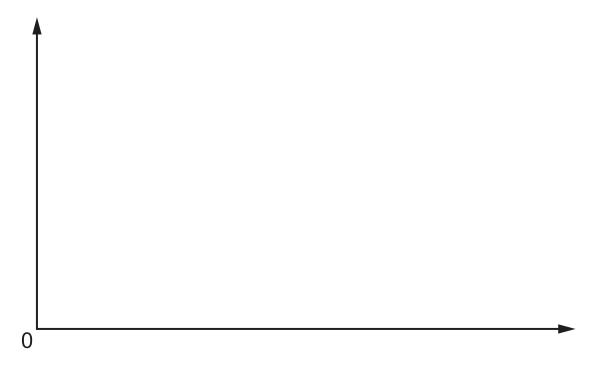
Answer
Y-axis: Volume of CO (cm) or Loss in mass (g)
X-axis: Time (s)
Curve: Starts at origin (0,0), rises steeply then gradually flattens to a horizontal plateau.
Graph with volume of gas (or mass loss) on y-axis and time on x-axis, showing a curve from origin reaching a horizontal plateau.
Background Concept
A graph of product formed (or reactant consumed) against time for a reaction that slows down as reactants are used up will show a curve starting at the origin, with a decreasing gradient, eventually reaching a horizontal asymptote (plateau) when the reaction is complete.
Understanding the Question
Sketch a graph of the dependent variable (volume of CO2 or mass loss) against time. Extend beyond the completion point. Label axes.
Approach
Y-axis: dependent variable (volume or mass). X-axis: time. Shape: curve from origin to plateau.
Step-by-Step Reasoning
- Label Y-axis: 'Volume of CO (cm)' or 'Loss in mass (g)'.
- Label X-axis: 'Time (s)' or 't'.
- Draw a curve starting at (0,0).
- The curve should have a steep initial gradient (fast reaction) that decreases over time.
- The curve must flatten to a horizontal line (plateau) indicating the reaction is complete and no more gas is produced/mass is lost.
- Extend the horizontal line beyond the plateau point.
Key Takeaways
Reaction progress graphs always start at zero, rise with decreasing gradient, and plateau when complete.
Common Mistakes
- Drawing a straight line (implies constant rate, which is incorrect for most reactions).
- Forgetting to label the axes with units.
- Not extending the line beyond the plateau.
Things to Be Careful About
The curve must be smooth, not jagged. The plateau must be clearly horizontal.
A student carries out this experiment once.
Describe how this one experiment should be carried out to ensure that the results are as accurate as possible.
Answer
Ensure the apparatus is completely sealed to prevent gas leakage (e.g., check bung fit), or if measuring mass loss, insert a cotton wool plug in the flask to prevent spray loss. Alternatively, use a balance or gas syringe with at least 2 decimal places.
Ensure apparatus is sealed to prevent gas loss (or insert cotton wool plug to prevent spray loss).
Background Concept
Accuracy in quantitative experiments depends on minimising systematic and random errors. For gas collection, leaks are a major source of error. For mass loss, spray or splashing of liquid can cause false mass loss readings.
Understanding the Question
Describe how to make the single experiment as accurate as possible.
Approach
Think about potential errors in the apparatus from part (iv) and suggest a fix.
Step-by-Step Reasoning
- If using gas syringe: Check that the bung is tight and the delivery tube connections are secure to prevent gas leaking out.
- If measuring mass loss: The reaction may produce spray/fumes. Insert a cotton wool plug in the flask neck to allow gas to escape but prevent liquid spray.
- General: Use equipment with higher precision (e.g., 0.01g balance instead of 0.1g).
Key Takeaways
Always consider how the measured quantity could be lost or falsely increased, and suggest a physical barrier or better equipment.
Common Mistakes
- Vague answers like 'be more careful' or 'repeat the experiment' (the question asks about this one experiment).
- Suggesting 'use a better balance' without specifying why or how it improves accuracy in context.
Things to Be Careful About
The answer must be specific to the method chosen (gas collection vs mass loss). 'Check apparatus is sealed' is a good general answer.
A student suspected that their sample of verdigris only contained .
Calculate the minimum volume, in , of that would be needed for the complete reaction of the sample if the student was correct.
[: ]
Working
From the equation, 1 mol CuCO reacts with 2 mol HCl:
Answer
16.2 cm^3
Background Concept
Stoichiometry calculations require converting mass to moles, using the balanced equation to find moles of the second substance, and then converting back to mass or volume using concentration or molar volume.
Understanding the Question
Calculate the minimum volume of 0.500 mol dm HCl needed to react completely with 0.5 g of pure CuCO.
Approach
- Calculate moles of CuCO.
- Use the 1:2 ratio from the equation to find moles of HCl.
- Calculate volume of HCl using .
Step-by-Step Reasoning
- From , ratio is 1:2.
- Convert to cm:
Key Takeaways
Always carry out calculations in the order: mass -> moles -> ratio -> moles -> volume/mass. Keep extra significant figures during intermediate steps.
Common Mistakes
- Forgetting the 1:2 stoichiometric ratio (using 1:1 gives half the volume).
- Forgetting to convert dm to cm (giving 0.0162 instead of 16.2).
- Using the wrong (e.g., including the hydroxide part).
Things to Be Careful About
The question asks for the volume in cm. Ensure the final unit is correct. Use 3 significant figures as appropriate (16.2).
The following information gives some of the hazards associated with the chemicals used in the procedure.
| Chemical | Hazard Information |
|---|---|
| Copper(II) carbonate hydroxide | The solid is classified as health hazard and is harmful if swallowed. Dispose of by reacting no more than in of warm ethanoic acid before pouring down a foul-water drain. |
| Hydrochloric acid | Solutions equal to or more concentrated than are classified as corrosive; solutions equal to or more concentrated than but less concentrated than are classified as moderate hazard and are irritant. |
Describe one relevant precaution, other than eye protection and a lab coat, that should be taken to keep the risk associated with the chemicals used to a minimum. Explain your answer.
Answer
Precaution: Wear lab gloves.
Explanation: The 10.0 mol dm HCl is corrosive and can cause skin burns, so gloves protect the hands.
Wear gloves because 10.0 mol dm^-3 HCl is corrosive.
Background Concept
Safety in the laboratory requires identifying hazards and taking appropriate precautions. Corrosive substances cause damage to skin and eyes. Harmful substances can cause illness if swallowed or inhaled.
Understanding the Question
Given hazard information for CuCO3(harmful if swallowed) and HCl(corrosive if mol dm), describe one precaution (other than eye protection/lab coat) and explain it.
Approach
Match a precaution to a hazard. Gloves protect against corrosive liquids. A mask or washing hands protects against harmful solids.
Step-by-Step Reasoning
- HCl is 10.0 mol dm, which is , so it is corrosive.
- Precaution: Wear gloves.
- Explanation: To prevent skin contact with corrosive acid, which could cause burns.
Alternatively: - CuCO3 is harmful if swallowed.
- Precaution: Wash hands after handling or wear a face mask.
- Explanation: To prevent ingestion or inhalation of harmful solid.
Key Takeaways
Always link the precaution directly to the specific hazard mentioned in the data.
Common Mistakes
- Suggesting 'work in a fume cupboard' without explaining why (HCl fumes are an issue, but the hazard table specifically mentions corrosive and harmful if swallowed).
- Suggesting 'wear gloves' without explaining that the acid is corrosive.
Things to Be Careful About
The question excludes eye protection and lab coat. Choose another relevant precaution like gloves, washing hands, or a mask.
Azurite is a blue copper-containing mineral. The copper compound in azurite has the formula . This copper compound reacts with sulfuric acid according to the reaction shown.
A student performed a series of titrations on samples of solid azurite using sulfuric acid.
It can be assumed that any other material present in azurite does not react with sulfuric acid.
The titration data is given in the table.
| experiment | rough | 1 | 2 |
|---|---|---|---|
| final reading / | 25.50 | 24.05 | 32.70 |
| initial reading / | 0.00 | 0.15 | 8.30 |
| titre / | 25.50 | 23.90 | 24.40 |
The indicator for the titration was bromophenol blue.
The student concluded that of sulfuric acid completely neutralised of azurite.
Using the student’s value of , calculate the percentage by mass of in the sample of azurite.
Write your answer to three significant figures.
[: ]
Working
From the equation, 1 mol reacts with 3 mol :
Answer
74.0%
74.0%
Background Concept
Titration calculations involve finding moles of titrant from volume and concentration, using the stoichiometric ratio to find moles of analyte, converting to mass, and then calculating percentage purity.
Understanding the Question
Calculate the percentage by mass of in a 1.50 g sample, given that 24.15 cm of 0.400 mol dm HSO was used.
Approach
- Calculate moles of HSO.
- Use the 1:3 ratio to find moles of azurite compound.
- Calculate mass of azurite compound.
- Calculate percentage in the 1.50 g sample.
Step-by-Step Reasoning
- Equation:
Ratio is 1:3.
- (to 3 s.f.)
Key Takeaways
Always check the stoichiometric ratio carefully. Here it is 1:3, not 1:2. Round only at the final step to 3 significant figures.
Common Mistakes
- Using a 1:2 ratio instead of 1:3 (forgetting there are 3 HSO molecules).
- Forgetting to divide by 1000 when converting cm to dm.
- Rounding intermediate values too early (e.g., using 1.11 g exactly is fine, but using 0.0032 mol gives 1.102 g -> 73.5%).
Things to Be Careful About
The question asks for 3 significant figures. 74.0% is correct (not 74%).
Identify two possible problems with the student’s titration and suggest improvements to it.
Answer
Problem 1: The titres (23.90 and 24.40 cm) are not concordant (difference is 0.50 cm).
Improvement 1: Repeat the titration until two concordant titres (within 0.10 cm) are obtained.
Problem 2: The colour change of bromophenol blue may be masked by the blue/green colour of the copper(II) sulfate solution.
Improvement 2: Use a different indicator with a colour change that is easier to see in the presence of Cu ions, or use a pH meter.
Titres not concordant (repeat for concordant values); indicator colour masked by Cu2+ (use alternative indicator or pH meter).
Background Concept
Evaluating experimental data involves checking for concordance (repeatability) and considering systematic errors like indicator choice in coloured solutions.
Understanding the Question
The student used 24.15 cm (average of 23.90 and 24.40). Identify two problems and suggest improvements.
Approach
- Look at the titre values: 23.90 and 24.40. Difference is 0.50 cm. Concordant titres should be within 0.10 cm.
- Look at the products: CuSO(aq) is blue/green. The indicator is bromophenol blue (yellow to blue/purple). The colour change might be hard to see.
Step-by-Step Reasoning
Problem 1: Titres 23.90 and 24.40 are not concordant (difference > 0.10 cm). The average is unreliable.
Improvement 1: Carry out further titrations until two results are within 0.10 cm of each other, then average those.
Problem 2: The solution contains Cu ions, which are blue/green. Bromophenol blue changes from yellow to blue. The blue colour of copper sulfate may mask the endpoint.
Improvement 2: Use an indicator with a different colour change (e.g., methyl orange, though pH range must be suitable), or use a pH meter to detect the endpoint precisely.
Key Takeaways
Always check titre concordance in titration data. Also consider the colour of the solution when choosing an indicator.
Common Mistakes
- Saying 'the indicator is wrong' without explaining why (masking by Cu colour).
- Suggesting 'repeat more times' without specifying the concordance criterion (within 0.10 cm).
Things to Be Careful About
The improvement must directly address the problem. If the problem is non-concordant titres, the improvement is 'repeat until concordant'. If the problem is colour masking, the improvement is 'use a different indicator' or 'pH meter'.
The rest of this paper
1 more questions- Q2Analysis, Conclusions and Evaluation12M