Chemistry 9701/42 — February/March 2017
Cambridge A-Level · A Level Structured Questions · worked solutions for every part, with the mark scheme
Topics Analytical Techniques · Hydrocarbons · Introduction to A Level Organic Chemistry · Carboxylic Acids and Derivatives · Hydroxy Compounds · Chemical Energetics · +6 more
The mass spectrum of silicon is shown.
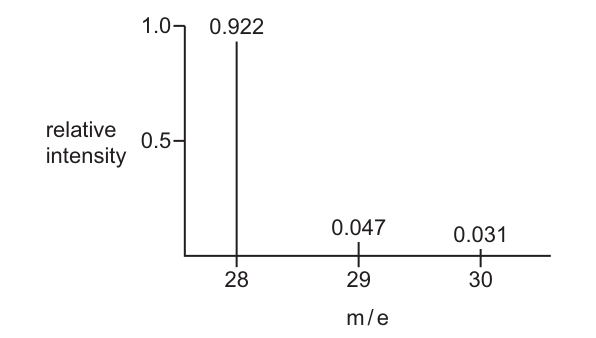
Calculate the of silicon. Give your answer to two decimal places.
Working
The relative atomic mass () is the weighted average of the isotopic masses:
Since the relative intensities sum to 1.000 (0.922 + 0.047 + 0.031 = 1.000), they can be used directly as relative abundances:
Rounding to two decimal places:
Answer
28.11
28.11
Background Concept
The relative atomic mass () of an element is the weighted mean of the masses of its naturally occurring isotopes, relative to one-twelfth the mass of a carbon-12 atom. In a mass spectrum, the x-axis gives the mass-to-charge ratio (), which for singly charged ions () is numerically equal to the isotopic mass. The y-axis gives the relative intensity (or relative abundance) of each ion. The sum of all relative intensities in a mass spectrum of an element equals 1 (or 100%), allowing them to be used directly as fractional abundances in the calculation.
Understanding the Question
The question provides a mass spectrum for silicon with three peaks at , , and , with relative intensities of , , and respectively. The task is to calculate the of silicon to two decimal places.
Approach
Multiply each isotopic mass (from the values) by its corresponding relative intensity (abundance), sum these products, and round the final result to the required number of decimal places.
Step-by-Step Reasoning
-
Identify isotopic masses and abundances:
- Isotope : mass = , abundance =
- Isotope : mass = , abundance =
- Isotope : mass = , abundance =
- Check that abundances sum to 1: . They do, so no normalization is needed.
-
Calculate the weighted sum:
-
Round to two decimal places:
.
Key Takeaways
- The value for a singly charged ion in a mass spectrum gives the isotopic mass directly.
- Relative intensities in a mass spectrum represent the relative abundances of the isotopes and can be used as fractional abundances if they sum to 1.
- Always check the required number of significant figures or decimal places before finalizing the answer.
Common Mistakes
- Forgetting to multiply each mass by its abundance and just averaging the masses: . This ignores the fact that is far more abundant.
- Rounding too early in the calculation, which can lead to a slightly incorrect final value.
- Failing to round to the correct number of decimal places (two in this case).
Things to Be Careful About
- Ensure the sum of relative intensities equals 1. If it does not (e.g., they sum to 100 or another value), you must divide each product by the sum before or after calculating.
- State symbols are not required for this calculation, but numerical precision and rounding rules must be followed strictly.
Silicon forms a low boiling point chloride which reacts with water.
Write an equation to show the reaction of the chloride with water.
Answer
SiCl4 + 4H2O -> Si(OH)4 + 4HCl
Background Concept
Covalent chlorides of non-metals and metalloids (like silicon) are highly reactive towards water. This is because the central atom has vacant low-energy orbitals (in silicon's case, 3d orbitals) that can accept lone pairs from water molecules, initiating a nucleophilic attack. The reaction is a hydrolysis where the chloride bonds are replaced by hydroxyl groups, releasing hydrogen chloride gas. Silicon typically forms a tetrachloride, , analogous to , but unlike carbon, silicon readily undergoes hydrolysis due to its ability to expand its coordination number using d-orbitals.
Understanding the Question
The question states that silicon forms a low boiling point chloride (which implies simple molecular covalent structure, hence ) and asks for the balanced equation for its reaction with water.
Approach
- Determine the formula of the chloride: silicon is in Group 14, so it forms .
- Write the unbalanced equation with water as a reactant.
- Predict the products: the Cl atoms are replaced by OH groups to form silicic acid, (or ), and the displaced Cl atoms combine with H from water to form .
- Balance the equation.
Step-by-Step Reasoning
- Formula of the chloride: Silicon has 4 valence electrons, so it bonds with 4 chlorine atoms: .
- Reactants: and .
- Products: Hydrolysis replaces Cl with OH. Four Cl atoms are replaced by four OH groups, giving . The four H atoms from the four water molecules combine with the four Cl atoms to give . The oxygen atoms from water are accounted for in the four OH groups.
- Balancing: Check atoms: Si (1=1), Cl (4=4), H (8 = 4+4), O (4=4). The equation is balanced.
Key Takeaways
- Group 14 tetrachlorides (, ) hydrolyze readily in water to form the corresponding tetrahydroxy compound and hydrogen halide.
- Carbon tetrachloride () does not hydrolyze because carbon lacks vacant d-orbitals to accept electron pairs from water.
Common Mistakes
- Writing instead of . Silicon is in Group 14 and forms four covalent bonds.
- Producing and directly without water acting to form the intermediate hydroxide: . While can dehydrate to , the primary hydrolysis product with excess water is . The mark scheme accepts .
- Failing to balance the equation (e.g., missing the coefficient 4 for and ).
Things to Be Careful About
- Ensure the equation is fully balanced. Mark schemes often require the correct stoichiometric coefficients.
- can also be written as (silicic acid). Both are generally acceptable, but stick to the mark scheme's preferred format if known.
Draw a three-dimensional diagram showing the shape of the chloride. Give the Cl–Si–Cl bond angle.
Answer
Shape: Tetrahedral
Diagram:
Bond angle:
(Diagram description: A central Si atom bonded to four Cl atoms. One bond is vertical (in plane), one is bottom-left (in plane), one is a solid wedge pointing bottom-right (coming out of the page), and one is a dashed wedge pointing downwards (going into the page).)
Answer
Bond angle =
109.5
Background Concept
The shape and bond angles of molecules can be predicted using Valence Shell Electron Pair Repulsion (VSEPR) theory. According to VSEPR theory, electron pairs (both bonding and lone pairs) around a central atom arrange themselves to minimize electrostatic repulsion. For a central atom with 4 bonding pairs and 0 lone pairs (steric number = 4), the electron geometry is tetrahedral, and the molecular shape is also tetrahedral. The ideal bond angle for a perfect tetrahedron is .
To represent a 3D tetrahedral molecule on a 2D surface, chemists use wedge-and-dash notation:
- Solid lines: bonds in the plane of the paper.
- Solid wedge (): bond coming out of the plane of the paper, towards the viewer.
- Dashed wedge ( or hashed lines): bond going into the plane of the paper, away from the viewer.
Understanding the Question
The question asks for a 3D diagram of the silicon chloride () and its Cl–Si–Cl bond angle. Silicon tetrachloride has a central silicon atom bonded to four chlorine atoms with no lone pairs on the central atom.
Approach
- Determine the steric number of the central Si atom: 4 bonding pairs + 0 lone pairs = 4.
- Deduce the shape: tetrahedral.
- State the bond angle: .
- Draw the 3D structure using appropriate wedge and dash notation to show the tetrahedral geometry.
Step-by-Step Reasoning
- Central atom: Silicon (Si) has 4 valence electrons.
- Bonding: It forms 4 single covalent bonds with 4 chlorine atoms. Total valence electrons used = 8. No lone pairs remain on Si.
- VSEPR prediction: 4 bonding domains, 0 lone pairs tetrahedral shape.
- Bond angle: The ideal angle for a tetrahedral arrangement is .
- Drawing the diagram:
- Place Si in the center.
- Draw two bonds in the plane of the paper (e.g., one pointing up, one pointing down-left).
- Draw one solid wedge bond (e.g., pointing down-right) to show it coming out of the page.
- Draw one dashed/hashed wedge bond (e.g., pointing down) to show it going into the page.
- Label the terminal atoms as Cl.
Key Takeaways
- Molecules with 4 bonding pairs and 0 lone pairs around the central atom are tetrahedral with bond angles of .
- 3D representations require clear use of solid lines, solid wedges, and dashed wedges to convey spatial arrangement.
Common Mistakes
- Drawing a square planar or flat cross shape, which is incorrect for 4 bonding pairs.
- Stating the bond angle as or .
- Failing to use wedge/dash notation properly, resulting in a 2D drawing that doesn't convey 3D geometry.
- Forgetting to label the atoms (Si and Cl).
Things to Be Careful About
- The bond angle must be stated as (or ). alone might not score the mark in strict marking schemes; is the standard expected value.
- Ensure the wedge and dash are clearly distinguished. A solid triangle for 'out' and parallel hash marks for 'in' is the standard convention.
Silicon reacts with oxygen to form a high melting point oxide.
- Suggest the formula of the oxide.
- Suggest, in terms of structure, why the oxide has a high melting point whereas the chloride has a low boiling point.
Answer
Formula of the oxide:
Explanation:
- has a giant covalent (macromolecular) structure, whereas is a simple molecular (covalent) structure.
- In , a large number of strong covalent bonds must be broken to melt it, requiring a lot of energy (high melting point). In , only weak intermolecular forces (van der Waals forces) need to be overcome to boil it, requiring little energy (low boiling point).
Answer
Formula:
Structure comparison: is giant covalent; is simple molecular.
SiO2
Background Concept
The physical properties of a substance, such as melting and boiling points, are determined by its structure and the type of bonding present.
- Giant covalent (macromolecular) structures consist of a vast network of atoms held together by strong covalent bonds throughout the entire structure (e.g., diamond, silicon dioxide, graphite). Melting or boiling such substances requires breaking these strong covalent bonds, which demands a large amount of thermal energy, resulting in high melting and boiling points.
- Simple molecular structures consist of discrete molecules held together by weak intermolecular forces (such as London dispersion forces / van der Waals forces). The covalent bonds within the molecules are strong, but melting or boiling only requires overcoming the weak forces between the molecules, which requires relatively little energy, resulting in low melting and boiling points.
Silicon is in Group 14, below carbon. Like carbon, it forms oxides with the formula (CO2 and SiO2). However, while CO2 is a simple molecular gas, SiO2 forms a giant covalent lattice (similar to diamond) because silicon can form four strong Si-O bonds in a continuous network.
Understanding the Question
The question asks for the formula of the high melting point oxide of silicon and an explanation, in terms of structure, for the difference in melting/boiling points between this oxide and the previously discussed chloride ().
Approach
- Deduce the formula: Silicon is Group 14 (valency 4), oxygen is Group 16 (valency 2). The formula is .
- Identify the structure of : It is a giant covalent (macromolecular) lattice.
- Identify the structure of : It is a simple molecular (discrete covalent) substance.
- Explain the property difference: Contrast the energy required to break strong covalent bonds in the giant lattice versus the weak intermolecular forces in the simple molecular substance.
Step-by-Step Reasoning
- Formula of the oxide: Silicon has a valency of 4, oxygen has a valency of 2. Cross-multiplying gives , which simplifies to .
- Structure of : Each silicon atom is covalently bonded to four oxygen atoms in a tetrahedral arrangement, and each oxygen is bonded to two silicon atoms, forming a continuous 3D giant covalent lattice (similar to the structure of diamond or -cristobalite).
- Structure of : As established in part (a)(iii), exists as discrete, individual tetrahedral molecules.
- Explaining the melting/boiling points:
- To melt , the strong covalent bonds throughout the giant lattice must be broken. This requires a very large amount of energy, hence the high melting point.
- To boil , only the weak van der Waals forces (London dispersion forces) between the simple molecules need to be overcome. The strong Si-Cl covalent bonds within the molecules remain intact. This requires very little energy, hence the low boiling point.
Key Takeaways
- Group 14 dioxides show a stark contrast in properties: CO2 is simple molecular (gas), while SiO2 is giant covalent (solid with high mp).
- Always link physical properties (melting/boiling points) directly to the type of structure (giant vs. simple molecular) and the forces that must be overcome (covalent bonds vs. intermolecular forces).
Common Mistakes
- Writing the formula as SiO or Si2O. Silicon is +4, oxygen is -2, so SiO2 is correct.
- Saying " has strong bonds and has weak bonds." This is imprecise. The covalent bonds within are strong; it is the intermolecular forces between the molecules that are weak. Must specify "giant covalent structure" vs "simple molecular structure" and "strong covalent bonds throughout the lattice" vs "weak intermolecular forces between molecules".
- Confusing the forces: stating that boiling breaks covalent bonds.
Things to Be Careful About
- The question specifically asks to suggest the explanation "in terms of structure". Therefore, you must explicitly name the structural types: giant covalent (or macromolecular) for and simple molecular (or discrete covalent) for .
- Use precise terminology: "intermolecular forces" or "van der Waals forces" for , not "weak covalent bonds".
Element A is in the same period as silicon. Element A reacts with dilute nitric acid to form a nitrate. This nitrate decomposes on heating to form an oxide.
Write an equation for the decomposition of the nitrate.
Working
Deduction of Element A:
- Element A is in the same period as silicon (Period 3).
- It reacts with dilute nitric acid to form a nitrate, indicating it is a metal (non-metals like Si do not react with dilute acids to form nitrates in this manner; Si reacts with concentrated HNO3 to form H2SiO3/SiO2).
- The nitrate decomposes on heating to form an oxide. Group 1 nitrates decompose to give the nitrite and oxygen (). Group 2 and most other metal nitrates (like Group 13, 14, 15, 16 metals) decompose to give the metal oxide, nitrogen dioxide, and oxygen.
- Since it forms a nitrate that decomposes to an oxide (not a nitrite), and it's in Period 3, Element A is likely a Group 2 metal, Magnesium (Mg), or possibly an aluminous element, but Mg is the standard Period 3 metal forming which decomposes to . (Note: Na forms NaNO2; Mg, Al, Si, P, S, Cl. Mg is the best fit for a nitrate decomposing to an oxide in this context, forming ).
- Formula of the nitrate: (assuming Group 2, like Mg).
Decomposition Equation:
Metal nitrates of Group 2 (and transition metals, etc.) decompose on heating to give the metal oxide, , and .
(If A is assumed to be Mg, the equation is )
Answer
2A(NO3)2 -> 2AO + 4NO2 + O2
Background Concept
Thermal decomposition of metal nitrates depends on the position of the metal in the reactivity series (or its group in the periodic table):
- Group 1 metals (except Lithium): Decompose to form the metal nitrite and oxygen.
- All other metal nitrates (Group 2, transition metals, post-transition metals like Al, Pb, etc.): Decompose to form the metal oxide, nitrogen dioxide (), and oxygen.
Element A is in Period 3 (same as Si: Na, Mg, Al, Si, P, S, Cl, Ar). It reacts with dilute nitric acid to form a nitrate, so it must be a metal (Na, Mg, or Al).
- Na (Group 1) nitrate decomposes to (nitrite), not an oxide.
- Mg (Group 2) nitrate decomposes to (oxide), , and .
- Al (Group 13) nitrate also decomposes to an oxide (), but Mg is the classic example used in this context for forming a divalent nitrate . The mark scheme uses the general formula , implying A is a Group 2 element like Magnesium.
Understanding the Question
Element A is in Period 3. It forms a nitrate with dilute . This nitrate thermally decomposes to form an oxide. We need to write the balanced equation for this decomposition, using 'A' to represent the element.
Approach
- Identify the valency of A's nitrate. Since the mark scheme uses , A is divalent (Group 2, e.g., Mg).
- Recall the thermal decomposition products of a Group 2 nitrate: metal oxide + nitrogen dioxide + oxygen.
- Write the unbalanced equation and balance it.
Step-by-Step Reasoning
- Nitrate formula: The nitrate is . This means A has a +2 oxidation state.
- Decomposition products: For a +2 metal nitrate, the products are the oxide , nitrogen dioxide , and oxygen .
- Unbalanced equation:
- Balancing:
- Start with 2 moles of to make oxygen balancing easier (since is diatomic and nitrates have 6 O atoms):
- Balance A: 2 on left 2AO on right.
- Balance N: 4 on left on right.
- Balance O: Left has O atoms. Right has (in 2AO) + (in ) + (in ).
. - Balanced equation:
- Start with 2 moles of to make oxygen balancing easier (since is diatomic and nitrates have 6 O atoms):
Key Takeaways
- Group 1 nitrates decompose to nitrites + .
- Group 2 and most other metal nitrates decompose to oxides + + .
- When writing decomposition equations for nitrates, ensure nitrogen and oxygen are balanced correctly, often by using a coefficient of 2 for the nitrate.
Common Mistakes
- Writing the products as nitrite () instead of oxide. This happens if one confuses the rules for Group 1 vs Group 2 nitrates.
- Balancing errors, particularly with the oxygen atoms. A common unbalanced attempt is (O: 6 on left, 1+4+2=7 on right - incorrect).
- Forgetting that the question asks for the equation in terms of A, not necessarily substituting Mg (though substituting Mg is also correct, using A is safer if the identity isn't explicitly asked for, but the mark scheme accepts the formula with A).
Things to Be Careful About
- The mark scheme specifically looks for the correct formula and a balanced equation. Using instead of is generally acceptable if the logic holds, but sticking to the variable 'A' as given in the prompt is best practice.
- State symbols are not explicitly required by the mark scheme for this part, but including them , is good practice if known.
The oxide of element A has a high melting point.
Suggest the structure and bonding present in the oxide of A.
Answer
Giant ionic structure and bonding.
(Note: The oxide AO, e.g., MgO, consists of a lattice of and ions held together by strong electrostatic forces of attraction between oppositely charged ions.)
Answer
Giant ionic
Giant ionic
Background Concept
The structure and bonding of oxides depend on the electronegativity difference between the metal and oxygen.
- Metal oxides (especially from Groups 1, 2, and most transition metals) have a large electronegativity difference with oxygen. They form giant ionic lattices consisting of positive metal cations and negative oxide anions (). The bonding is strong electrostatic attraction between these oppositely charged ions. This results in high melting and boiling points.
- Non-metal oxides (like , ) are simple molecular with covalent bonding within molecules and weak intermolecular forces between them.
- Metalloid oxides (like ) form giant covalent (macromolecular) structures.
Element A is a Group 2 metal (like Magnesium). Its oxide, AO (e.g., MgO), is a classic example of a giant ionic lattice.
Understanding the Question
The oxide of element A (which we deduced is a Group 2 metal like Mg, forming AO) has a high melting point. The question asks to suggest the structure and bonding present in this oxide.
Approach
- Recognize that AO is a metal oxide (Group 2).
- Recall that Group 2 metal oxides have a giant ionic structure.
- State the structure and bonding type clearly.
Step-by-Step Reasoning
- Element A: A divalent metal from Period 3 (Mg).
- Oxide: AO (e.g., MgO).
- Electronegativity: Mg (1.31) and O (3.44) have a large difference (), indicating ionic bonding.
- Structure: The ions arrange in a regular, repeating 3D lattice (specifically, the sodium chloride structure for MgO).
- Conclusion: The structure is giant ionic (or ionic lattice) and the bonding is ionic.
Key Takeaways
- Metal oxides of Groups 1 and 2 are giant ionic structures.
- High melting points in oxides are a strong indicator of giant ionic or giant covalent structures.
- Always specify both the structure (giant ionic lattice) and the bonding (ionic bonds / electrostatic attraction between ions) if asked, though 'giant ionic' covers both concisely.
Common Mistakes
- Saying "covalent" for a metal oxide. While there is some covalent character in oxides of metals with high charge density (like or ), MgO is predominantly ionic and is classified as giant ionic in A-Level chemistry.
- Saying "molecular" or "simple molecular". Ionic compounds do not exist as discrete molecules.
- Forgetting the word "giant". An ionic compound is a giant ionic lattice; just saying "ionic" might lose a mark if the structure type isn't clear.
Things to Be Careful About
- The mark scheme specifically looks for the phrase giant ionic. Ensure you use this exact terminology.
- Do not confuse the structure of the oxide (giant ionic) with the structure of the chloride (simple molecular, as discussed in part a(iv)).
The rest of this paper
8 more questions- Q2Chemical Energetics10M
- Q3Electrochemistry8M
- Q4Reaction Kinetics · Equilibria17M
- Q5Hydrocarbons · Nitrogen Compounds9M
- Q6Transition Elements18M
- Q7Introduction to A Level Organic Chemistry · Carboxylic Acids and Derivatives · Hydroxy Compounds · Hydrocarbons · Polymerisation · Analytical Techniques12M
- Q8Hydroxy Compounds · Carboxylic Acids and Derivatives7M
- Q9Analytical Techniques · Introduction to A Level Organic Chemistry10M