Chemistry 9701/52 — October/November 2015
Cambridge A-Level · Planning, Analysis and Evaluation · worked solutions for every part, with the mark scheme
Topics Analysis, Conclusions and Evaluation · Planning
It is possible to determine the relative molecular mass, , of a small sample of a volatile liquid by measuring its mass and then heating to vaporise it to obtain its volume as a gas.
Explain how the relative molecular mass can be determined in this way.
The volume of the vaporised sample depends on its temperature and pressure.
In an experiment, a sample of volatile liquid of known mass was vaporised and its volume recorded. The pressure was correctly recorded as but the temperature was incorrectly recorded as . The correct temperature was .
By considering the effect of these different temperatures on the gas volume, explain how the value of the calculated would be affected.
The temperature was maintained at but the pressure was increased to . Would this have given an answer that was nearer to the true value of the relative molecular mass? Explain your answer.
In an experiment to determine the relative molecular mass of hexane, boiling point , a specialist piece of apparatus called a Victor Meyer tube can be used. This consists of a long tube with a bulb at the base in which a sample can be vaporised. The tube has a side arm to allow the escape of gas from within the tube. The tube is surrounded by another which can be used to heat the contents of the first tube.
A diagram of the apparatus is shown below.
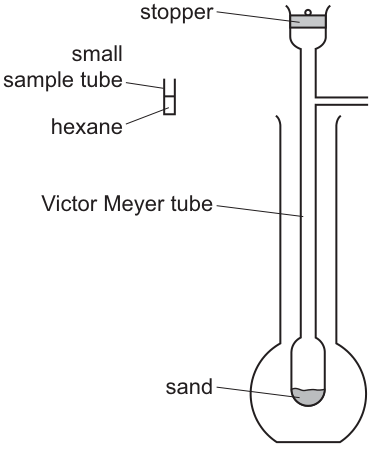
A small sample tube containing the hexane is inserted at the top of the Victor Meyer tube. The sample tube is small enough to fit inside the Victor Meyer tube and falls freely onto the hot sand below. The sand will cushion its fall so that the sample tube does not break. The stopper is then quickly replaced at the top of the Victor Meyer tube. The hot sand causes the hexane to vaporise and expel air contained in the Victor Meyer tube.
Complete the diagram above to show:
- how the apparatus should be heated,
- a connection to further apparatus which would allow the air expelled from the Victor Meyer tube when the sample of hexane is vaporised to be collected and measured.
Suggest one hazard associated with the use of hexane.
With the gas collection apparatus connected to the heated Victor Meyer tube, expelled air will be collected before the hexane is introduced. Explain why.
At which stage of the experimental procedure should the sample tube be dropped into the Victor Meyer tube?
State what measurements you would need to make in order to determine the relative molecular mass of hexane.
The rest of this paper
1 more questions- Q2Analysis, Conclusions and Evaluation15M