Chemistry 9701/52 — May/June 2015
Cambridge A-Level · Planning, Analysis and Evaluation · worked solutions for every part, with the mark scheme
Topics Analysis, Conclusions and Evaluation · Planning
This question concerns electrolysis of different compounds.
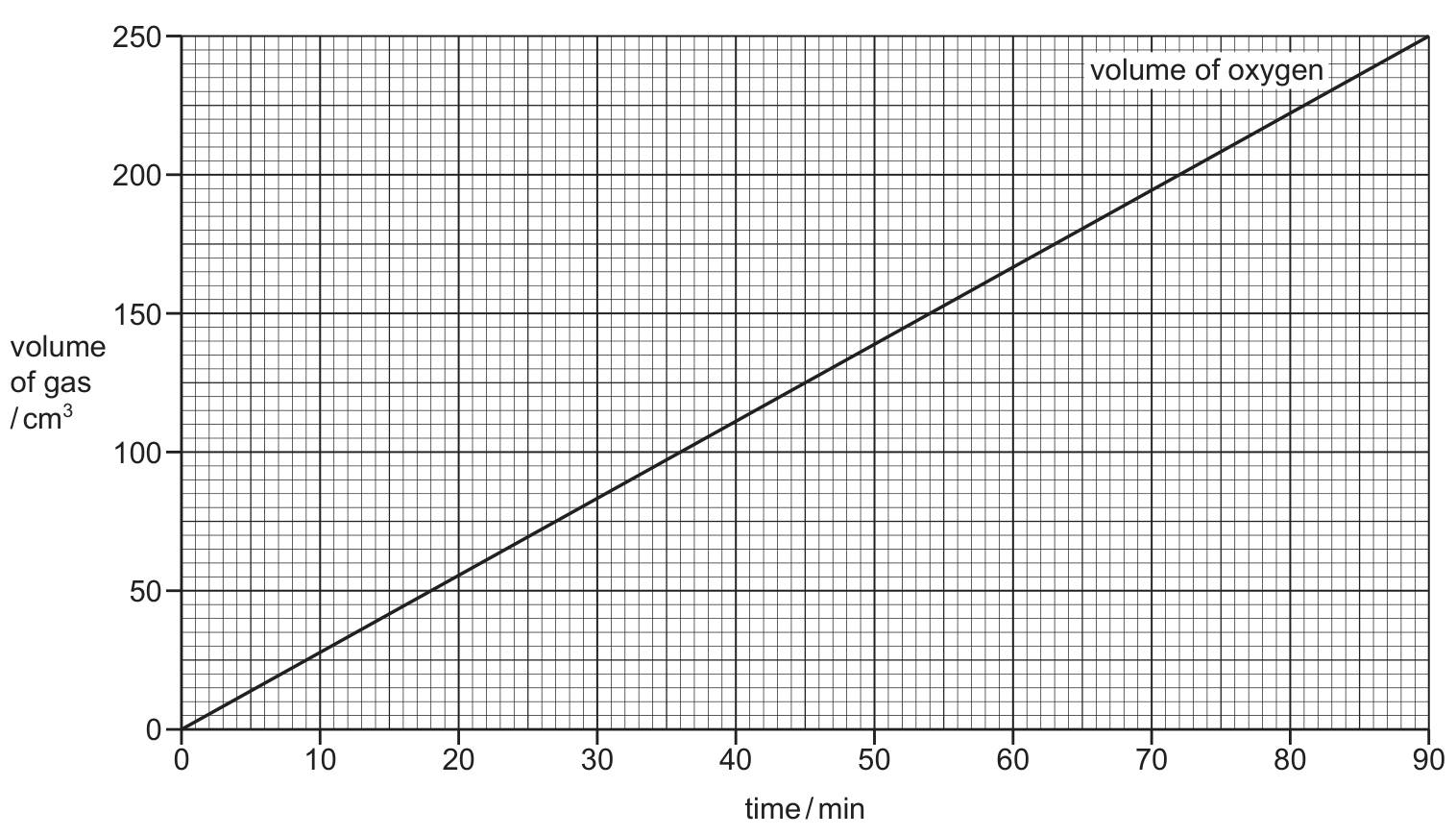
During the electrolysis of dilute sulfuric acid using a current of for , the volume of oxygen gas collected was recorded and is shown in the graph below.
Give equations for the reactions that occur at each electrode in the electrolysis of sulfuric acid.
On the graph above, use a ruler to draw and label a line (hydrogen) to predict the volume of hydrogen that would be given off during the same experiment.
On the graph above, use a ruler to draw and label a line (oxygen) to predict the volume of oxygen that would be produced if a current of was used instead of the used in the original experiment.
During the electrolysis of potassium butanedioate, the following reaction occurs.
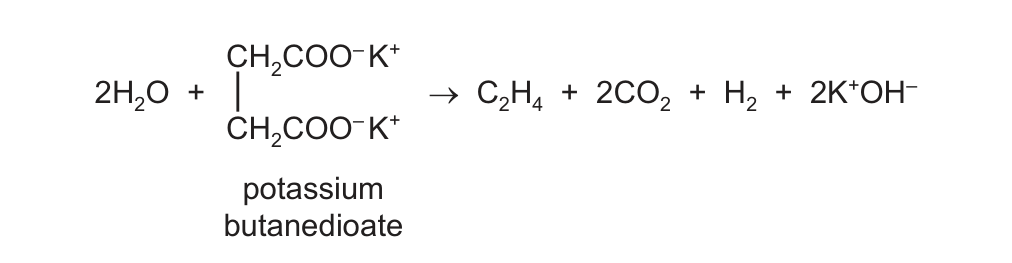
An experiment can be carried out to confirm the above equation. In order to do this, the amounts of hydrogen, ethene and carbon dioxide produced need to be measured.
Hydrogen is produced at one electrode, ethene and carbon dioxide are produced at the other. The carbon dioxide can be separated from the ethene by absorbing it in an alkali before the volume of ethene is measured.
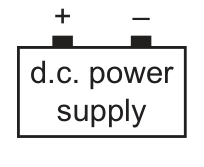
Using the power supply drawn below, draw a fully labelled circuit diagram and apparatus which shows how:
- the current could be measured,
- the hydrogen produced could be collected and its volume measured,
- the carbon dioxide could be removed using a named alkali,
- the volume of ethene could be measured.
State what measurements should be taken when carrying out the experiment.
coulombs of electricity resulted in of hydrogen gas being produced during the electrolysis.
In terms of and , state the number of coulombs, , that would be required to produce of hydrogen.
In terms of , state the number of faradays of electricity that would be required to produce of hydrogen at room temperature and pressure.
()
Give the equation for the reaction that takes place when the carbon dioxide is absorbed by the alkali. Include state symbols.
Predict the organic product that would be obtained at the anode when a solution of potassium hexanedioate is electrolysed.
The rest of this paper
1 more questions- Q2Analysis, Conclusions and Evaluation15M