Chemistry 9701/52 — October/November 2014
Cambridge A-Level · Planning, Analysis and Evaluation · worked solutions for every part, with the mark scheme
Topics Analysis, Conclusions and Evaluation · Planning
A solder is an alloy of metals which is used to join other metal pieces together.
A specialist solder that can be used to join together pieces of aluminium is made from a mixture by mass of 65% zinc, 20% aluminium and 15% copper.
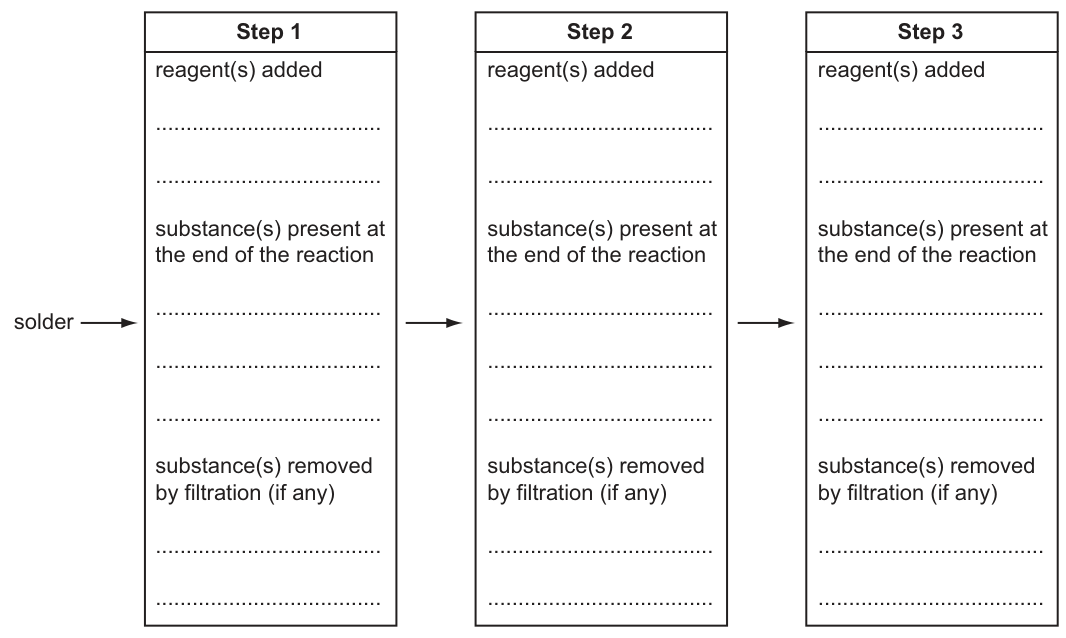
You are to plan an experimental procedure to confirm the composition of a powdered sample of this solder, by adding reagents and then extracting from the mixture each of the following in sequence;
(i) the copper metal,
(ii) the aluminium as aluminium hydroxide,
(iii) the zinc as zinc hydroxide.
You are provided with
- a sample of this solder, with approximate mass 4 g,
- 1.00 mol dm sulfuric acid,
- 1.00 mol dm ammonia.
No other reagents should be used. Standard laboratory equipment is available including a balance, accurate to two decimal places.
Complete the flowchart below to show the order in which the reagents would be added to the solder to allow you to extract and separate the components as copper metal, (Step 1), aluminium hydroxide, (Step 2), and zinc hydroxide, (Step 3).
You are reminded that aqueous ammonia contains both the base OH and the complex-forming molecule NH.
For some of the steps in the procedure you would need to be careful to add an appropriate quantity of a reagent.
For each step of your procedure explain why particular quantities of reagent should be chosen.
Step 1
Step 2
Step 3
The aluminium hydroxide and zinc hydroxide that have been extracted are difficult to dry so it is better to convert them to their oxides.
Describe how this could be done and how you would make sure that each hydroxide had been completely converted into its oxide.
The purpose of the experiment is to confirm the composition of the solder.
When the experiment is carried out state
- the measurements that would be taken,
- what you would do to the copper to make sure that the correct value is obtained.
If the mass of aluminium oxide obtained was 1.50 g, calculate the mass of aluminium that was present in the solder.
(: Al, 27.0; O, 16.0)
Even if the experimental difficulties of extracting all of the copper from the mixture were overcome, it would be difficult to obtain an accurate mass of copper from this experiment.
Suggest why.
The rest of this paper
1 more questions- Q2Analysis, Conclusions and Evaluation15M