Chemistry 9701/52 — May/June 2014
Cambridge A-Level · Planning, Analysis and Evaluation · worked solutions for every part, with the mark scheme
Topics Analysis, Conclusions and Evaluation · Planning
The liquids trichloromethane and water separate into two immiscible layers when shaken together and allowed to stand.
Ammonia can dissolve in both of these layers. The distribution of ammonia between these two solvents is called partition, where the concentration of ammonia in each solvent will be different. The partition coefficient represents the ratio of the distribution.
You are to plan an experiment, using a titration with sulfuric acid, to determine the value of the partition coefficient of ammonia between water and trichloromethane at room temperature.
The following information gives some of the hazards associated with trichloromethane and ammonia.
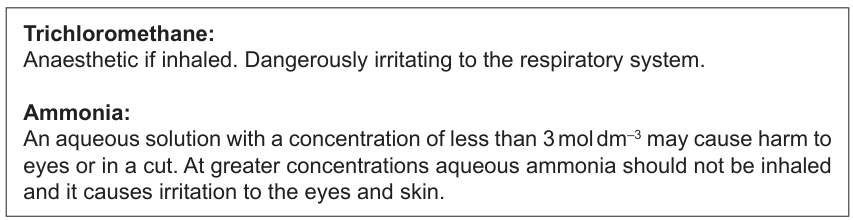
You are provided with the following.
- trichloromethane
- aqueous ammonia of concentration
- sulfuric acid, of concentration
- distilled water for dilution of aqueous ammonia
Explain why ammonia is likely to be more soluble in water than in trichloromethane.
Define the partition coefficient, , for ammonia between water and trichloromethane. State whether the partition coefficient you have defined will be greater or less than 1.
In the experiment, explain whether it is important that the volumes of water and trichloromethane are the same.
Write an equation for the reaction of aqueous ammonia and sulfuric acid.
The partition coefficient for ammonia distributed between water and trichloromethane is approximately 25.
Calculate the concentration of aqueous ammonia that should be used so that a sample of the aqueous ammonia layer would require approximately of sulfuric acid for complete neutralisation.
Then state the factor by which the aqueous ammonia should be diluted to give that concentration.
Describe, in detail, how you would dilute aqueous ammonia to make of aqueous ammonia ready for use in the experiment.
Other than the use of eye protection and gloves, state one safety precaution you would take while setting up the experiment.
State a suitable indicator for use in the titration of a sample taken from the experiment. Explain your answer.
It is unnecessary to titrate both layers of the partition. Explain why it would be better to titrate a sample of the aqueous layer rather than the trichloromethane layer.
Once a mean titre has been calculated, outline the steps you would take to calculate the partition coefficient.
The rest of this paper
1 more questions- Q2Analysis, Conclusions and Evaluation15M