Chemistry 9701/43 — May/June 2014
Cambridge A-Level · worked solutions for every part, with the mark scheme
Topics Nitrogen Compounds · Introduction to A Level Organic Chemistry · Carboxylic Acids and Derivatives · Transition Elements · Hydrocarbons · Hydroxy Compounds · +5 more
State how the melting point and density of iron compare to those of calcium.
melting point of iron:
density of iron:
Answer
melting point of iron: higher than that of calcium
density of iron: greater than that of calcium
melting point: higher; density: greater
Background Concept
Transition metals (like iron) and Group 2 s-block metals (like calcium) both form giant metallic lattices consisting of positive metal cations in a 'sea' of delocalised electrons. However, the nature and number of delocalised electrons differ significantly between the two groups, leading to different physical properties such as melting point, boiling point, and density.
Understanding the Question
The question asks for a direct comparison of two physical properties—melting point and density—between iron (a transition metal) and calcium (a Group 2 metal). No explanation is required in this part, only the directional comparison (higher/lower, greater/less).
Approach
Recall the general trends for transition metals compared to s-block metals in the same or adjacent periods. Transition metals typically have higher melting points and greater densities. Simply state these comparisons clearly for iron relative to calcium.
Step-by-Step Reasoning
- Melting point: Iron has a higher melting point than calcium. (Iron melts at 1538 °C; calcium melts at 842 °C). The answer requires stating that iron's melting point is higher/greater.
- Density: Iron has a greater density than calcium. (Iron is ~7.87 g/cm³; calcium is ~1.55 g/cm³). The answer requires stating that iron's density is higher/greater.
Key Takeaways
Transition metals generally exhibit higher melting points and densities than s-block metals due to stronger metallic bonding and more compact atomic packing.
Common Mistakes
- Stating the exact numerical values when only a comparison is asked.
- Confusing the direction of the comparison (e.g., saying calcium has a higher melting point than iron).
Things to Be Careful About
Use comparative adjectives correctly: 'higher' or 'greater' for iron compared to calcium. Do not just write 'high' or 'large'; the comparison must be explicit.
Explain why these differences occur.
melting point:
density:
Answer
melting point: iron has more delocalised electrons (from both 4s and 3d orbitals), resulting in stronger electrostatic attraction between the cations and the delocalised electron sea.
density: iron has a greater relative atomic mass () and a smaller atomic radius than calcium.
stronger metallic bonding due to more delocalised electrons; greater and smaller atomic radius
Background Concept
Metallic bonding involves the electrostatic attraction between positive metal cations and a sea of delocalised electrons. The strength of this bonding determines the melting point and boiling point. Transition metals can delocalise electrons from both their outermost s-orbital and their inner d-orbitals, providing more delocalised electrons per atom than s-block metals, which only delocalise s-electrons.
Density in a metallic lattice depends on how much mass is packed into a given volume. This is influenced by the relative atomic mass () of the atoms and their atomic radius. A higher and a smaller atomic radius lead to a higher density.
Understanding the Question
The question asks for the underlying reasons why iron has a higher melting point and greater density than calcium. This requires explaining the difference in metallic bonding strength (for melting point) and atomic packing/mass (for density).
Approach
- For melting point, discuss the number of delocalised electrons and the resulting strength of the metallic bond.
- For density, discuss the relative atomic mass () and atomic radius of the two elements.
Step-by-Step Reasoning
- Melting point explanation: Iron (electron configuration [Ar] 3d⁶ 4s²) can delocalise up to 8 electrons per atom (both 4s and 3d electrons contribute to the sea). Calcium ([Ar] 4s²) only delocalises 2 electrons per atom. More delocalised electrons lead to stronger electrostatic forces of attraction between the cations and the electron sea, requiring more energy (higher temperature) to overcome. Thus, iron has a higher melting point.
- Density explanation: Iron has a higher relative atomic mass () compared to calcium (). Additionally, iron has a smaller atomic radius than calcium due to poor shielding by d-electrons (effective nuclear charge is higher). Greater mass packed into a smaller volume results in a higher density.
Key Takeaways
The physical properties of metals are directly linked to the strength of metallic bonding (number of delocalised electrons) and atomic properties ( and radius).
Common Mistakes
- Saying 'stronger bonds' without specifying metallic bonds or mentioning delocalised electrons.
- Forgetting to mention both and atomic radius for the density explanation; stating only one is insufficient.
Things to Be Careful About
- Ensure the explanation for melting point explicitly mentions delocalised electrons and electrostatic attraction.
- For density, both greater and smaller radius are required for full marks.
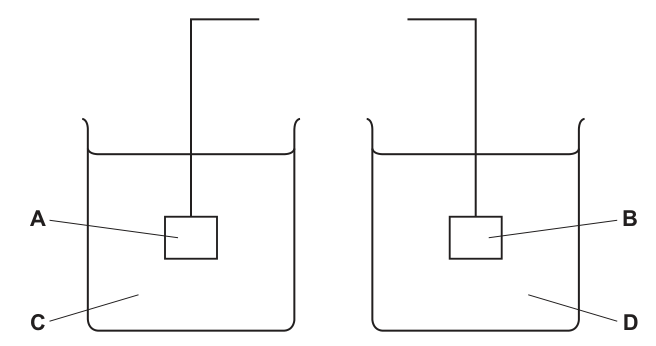
The following diagram shows the apparatus used to measure the standard electrode potential, , of a cell composed of a Cu(II)/Cu electrode and an Fe(II)/Fe electrode.
Finish the diagram by adding components to show the complete circuit. Label the components you add.
Answer
- Connect the two vertical wires from electrodes A and B with a voltmeter (label it 'V' or 'voltmeter').
- Connect the two solutions (C and D) with a salt bridge (e.g., a U-tube containing inert electrolyte like KNO₃(aq) or filter paper soaked in KNO₃(aq)). Label it 'salt bridge'.
voltmeter and salt bridge added and labelled
Background Concept
A standard electrochemical cell (galvanic cell) consists of two half-cells, each containing an electrode dipped in a solution of its own ions. To complete the circuit and allow ion flow to maintain electrical neutrality, two external components are required:
- A voltmeter (or high-resistance voltmeter): Connected between the two electrodes to measure the potential difference (cell potential) without allowing significant current to flow.
- A salt bridge: Connects the two half-cell solutions. It contains an inert electrolyte (like KNO₃ or KCl) and allows ions to migrate between the half-cells to balance the charge buildup that occurs as the redox reaction proceeds.
Understanding the Question
The diagram shows two beakers with electrodes (A and B) and solutions (C and D), with wires extending upwards from the electrodes but not connected. The candidate must add the missing components to complete the circuit and label them.
Approach
Identify the two missing standard components of a half-cell setup: the measuring device (voltmeter) and the ion-transport bridge (salt bridge). Describe where they go and ensure they are labelled.
Step-by-Step Reasoning
- Voltmeter: The wires from electrodes A and B must be connected to a voltmeter to measure the cell potential. Draw a circle with a 'V' inside (or write 'voltmeter') between the two wire ends.
- Salt bridge: The two solutions must be connected to allow ion flow. Draw a U-tube or a bridge between the two beakers, dipping into both solutions C and D. Label it clearly as 'salt bridge'.
Key Takeaways
A complete electrochemical cell for measuring standard electrode potentials requires a voltmeter to measure potential difference and a salt bridge to complete the ionic circuit.
Common Mistakes
- Forgetting to label the salt bridge; the mark scheme explicitly states '[must be labelled]'.
- Drawing a wire connecting the two solutions instead of a salt bridge.
- Using a low-resistance ammeter instead of a voltmeter (though 'voltmeter' is the expected answer).
Things to Be Careful About
Ensure the salt bridge is drawn dipping into both solutions. The voltmeter must be in the external circuit between the two electrodes.
In the spaces below, identify or describe what the four letters A-D represent.
A
B
C
D
Answer
A: Copper electrode (Cu metal)
B: Iron electrode (Fe metal)
(Note: A and B can be swapped if C and D are adjusted accordingly)
C: 1 mol dm⁻³ Cu²⁺ solution (e.g., CuSO₄ or CuCl₂)
D: 1 mol dm⁻³ Fe²⁺ solution (e.g., FeSO₄)
(Note: C and D must match A and B respectively)
A: Cu electrode; B: Fe electrode; C: 1 M Cu2+ solution; D: 1 M Fe2+ solution
Background Concept
To measure a standard electrode potential (), the half-cell must be under standard conditions:
- Temperature: 298 K (25 °C)
- Pressure: 100 kPa (for gases)
- Concentration: 1 mol dm⁻³ for all aqueous ions.
The electrode is the solid metal in equilibrium with its aqueous ions. For Cu(II)/Cu, it is a copper metal strip in a 1 mol dm⁻³ Cu²⁺ solution. For Fe(II)/Fe, it is an iron metal strip in a 1 mol dm⁻³ Fe²⁺ solution.
Understanding the Question
The question asks to identify or describe what the letters A, B, C, and D represent in the diagram of a cell composed of Cu(II)/Cu and Fe(II)/Fe electrodes.
Approach
- A and B are the solid electrodes (metals).
- C and D are the aqueous solutions containing the metal ions at standard concentration (1 mol dm⁻³).
- Match each metal to its corresponding ion solution.
Step-by-Step Reasoning
- A and B: These are the electrodes. One must be copper (Cu) and the other iron (Fe). Let's say A = Cu and B = Fe. (The mark scheme allows either assignment as long as C and D match).
- C and D: These are the electrolyte solutions. If A is Cu, then C must be a 1 mol dm⁻³ solution of Cu²⁺ ions (e.g., CuSO₄(aq), CuCl₂(aq)). If B is Fe, then D must be a 1 mol dm⁻³ solution of Fe²⁺ ions (e.g., FeSO₄(aq)).
- Concentration: Since the question asks for standard electrode potential (), the concentrations must be 1 mol dm⁻³ (or 1 M). This is a critical mark.
Key Takeaways
Standard electrode potential measurements require 1 mol dm⁻³ solutions and the corresponding pure metal electrodes.
Common Mistakes
- Forgetting to state the concentration (1 mol dm⁻³) for solutions C and D.
- Mismatching the electrode and solution (e.g., Cu electrode in Fe²⁺ solution).
- Writing 'copper ion' instead of 'Cu²⁺' or 'copper sulfate' without specifying the concentration.
Things to Be Careful About
The mark scheme gives 1 mark for A and B being the correct metals (in any order), 1 mark for either C or D being 1 mol dm⁻³, and 1 mark for the correct pairing of ions/salts with the electrodes. Ensure consistency: if A is Cu, C must be Cu²⁺.
Use the Data Booklet to calculate the for this cell.
Working
From the Data Booklet:
(Alternatively: )
Answer
+0.78 V
Background Concept
The standard cell potential () is calculated using the standard electrode potentials of the two half-cells:
where is the more positive value (cathode, where reduction occurs) and is the less positive/more negative value (anode, where oxidation occurs).
From the CIE Data Booklet:
Understanding the Question
Calculate the standard cell potential for a cell composed of Cu(II)/Cu and Fe(II)/Fe electrodes.
Approach
- Look up the two values in the Data Booklet.
- Identify the cathode (more positive ) and anode (less positive ).
- Apply the formula .
Step-by-Step Reasoning
- (more positive, so Cu²⁺ is reduced, Cu is the cathode)
- (less positive, so Fe is oxidised, Fe is the anode)
The mark scheme also accepts the addition method: (adding the reduction potential of the cathode to the oxidation potential of the anode, where oxidation potential is the negative of the reduction potential).
Key Takeaways
Always use the formula (or cathode - anode) with the values as given in the Data Booklet (all as reduction potentials).
Common Mistakes
- Subtracting in the wrong order: . The cell potential for a spontaneous reaction (as implied by 'calculate the cell potential' without specifying direction) is positive.
- Using wrong values from the Data Booklet (e.g., Fe³⁺/Fe²⁺ instead of Fe²⁺/Fe).
Things to Be Careful About
Include the unit V (volts). The mark scheme awards 1 mark for the correct calculation and final answer of 0.78 V.
Predict how the size of the overall cell potential would change, if at all, as the concentration of solution C is increased.
Explain your reasoning.
Answer
Case 1: If C is the Fe²⁺/Fe half-cell (anode):
As increases, the equilibrium shifts right (Le Chatelier), making for this half-cell more positive (less negative). Since this is the anode (subtracted in ), the overall decreases (becomes less positive/more negative).
Case 2: If C is the Cu²⁺/Cu half-cell (cathode):
As increases, the equilibrium shifts right, making for this half-cell more positive. Since this is the cathode (added in ), the overall increases (becomes more positive).
(Candidate must state one consistent scenario with correct reasoning)
Depends on assignment: if C is Fe2+, E_cell decreases; if C is Cu2+, E_cell increases.
Background Concept
The Nernst equation describes how electrode potential changes with concentration:
For a half-cell reduction reaction:
Thus, increasing the concentration of the metal ion () makes the electrode potential more positive (more easily reduced).
Alternatively, use Le Chatelier's principle: increasing shifts the reduction equilibrium to the right, favouring reduction, which makes the potential more positive.
Understanding the Question
The question asks how the overall cell potential changes if the concentration of solution C is increased. Since the candidate can assign either Cu²⁺ or Fe²⁺ to solution C (as shown in part b(ii)), there are two valid cases to consider. The mark scheme accepts either, provided the reasoning is consistent.
Approach
- Assume C is one of the two solutions (Fe²⁺ or Cu²⁺).
- Determine how increasing affects the half-cell potential of that half-cell (it becomes more positive).
- Determine whether that half-cell is the cathode or anode.
- Calculate the effect on the overall .
Step-by-Step Reasoning
Assume C is the Fe²⁺/Fe half-cell (anode, V):
- Increasing makes the Fe²⁺/Fe half-cell potential more positive (e.g., from -0.44 V to -0.40 V).
- .
- Subtracting a larger number gives a smaller result. So decreases (becomes less positive/more negative).
Assume C is the Cu²⁺/Cu half-cell (cathode, V):
- Increasing makes the Cu²⁺/Cu half-cell potential more positive (e.g., from +0.34 V to +0.38 V).
- .
- Adding a larger number gives a larger result. So increases (becomes more positive).
The mark scheme explicitly allows either case:
- if C is Fe²⁺; (as [C] increases), the E of the Fe²⁺/Fe increases/becomes more positive/less negative → so the overall cell potential would decrease/become less positive/more negative
- or if C is Cu²⁺; (as [C] increases), the E of the Cu²⁺/Cu increases/becomes more positive/less negative → so the overall cell potential would increase/become more positive/less negative
Key Takeaways
Increasing the concentration of the oxidised species in a half-cell makes its reduction potential more positive. The effect on the overall cell potential depends on whether that half-cell is the cathode or anode.
Common Mistakes
- Stating 'the cell potential increases' without specifying which case is being considered, or without showing the correct reasoning for the chosen case.
- Getting the direction of the shift wrong (e.g., saying increasing [Fe²⁺] makes the potential more negative).
- Forgetting to link the half-cell potential change to the overall calculation.
Things to Be Careful About
The mark scheme gives 1 mark for the correct half-cell potential change and 1 mark for the correct overall change. You must be consistent: if you choose C = Fe²⁺, you must conclude decreases. Do not mix the two cases.
The iron(II) complex ferrous bisglycinate hydrochloride is sometimes prescribed, in capsule form, to treat iron deficiency or anaemia.
A capsule containing 500 mg of this iron(II) complex was dissolved in dilute and titrated with .
of solution were required to reach the end point.
The equation for the titration reaction is as follows.
Describe how you would recognise the end point of this titration.
Answer
The solution changes from colourless to pale pink/pale purple (or the first permanent pale pink/purple colour appears).
colourless to pale pink/pale purple
Background Concept
Potassium manganate(VII), , is a strong oxidising agent. In acidic solution, the ion (deep purple) is reduced to (pale pink, often appears colourless in dilute solution):
The ion is pale green (often appears colourless in dilute solution) and is oxidised to (yellow/brown, but dilute solutions appear pale/yellow).
Because is intensely coloured, it acts as a self-indicator. No external indicator (like phenolphthalein) is needed.
Understanding the Question
Describe how to recognise the end point of a titration between and in acidic solution.
Approach
Describe the colour change observed as the last drop of is added and is no longer decolourised.
Step-by-Step Reasoning
- During the titration, the purple is immediately reduced to colourless/pale pink by , so the solution remains colourless.
- At the end point, all has been oxidised. The next drop (or half-drop) of is not reduced, and the excess colours the solution.
- The observation is: colourless to pale pink (or pale purple/lilac). It must be a permanent colour change (not just a fleeting colour that disappears on swirling).
Key Takeaways
titrations are self-indicating. The endpoint is marked by the first permanent pale pink/purple colour.
Common Mistakes
- Saying 'purple to colourless' (this is the reverse of what happens in the flask; the titrant is purple, the flask is colourless, so the flask goes colourless → pink).
- Not mentioning 'permanent' or 'first drop that doesn't decolourise'.
- Using terms like 'dark purple' — the endpoint is a pale pink/purple.
Things to Be Careful About
Use the exact colour terms from the mark scheme: 'colourless to pink/pale purple' or 'first permanent pale pink/purple colour'.
Calculate
- the number of moles of in the capsule,
- the mass of iron in the capsule,
- the molar mass of the iron(II) complex, assuming 1 mol of the complex contains 1 mol of iron.
Working
1. Moles of :
2. Moles of :
From the equation:
3. Mass of iron (Fe):
4. Molar mass of the complex:
Given 1 mol complex contains 1 mol Fe, so moles of complex = mol.
Mass of capsule = 500 mg = 0.500 g.
Answer
- Moles of :
- Mass of iron:
- Molar mass of complex:
n(Fe2+) = 1.81×10⁻³ mol; mass(Fe) = 0.101 g; Mr = 276.2
Background Concept
This is a redox titration calculation involving:
- Finding moles of titrant () from concentration and volume.
- Using the stoichiometric ratio from the balanced equation to find moles of analyte ().
- Converting moles to mass using the relative atomic mass () of iron.
- Calculating the molar mass () of the complex using the total mass of the capsule and the moles of iron (since 1 mol complex = 1 mol Fe).
The balanced equation is:
Understanding the Question
Calculate:
- Moles of in the capsule.
- Mass of iron in the capsule.
- Molar mass of the iron(II) complex.
Given: 500 mg complex, 0.0200 mol dm⁻³ , 18.1 cm³ used.
Approach
- Calculate moles of : (remember to convert cm³ to dm³ by dividing by 1000).
- Use the 5:1 ratio to find moles of .
- Multiply moles of by to get mass of Fe in grams.
- Convert 500 mg to 0.500 g. Since moles of complex = moles of Fe, use .
Step-by-Step Reasoning
Step 1: Moles of
Step 2: Moles of
From the equation, 5 moles of react with 1 mole of .
Step 3: Mass of iron
(Round to 3 significant figures to match the data: 18.1 cm³ and 0.0200 mol dm⁻³)
Step 4: Molar mass of the complex
Mass of capsule = 500 mg = 0.500 g.
Moles of complex = moles of Fe = mol.
The mark scheme allows error carried forward (ecf): if a candidate made an error in Step 1 but used it correctly in subsequent steps, they still get marks for Steps 2, 3, and 4.
Key Takeaways
Redox titration calculations require careful use of the stoichiometric ratio and unit conversions (cm³ to dm³, mg to g). Error carried forward is often applied in multi-step calculations.
Common Mistakes
- Forgetting to divide volume by 1000 to convert cm³ to dm³ (gives a result 1000× too large).
- Using the wrong mole ratio (e.g., 1:1 instead of 5:1).
- Forgetting to convert 500 mg to 0.500 g before calculating .
- Not rounding to the correct number of significant figures (3 s.f. is appropriate here).
Things to Be Careful About
- Show all working clearly; the mark scheme awards method marks (M1, M2) even if the final answer is wrong, as long as the correct method is used.
- Use from the Data Booklet.
- The final answer for should be around 276.2; if you get something wildly different, check your unit conversions.
The rest of this paper
7 more questions- Q2Transition Elements · Chemical Energetics16M
- Q3Nitrogen Compounds · Introduction to A Level Organic Chemistry · Hydrocarbons · Equilibria16M
- Q4Introduction to A Level Organic Chemistry · Organic Synthesis · Hydroxy Compounds · Nitrogen Compounds · Carboxylic Acids and Derivatives14M
- Q5Hydroxy Compounds · Introduction to A Level Organic Chemistry · Hydrocarbons8M
- Q6Nitrogen Compounds10M
- Q7Analytical Techniques · Carboxylic Acids and Derivatives11M
- Q8Carboxylic Acids and Derivatives · Nitrogen Compounds · Introduction to A Level Organic Chemistry9M