Chemistry 9701/42 — May/June 2014
Cambridge A-Level · A Level Structured Questions · worked solutions for every part, with the mark scheme
Topics Introduction to A Level Organic Chemistry · Nitrogen Compounds · Equilibria · Carboxylic Acids and Derivatives · Polymerisation · Transition Elements · +6 more
On the diagrams below, show the outer electron arrangements of the atoms and ions indicated. (Use the symbol to represent a pair of electrons in an orbital.)
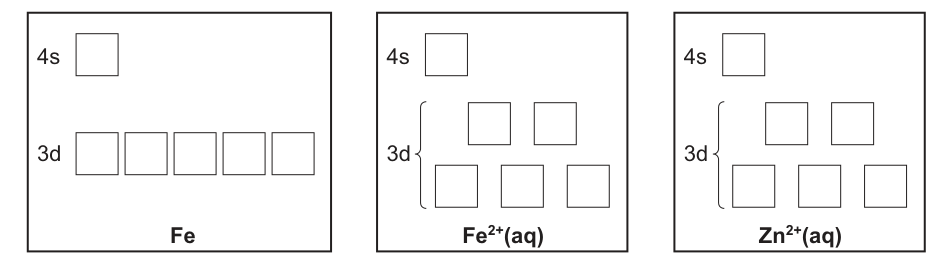
See diagram
Background Concept
Transition metals are elements that have an incomplete d sub-shell in their atom or one of their common ions. The outer electron configuration of first-row transition metals involves the 4s and 3d subshells. According to the Aufbau principle, the 4s subshell is filled before the 3d subshell. However, when transition metals form positive ions, they lose electrons from the 4s subshell before the 3d subshell. This is because the 4s electrons are further from the nucleus on average and are lost first during ionisation.
Understanding the Question
The question asks to draw the outer electron arrangements (4s and 3d orbitals) for a neutral iron atom (Fe), the iron(II) ion (Fe²⁺), and the zinc(II) ion (Zn²⁺). You must use the symbol ↑↓ to represent paired electrons in an orbital and single arrows for unpaired electrons, following Hund's rule (maximise unpaired electrons in degenerate orbitals before pairing).
Approach
- Determine the electron configuration of neutral Fe (Z=26): [Ar] 4s² 3d⁶.
- Determine the configuration of Fe²⁺ by removing two electrons from the 4s subshell: [Ar] 3d⁶.
- Determine the configuration of Zn (Z=30): [Ar] 4s² 3d¹⁰, and Zn²⁺ by removing the two 4s electrons: [Ar] 3d¹⁰.
- Draw the orbital boxes, placing electrons singly with parallel spins in the 3d orbitals before pairing them up.
Step-by-Step Reasoning
- Fe atom: Has 26 electrons. Outer configuration is 4s² 3d⁶. The 4s box contains one pair (↑↓). The five 3d boxes contain six electrons: one pair (↑↓) and four single up arrows (↑) in the remaining four boxes, following Hund's rule.
- Fe²⁺ ion: Loses the two 4s electrons first. Outer configuration is 3d⁶. The 4s box is empty. The five 3d boxes contain the same six electrons as the neutral atom: one pair (↑↓) and four single up arrows (↑).
- Zn²⁺ ion: Zinc has 30 electrons. Neutral Zn is 4s² 3d¹⁰. Zn²⁺ loses the two 4s electrons. Outer configuration is 3d¹⁰. The 4s box is empty. All five 3d boxes are completely filled with pairs (↑↓).
Key Takeaways
- Transition metals lose 4s electrons before 3d electrons when forming ions.
- Hund's rule must be applied when filling degenerate d-orbitals: electrons occupy empty orbitals singly with parallel spins before pairing.
Common Mistakes
- Removing 3d electrons instead of 4s electrons to form the ion (e.g., drawing Fe²⁺ as 4s² 3d⁴).
- Forgetting to leave the 4s box empty for the ions.
- Pairing electrons in the 3d subshell before all five orbitals have one electron each.
Things to Be Careful About
- The question specifically asks for the outer electron arrangements, so only draw the 4s and 3d boxes.
- Use the exact symbol ↑↓ for pairs as instructed.
- Zn is not a transition metal because Zn²⁺ has a full d-subshell (d¹⁰), which is the key to part (a)(ii).
Use the above diagrams to explain why ions are coloured, whereas ions are colourless.
Answer
- Fe²⁺ has partially filled d-orbitals, allowing electrons to be promoted from lower to higher energy d-orbitals by absorbing visible light.
- Zn²⁺ has completely filled d-orbitals (no empty d-orbitals), so electrons cannot be promoted within the d-subshell.
Fe2+ has partially filled d-orbitals allowing d-d transitions; Zn2+ has full d-orbitals preventing promotion.
Background Concept
The colour of transition metal complexes arises from d-d electron transitions. When ligands surround a central metal ion, the degenerate d-orbitals split into two energy levels (e.g., t₂g and eg in an octahedral field). Electrons in the lower energy d-orbitals can absorb photons of visible light to be promoted to the higher energy d-orbitals. The wavelength of light absorbed corresponds to the energy gap between these split levels. If the d-subshell is empty (d⁰) or completely full (d¹⁰), no such promotion is possible, and the complex is colourless.
Understanding the Question
Explain why Fe²⁺(aq) is coloured while Zn²⁺(aq) is colourless, using the electron arrangements drawn in part (a)(i).
Approach
Compare the d-orbital occupancy of Fe²⁺ (d⁶) and Zn²⁺ (d¹⁰). State that colour requires an electron to be promoted from a lower to a higher d-orbital, which is only possible if there is both a partially filled d-subshell and empty space in the higher energy level.
Step-by-Step Reasoning
- Fe²⁺: Has a 3d⁶ configuration. There are electrons in the lower energy d-orbitals and empty space in the higher energy d-orbitals. Electrons can absorb visible light and be promoted, causing the ion to appear coloured.
- Zn²⁺: Has a 3d¹⁰ configuration. All five d-orbitals are completely filled. There is no empty higher-energy d-orbital for an electron to be promoted into. Therefore, no visible light is absorbed via d-d transitions, and the ion is colourless.
Key Takeaways
- Colour in transition metal ions requires a partially filled d-subshell.
- d¹⁰ ions (like Zn²⁺) and d⁰ ions (like Sc³⁺) are colourless.
Common Mistakes
- Saying 'Zn²⁺ has no d-electrons' (it has 10).
- Failing to mention that electrons must be promoted to a higher energy level.
- Not specifying that the promotion is within the d-orbitals (d-d transition).
Things to Be Careful About
- Use precise terminology: 'partially filled d-orbitals', 'promoted', 'higher energy level'.
- Do not say 'absorbs all light' or 'reflects all light' without explaining the mechanism.
When concentrated is added to a solution of ions, the solution turns yellow.
State the formula of the species responsible for the yellow colour and name the type of reaction that has occurred.
Answer
- Formula:
- Reaction type: ligand substitution (or ligand displacement / exchange)
[CuCl4]2-; ligand substitution
Background Concept
Copper(II) ions in aqueous solution exist as the hexaaquacopper(II) complex, , which is pale blue. When concentrated hydrochloric acid is added, the high concentration of chloride ions acts as ligands, displacing the water molecules to form the tetrachlorocuprate(II) complex, , which is yellow. This is a ligand substitution (or ligand exchange) reaction.
Understanding the Question
State the formula of the yellow species formed when conc. HCl is added to Cu²⁺(aq), and name the type of reaction.
Approach
Recall the colour change from blue to yellow upon addition of concentrated HCl. Identify the reaction as ligand substitution.
Step-by-Step Reasoning
- The yellow colour is due to the formation of the tetrachlorocuprate(II) ion, .
- The reaction involves replacing water ligands with chloride ligands, which is called ligand substitution, ligand displacement, or ligand exchange.
Key Takeaways
- is blue; is yellow.
- Addition of conc. HCl to Cu²⁺(aq) causes a ligand substitution.
Common Mistakes
- Writing without the charge.
- Calling the reaction 'precipitation' or 'oxidation-reduction'.
Things to Be Careful About
- The formula must include the correct charge: .
- 'Ligand substitution' is the preferred term; 'displacement' or 'exchange' are also accepted.
Ammonia can react as a base or as a ligand.
Describe the colour changes that occur when is gradually added, with stirring, to the yellow solution, until the is in excess.
Identify the three ions or compounds responsible for the new colours.
Answer
- The solution turns blue due to the formation of .
- A pale blue precipitate forms, which is (or ).
- On adding excess , the precipitate dissolves to give a deep/purple/dark blue solution due to (or ).
- Three species: , , .
Blue solution [Cu(H2O)6]2+; blue ppt Cu(OH)2; deep blue solution [Cu(NH3)4]2+
Background Concept
When aqueous ammonia is added to a copper(II) solution, a sequence of reactions occurs. Initially, ammonia acts as a base, deprotonating water ligands to form a pale blue precipitate of copper(II) hydroxide. As more ammonia is added, it acts as a ligand, displacing water and hydroxide ligands to form the deep blue tetraamminecopper(II) complex.
Understanding the Question
Describe the colour changes when NH₃(aq) is gradually added to the yellow solution until excess, and identify the three ions/compounds responsible for the new colours.
Approach
Trace the chemical changes step-by-step:
- Dilution/replacement of Cl⁻ by H₂O to reform .
- Acid-base reaction forming Cu(OH)₂ precipitate.
- Ligand substitution forming .
Step-by-Step Reasoning
- Step 1: The yellow is diluted and water molecules displace chloride ligands, turning the solution blue due to .
- Step 2: Ammonia acts as a base: . The OH⁻ ions react with to form a pale blue precipitate of (or ).
- Step 3: On adding excess NH₃, the ammonia acts as a ligand, displacing water and hydroxide ligands. The precipitate dissolves to form a deep/purple/dark blue solution of (often written simply as ).
Key Takeaways
- NH₃ can act as a base (forming precipitate) or as a ligand (forming soluble complex).
- The sequence is: yellow → blue solution → blue precipitate → deep blue solution.
Common Mistakes
- Forgetting the intermediate blue precipitate.
- Stating the final solution is 'blue' instead of 'deep blue' or 'purple'.
- Writing the formula of the final complex incorrectly (e.g., ).
Things to Be Careful About
- The question asks for the colour changes gradually added, so all stages must be described.
- Identify the three species: the blue aqueous complex, the blue precipitate, and the deep blue aqueous complex.
When aqueous solutions of and are mixed almost no reaction occurs, but when a few drops of or are added, iodine, , is produced at a steady rate.
Write an equation for the overall reaction.
Answer
2I- + S2O8^2- -> 2SO4^2- + I2
Background Concept
Potassium iodide (KI) provides I⁻ ions, and potassium persulfate (K₂S₂O₈) provides S₂O₈²⁻ ions. Persulfate is a strong oxidising agent that can oxidise iodide to iodine, while being reduced to sulphate. The reaction is slow without a catalyst because both reactants are negatively charged and repel each other.
Understanding the Question
Write the overall equation for the reaction between KI and K₂S₂O₈.
Approach
Write the ionic equation by identifying the oxidation and reduction half-reactions and combining them.
- Oxidation:
- Reduction:
Step-by-Step Reasoning
Combine the half-equations to get the overall ionic equation:
A full molecular equation (2KI + K₂S₂O₈ → 2K₂SO₄ + I₂) is also acceptable but the ionic form is preferred.
Key Takeaways
- Persulfate oxidises iodide to iodine.
- Always write ionic equations for redox reactions involving aqueous ions.
Common Mistakes
- Not balancing the charges or atoms.
- Writing the molecular equation instead of the ionic equation (though usually accepted, ionic is better).
Things to Be Careful About
- Ensure the equation is balanced for both mass and charge.
- State symbols are not strictly required unless specified, but if included, I₂ is (aq) or (s) depending on concentration.
State the precise role of the iron ions during this reaction.
Answer
Homogeneous catalyst.
homogeneous catalyst
Background Concept
A catalyst speeds up a reaction by providing an alternative pathway with a lower activation energy. A homogeneous catalyst is in the same phase as the reactants. Here, the reactants (I⁻, S₂O₈²⁻) and the catalyst (Fe²⁺/Fe³⁺) are all in aqueous solution.
Understanding the Question
State the precise role of the iron ions.
Approach
The iron ions are not consumed in the overall reaction but speed it up. Since they are in the same phase (aqueous) as the reactants, they are a homogeneous catalyst.
Step-by-Step Reasoning
- The iron ions participate in the reaction mechanism but are regenerated at the end.
- They are in the same phase (aqueous) as the reactants.
- Therefore, they act as a homogeneous catalyst.
Key Takeaways
- Homogeneous catalysts are in the same phase as reactants.
- Iron ions catalyse this reaction by providing an alternative redox pathway.
Common Mistakes
- Calling it a 'catalyst' without specifying 'homogeneous'.
- Saying 'it speeds up the reaction' (this is what a catalyst does, but the question asks for the role or type).
Things to Be Careful About
- Use the exact term 'homogeneous catalyst'.
By means of equations or otherwise, explain why the presence of either or is able to speed up the reaction.
Answer
The reactants (I⁻ and S₂O₈²⁻) are both negative ions and repel each other, so the uncatalysed reaction is slow. Fe²⁺ is oxidised by S₂O₈²⁻, and Fe³⁺ is reduced by I⁻, providing an alternative pathway with a lower activation energy.
2Fe2+ + S2O8^2- -> 2Fe3+ + 2SO4^2-; 2Fe3+ + 2I- -> 2Fe2+ + I2; reactants are both negative and repel
Background Concept
Catalysts provide an alternative reaction mechanism with a lower activation energy. In this redox reaction, the direct reaction between I⁻ and S₂O₈²⁻ is slow because both are negatively charged and electrostatically repel each other. Iron ions can catalyse this by undergoing reversible redox changes: Fe²⁺ can be oxidised by the strong oxidising agent S₂O₈²⁻, and Fe³⁺ can be reduced by I⁻.
Understanding the Question
Explain why either Fe²⁺ or Fe³⁺ can speed up the reaction, using equations or otherwise.
Approach
Write the two equations that make up the catalytic cycle. Explain that the direct reaction is slow due to electrostatic repulsion between negative ions, and the catalysed path avoids this.
Step-by-Step Reasoning
- Equations:
- (Fe²⁺ is oxidised)
- (Fe³⁺ is reduced)
- Explanation: The overall reactants are I⁻ and S₂O₈²⁻, which are both negative ions. They repel each other, making the direct collision and reaction slow. The iron ions provide an alternative pathway where a positive/neutral ion (Fe²⁺ or Fe³⁺) reacts with the negative ions, avoiding the strong electrostatic repulsion. This alternative pathway has a lower activation energy, speeding up the reaction.
Key Takeaways
- Catalysts work by providing an alternative pathway with lower activation energy.
- In redox catalysis, the catalyst changes oxidation state.
- Electrostatic repulsion between like-charged reactants can make a reaction slow.
Common Mistakes
- Not balancing the equations.
- Forgetting to explain why the catalysed path is faster (repulsion between negative ions).
- Writing the overall equation instead of the catalytic cycle steps.
Things to Be Careful About
- Ensure the equations are balanced for mass and charge.
- The explanation must mention the repulsion between the original reactants or the alternative lower-energy pathway.
The rest of this paper
7 more questions- Q2Electrochemistry · Equilibria · Chemical Energetics20M
- Q3Introduction to A Level Organic Chemistry · Carboxylic Acids and Derivatives · Equilibria15M
- Q4Hydrocarbons · Introduction to A Level Organic Chemistry · Organic Synthesis · Carboxylic Acids and Derivatives · Nitrogen Compounds11M
- Q5Introduction to A Level Organic Chemistry10M
- Q6Nitrogen Compounds · Polymerisation10M
- Q7Nitrogen Compounds · Analytical Techniques10M
- Q8Polymerisation10M