Chemistry 9701/41 — May/June 2014
Cambridge A-Level · A Level Structured Questions · worked solutions for every part, with the mark scheme
Topics Introduction to A Level Organic Chemistry · Nitrogen Compounds · Carboxylic Acids and Derivatives · Transition Elements · Electrochemistry · Chemical Energetics · +4 more
State how the melting point and density of iron compare to those of calcium.
melting point of iron:
density of iron:
Explain why these differences occur.
melting point:
density:
The following diagram shows the apparatus used to measure the standard electrode potential, , of a cell composed of a Cu(II)/Cu electrode and an Fe(II)/Fe electrode.
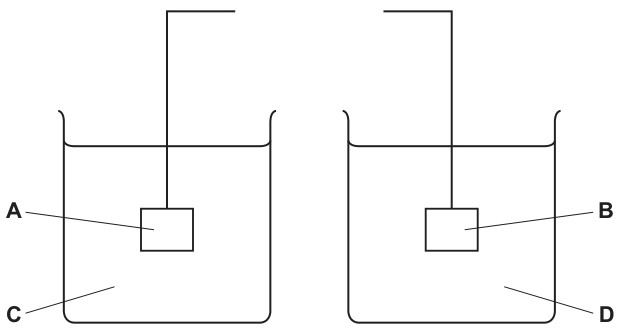
Finish the diagram by adding components to show the complete circuit. Label the components you add.
In the spaces below, identify or describe what the four letters A-D represent.
A
B
C
D
Use the Data Booklet to calculate the for this cell.
Predict how the size of the overall cell potential would change, if at all, as the concentration of solution C is increased.
Explain your reasoning.
The iron(II) complex ferrous bisglycinate hydrochloride is sometimes prescribed, in capsule form, to treat iron deficiency or anaemia.
A capsule containing 500 mg of this iron(II) complex was dissolved in dilute and titrated with 0.0200 mol dm⁻³ .
18.1 cm³ of solution were required to reach the end point.
The equation for the titration reaction is as follows.
Describe how you would recognise the end point of this titration.
Calculate
- the number of moles of in the capsule,
- the mass of iron in the capsule,
- the molar mass of the iron(II) complex, assuming 1 mol of the complex contains 1 mol of iron.
The rest of this paper
7 more questions- Q2Transition Elements · Chemical Energetics16M
- Q3Nitrogen Compounds · Introduction to A Level Organic Chemistry · Carboxylic Acids and Derivatives · Equilibria16M
- Q4Introduction to A Level Organic Chemistry · Organic Synthesis · Hydroxy Compounds · Nitrogen Compounds · Carboxylic Acids and Derivatives14M
- Q5Introduction to A Level Organic Chemistry8M
- Q6Nitrogen Compounds10M
- Q7Analytical Techniques · Introduction to A Level Organic Chemistry11M
- Q8Carboxylic Acids and Derivatives · Introduction to A Level Organic Chemistry9M