Chemistry 9701/41 — October/November 2013
Cambridge A-Level · A Level Structured Questions · worked solutions for every part, with the mark scheme
Topics Nitrogen Compounds · Group 2 · Equilibria · Carboxylic Acids and Derivatives · Chemical Energetics · Halogen Compounds · +5 more
Gaseous ammonia reacts with gaseous hydrogen chloride to form solid ammonium chloride.
The bonding in ammonium chloride includes ionic, covalent and co-ordinate (dative covalent) bonds.
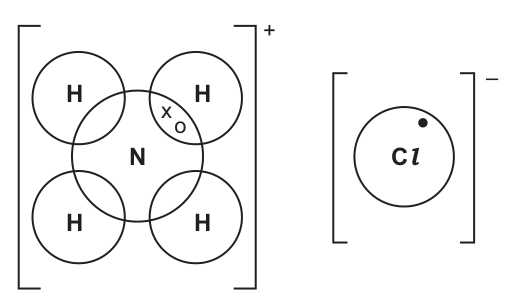
Complete the following 'dot-and-cross' diagram of the bonding in ammonium chloride. For each of the six atoms show all the electrons in its outer shell. Three electrons have already been included.
Use the following code for your electrons.
- electrons from chlorine
- electrons from hydrogen
- electrons from nitrogen
When a sample of dry ammonia is needed in the laboratory, the gas is passed through a tower containing lumps of solid calcium oxide, .
Suggest why the usual drying agent for gases, concentrated , is not used for ammonia.
Write an equation for the reaction between and .
Suggest why rather than is used to dry ammonia.
Write an equation showing the thermal decomposition of calcium nitrate, .
State and explain how the thermal stabilities of the nitrates vary down Group II.
The rest of this paper
7 more questions- Q2Chemical Energetics · Halogen Compounds · Group 2 · Electrochemistry6M
- Q3Equilibria · Carboxylic Acids and Derivatives18M
- Q4Chemical Energetics · Halogen Compounds · Carboxylic Acids and Derivatives19M
- Q5Polymerisation · Introduction to A Level Organic Chemistry · Transition Elements · Carboxylic Acids and Derivatives · Nitrogen Compounds17M
- Q6Nitrogen Compounds · Polymerisation · Reaction Kinetics10M
- Q7Nitrogen Compounds · Equilibria11M
- Q8Equilibria · Group 2 · Nitrogen Compounds · Transition Elements9M