Chemistry 9701/42 — May/June 2013
Cambridge A-Level · A Level Structured Questions · worked solutions for every part, with the mark scheme
Topics Halogen Compounds · Hydroxy Compounds · Transition Elements · Carboxylic Acids and Derivatives · Hydrocarbons · Nitrogen Compounds · +6 more
A bromoalkane, R–Br, is hydrolysed by aqueous sodium hydroxide.
Write a balanced equation for this reaction.
What type of reaction is this?
The concentration of bromoalkane was determined at regular time intervals as the reaction progressed.
Two separate experiments were carried out, with different concentrations.
The graph below shows the results of an experiment using .
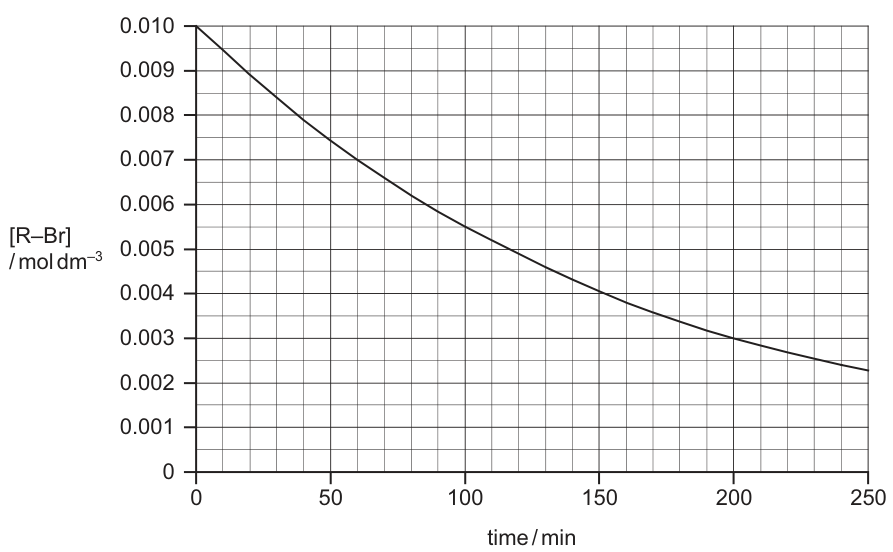
When the experiment was repeated using , the following results were obtained.
| time / min | [R–Br] / |
|---|---|
| 0 | 0.0100 |
| 40 | 0.0070 |
| 80 | 0.0049 |
| 120 | 0.0034 |
| 160 | 0.0024 |
| 200 | 0.0017 |
| 240 | 0.0012 |
Plot these data on the axes above, and draw a line of best fit.
Use one of the graphs to confirm that the reaction is first order with respect to R–Br. Show all your working, and show clearly any construction lines you draw.
Use the graphs to calculate the order of reaction with respect to . Show all your working, and show clearly any construction lines you draw on the graphs.
Write the rate equation for this reaction, and calculate the value of the rate constant.
Nitric oxide, , and bromine vapour react together according to the following equation.
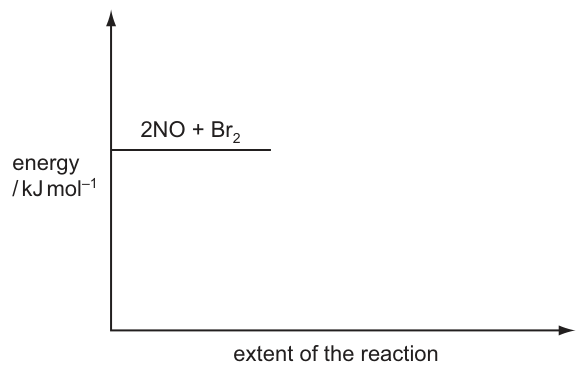
The reaction has an activation energy of .
Use the following axes to sketch a fully-labelled reaction pathway diagram for this reaction.
Include all numerical data on your diagram.
The rest of this paper
7 more questions- Q2Electrochemistry · Transition Elements · Equilibria · Carboxylic Acids and Derivatives17M
- Q3Hydrocarbons · Hydroxy Compounds · Nitrogen Compounds11M
- Q4Transition Elements14M
- Q5Introduction to A Level Organic Chemistry · Hydroxy Compounds · Carboxylic Acids and Derivatives · Hydrocarbons · Halogen Compounds17M
- Q6Polymerisation · Nitrogen Compounds10M
- Q7Analytical Techniques · Halogen Compounds10M
- Q8Polymerisation · Hydroxy Compounds10M