Chemistry 9701/43 — October/November 2012
Cambridge A-Level · A Level Structured Questions · worked solutions for every part, with the mark scheme
Topics Electrochemistry · Analytical Techniques · Chemical Energetics · Introduction to A Level Organic Chemistry · Carboxylic Acids and Derivatives · Nitrogen Compounds · +7 more
Write down what you would see, and write equations for the reactions that occur, when magnesium chloride, aluminium chloride and silicon tetrachloride are separately mixed with water.
magnesium chloride
aluminium chloride
silicon tetrachloride
Answer
magnesium chloride
Dissolves to form a colourless solution.
aluminium chloride
Produces a white precipitate and/or steamy fumes.
(or )
silicon tetrachloride
Produces a white precipitate and/or steamy fumes.
See working
Background Concept
When chlorides of period 3 elements are added to water, the observations depend on the nature of the bonding and the ability of the central atom to accept electron pairs from water molecules (hydrolysis).
- MgCl₂ is an ionic chloride. It simply dissolves in water to form a neutral, colourless solution containing hydrated Mg²⁺ and Cl⁻ ions. No hydrolysis occurs to a significant extent.
- AlCl₃ and SiCl₄ are covalent chlorides. The central atoms (Al and Si) have vacant orbitals and can act as Lewis acids, accepting lone pairs from water molecules. This leads to hydrolysis, producing hydrogen chloride gas (observed as steamy white fumes) and the corresponding oxide or hydroxide (observed as a white precipitate).
Understanding the Question
The question asks for the visual observations and the chemical equations when three different chlorides (MgCl₂, AlCl₃, SiCl₄) are mixed with water. You must link the type of chloride (ionic vs covalent) to the expected observations and write the correct balanced equation for the covalent hydrolysis reactions.
Approach
- Recall the observation for dissolving an ionic chloride (MgCl₂).
- Recall the observation for hydrolysing a covalent period 3 chloride (AlCl₃ and SiCl₄) — steamy fumes of HCl and a white precipitate of oxide/hydroxide.
- Write the balanced equation for each hydrolysis. For AlCl₃, either the formation of Al₂O₃/Al(OH)₃ or the complex ion [Al(H₂O)₅(OH)]²⁺ is acceptable.
Step-by-Step Reasoning
- Magnesium chloride: Ionic lattice. Dissolves endothermically to give a colourless solution. No fumes or precipitate.
- Aluminium chloride: Covalent molecule (often dimeric Al₂Cl₆). Reacts vigorously with water. HCl gas is produced (steamy fumes). Al₂O₃ or Al(OH)₃ is produced (white ppt). Equation: or . Alternatively, in excess water, the hexaaquaaluminium(III) ion forms and hydrolyses: .
- Silicon tetrachloride: Covalent network-like molecule. Hydrolyses violently. White ppt of SiO₂ (or H₂SiO₃) and steamy fumes of HCl. Equation: .
Key Takeaways
- Ionic chlorides (like MgCl₂) simply dissolve.
- Covalent chlorides of period 3 (Al, Si, P, S, Cl) hydrolyse to produce HCl gas and the corresponding oxide/hydroxy species.
- Observations must include both the gas (steamy fumes) and the solid (white precipitate) where applicable.
Common Mistakes
- Forgetting to mention the steamy fumes (HCl gas) or the white precipitate (oxide/hydroxide) for AlCl₃ and SiCl₄.
- Writing unbalanced equations or incorrect products (e.g., writing H₂SiO₄ instead of SiO₂ + H₂O, though H₂SiO₃ is acceptable).
- Claiming MgCl₂ produces fumes or a precipitate.
Things to Be Careful About
- Ensure equations are balanced. For AlCl₃, if writing the complex ion equation, ensure charges and atoms balance.
- State symbols are not strictly required in part (a) based on the mark scheme, but including them is good practice where known.
Sodium chloride is traditionally added to a particular meat product. In response to the evidence that sodium chloride can lead to high blood pressure, the manufacturers have replaced the sodium chloride with a mixture of sodium and potassium chlorides. of the meat product usually contains about of the chloride mixture.
A particular meat product contains of sodium chloride and potassium chloride in .
Calculate the number of moles of chloride ions in of this meat product.
Working
Answer
3.09e-2 mol
Background Concept
The number of moles of a substance is calculated by dividing its mass by its molar mass (). When a sample contains multiple compounds that dissociate to give the same ion (e.g., NaCl and KCl both give Cl⁻), the total moles of that ion is the sum of the moles contributed by each compound.
Understanding the Question
You are given the masses of NaCl (1.10 g) and KCl (0.90 g) in 100 g of meat product. You need to calculate the total number of moles of chloride ions (Cl⁻) present.
Approach
- Calculate the moles of NaCl using its molar mass (58.5 g/mol).
- Calculate the moles of KCl using its molar mass (74.6 g/mol).
- Since each mole of NaCl and KCl produces one mole of Cl⁻, sum the two mole values to get the total moles of Cl⁻.
Step-by-Step Reasoning
- Moles of NaCl: .
- Moles of KCl: .
- Total moles of Cl⁻: .
Key Takeaways
- Always use precise molar masses (Na=23, Cl=35.5, K=39.1).
- When summing ions from multiple sources, add the moles of each source compound.
Common Mistakes
- Using incorrect molar masses (e.g., forgetting to include Cl in both, or using atomic mass instead of molecular mass for KCl).
- Rounding too early in the calculation, leading to a final answer like 3.1 × 10⁻² instead of 3.09 × 10⁻².
Things to Be Careful About
- Keep at least 3 significant figures in intermediate steps to avoid rounding errors.
- The question asks for moles of chloride ions, not the mass of chloride.
The amount of chloride in the meat product can be found by titration with silver nitrate solution.
Write the ionic equation, including state symbols, for the reaction between aqueous sodium chloride and aqueous silver nitrate.
Answer
Ag+(aq) + Cl-(aq) -> AgCl(s)
Background Concept
Silver nitrate solution is used to test for halide ions. When Ag⁺ ions react with Cl⁻ ions in aqueous solution, a white precipitate of silver chloride (AgCl) forms. This is a precipitation reaction and is often written as a net ionic equation.
Understanding the Question
Write the ionic equation for the reaction between aqueous sodium chloride and aqueous silver nitrate, including state symbols.
Approach
- Identify the reacting ions: Ag⁺(aq) and Cl⁻(aq).
- Identify the product: AgCl(s).
- Write the balanced net ionic equation with correct state symbols.
Step-by-Step Reasoning
- The full molecular equation is: .
- The spectator ions are Na⁺ and NO₃⁻. Removing them gives the net ionic equation: .
- State symbols are mandatory here: (aq) for the ions and (s) for the precipitate.
Key Takeaways
- Net ionic equations omit spectator ions.
- State symbols are crucial for precipitation reactions.
Common Mistakes
- Forgetting state symbols.
- Writing the full molecular equation instead of the ionic equation.
- Incorrectly balancing charges or atoms.
Things to Be Careful About
- Ensure the equation is balanced in both mass and charge. Here, both are balanced with a 1:1 ratio.
The chlorides from meat product are extracted into water and the solution made up to in a volumetric flask. A portion of this solution is then titrated with silver nitrate solution to precipitate the chloride.
Calculate the volume of silver nitrate solution that would be required if this titration were carried out on of the particular meat product described above.
Working
Moles of Cl⁻ in the 10.0 cm³ sample:
From the ionic equation, .
Volume of AgNO₃ solution:
Answer
15.5 cm^3
Background Concept
In a titration, the moles of titrant used are calculated from its concentration and volume (). The stoichiometry of the reaction (from the balanced equation) relates the moles of titrant to the moles of analyte. When a solution is diluted, the moles of solute remain constant, but the concentration changes. The dilution factor must be applied correctly.
Understanding the Question
You have 100 g of meat product containing mol of Cl⁻. This is dissolved and made up to 1000 cm³. A 10.0 cm³ aliquot is titrated with 0.0200 mol dm⁻³ AgNO₃. Find the volume of AgNO₃ required.
Approach
- Calculate the moles of Cl⁻ in the 10.0 cm³ aliquot using the dilution factor (10/1000).
- Use the 1:1 stoichiometry from part (ii) to find the moles of Ag⁺ required.
- Calculate the volume of AgNO₃ solution using .
- Convert the volume from dm³ to cm³.
Step-by-Step Reasoning
- Total moles of Cl⁻ in 1000 cm³ = mol.
- Moles in 10.0 cm³ aliquot: mol.
- Reaction ratio Ag⁺ : Cl⁻ is 1 : 1, so moles of Ag⁺ needed = mol.
- Volume of AgNO₃ = dm³.
- Convert to cm³: cm³. Round to 3 significant figures: cm³.
Key Takeaways
- Always apply the dilution factor correctly: .
- Remember to convert dm³ to cm³ by multiplying by 1000.
- Use the correct number of significant figures (3 sf is appropriate here).
Common Mistakes
- Forgetting to apply the dilution factor and calculating the volume for the full 1000 cm³ instead of the 10 cm³ aliquot.
- Forgetting to convert dm³ to cm³ at the end.
- Using the wrong concentration or volume in the formula.
Things to Be Careful About
- The concentration is given in mol dm⁻³, so volume must be in dm³ for the calculation, then converted to cm³.
- Error carried forward (ecf) is allowed if an earlier calculation was wrong, as long as the method is correct.
The iodination of benzene requires the presence of nitric acid.
Using bond enthalpies from the Data Booklet, calculate the enthalpy change for the following reaction.
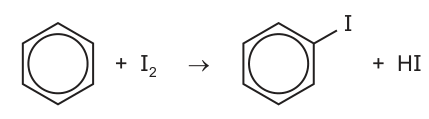
Working
Bonds broken (endothermic, +):
C–H:
I–I:
Total energy absorbed =
Bonds formed (exothermic, –):
C–I:
H–I:
Total energy released =
Answer
+22 kJ mol^-1
Background Concept
The enthalpy change of a reaction can be estimated using bond enthalpies. The principle is that breaking bonds requires energy (endothermic, +ΔH), while forming bonds releases energy (exothermic, -ΔH).
Note: The value is positive if more energy is absorbed to break bonds than is released when new bonds form.
Understanding the Question
Calculate the enthalpy change for the iodination of benzene: .
You must identify which bonds are broken and which are formed, then use the bond enthalpy values from the Data Booklet.
Approach
- Identify bonds broken in reactants: one C–H bond in benzene, one I–I bond.
- Identify bonds formed in products: one C–I bond in iodobenzene, one H–I bond.
- Sum the bond enthalpies for broken bonds (positive) and formed bonds (negative).
- Calculate ΔH = (sum broken) - (sum formed).
Step-by-Step Reasoning
-
Bonds broken (reactants):
- C–H bond in benzene:
- I–I bond:
- Total =
-
Bonds formed (products):
- C–I bond:
- H–I bond:
- Total =
-
Enthalpy change:
The reaction is endothermic.
Key Takeaways
- Always remember: breaking bonds is endothermic (+), forming bonds is exothermic (-).
- The formula is .
- Only count the bonds that actually change; the C–C bonds in the benzene ring remain intact (delocalised system).
Common Mistakes
- Forgetting that the reaction is endothermic and writing a negative value.
- Including bonds that do not change (e.g., C–C bonds in benzene).
- Using the wrong sign for bonds formed (adding instead of subtracting).
Things to Be Careful About
- Use the exact values from the Data Booklet provided in the exam.
- Ensure units are correct (kJ mol⁻¹).
- The question asks for the enthalpy change, so the sign is essential.
Nitric acid reacts with hydrogen iodide according to the following unbalanced equation.
Balance this equation, and describe how the oxidation numbers of nitrogen and iodine have changed during the reaction.
nitrogen
iodine
Answer
Balanced equation:
Oxidation number changes:
- nitrogen: reduced from +5 to +3
- iodine: oxidised from –1 to 0
4HI + 2HNO3 -> 2I2 + N2O3 + 3H2O; N: +5 to +3; I: -1 to 0
Background Concept
Balancing redox equations involves ensuring that both mass and charge are conserved. Oxidation numbers help track the transfer of electrons. An increase in oxidation number indicates oxidation (loss of electrons), while a decrease indicates reduction (gain of electrons).
In this reaction:
- HI is oxidised to I₂ (iodine goes from -1 to 0).
- HNO₃ is reduced to N₂O₃ (nitrogen goes from +5 to +3).
Understanding the Question
Balance the given unbalanced equation and describe the changes in oxidation numbers for nitrogen and iodine.
Approach
- Assign oxidation numbers to the relevant elements in reactants and products.
- Determine the change in oxidation number for I and N.
- Balance the equation by adjusting coefficients to ensure electron transfer is balanced and atoms are conserved.
Step-by-Step Reasoning
-
Oxidation numbers:
- In HI: H is +1, I is -1.
- In HNO₃: H is +1, O is -2, so N is +5.
- In I₂: I is 0.
- In N₂O₃: O is -2, so N is +3.
-
Changes:
- Iodine: -1 → 0 (oxidation, loss of 1 e⁻ per I atom).
- Nitrogen: +5 → +3 (reduction, gain of 2 e⁻ per N atom).
-
Balancing:
- To balance electrons: 2 I atoms lose 2 e⁻ total, 1 N atom gains 2 e⁻. But I₂ has 2 I atoms, so we need 4 HI to produce 2 I₂ (losing 4 e⁻). This requires 2 N atoms to gain 4 e⁻ (each gaining 2 e⁻). So we need 2 HNO₃.
- Reactants: .
- Products: .
- Balance H and O: Reactants have 4 H (from HI) + 2 H (from HNO₃) = 6 H. Products need 3 H₂O to balance 6 H and 3 O (matching N₂O₃).
- Final balanced equation: .
Key Takeaways
- Oxidation number changes must balance: total electrons lost = total electrons gained.
- When balancing, start with the elements that change oxidation state, then balance the rest (H, O) using H₂O and H⁺ (or just atoms in simple equations).
Common Mistakes
- Incorrectly assigning oxidation numbers (e.g., forgetting H is +1 in HI).
- Balancing the equation incorrectly (e.g., not balancing oxygen with water).
- Describing the change as "reduced to +3" instead of "reduced from +5 to +3".
Things to Be Careful About
- The question asks for the change in oxidation number, so state the initial and final values clearly (e.g., "from +5 to +3").
- Ensure the final equation is fully balanced for all atoms and charge.
The rest of this paper
7 more questions- Q2Reaction Kinetics · Chemical Energetics10M
- Q3Transition Elements · Electrochemistry · Introduction to A Level Organic Chemistry · Carboxylic Acids and Derivatives · Equilibria20M
- Q4Organic Synthesis · Carboxylic Acids and Derivatives · Hydroxy Compounds13M
- Q5Nitrogen Compounds13M
- Q6Introduction to A Level Organic Chemistry · Nitrogen Compounds13M
- Q7Analytical Techniques10M
- Q8Polymerisation7M