Chemistry 9701/52 — May/June 2012
Cambridge A-Level · Planning, Analysis and Evaluation · worked solutions for every part, with the mark scheme
Topics Analysis, Conclusions and Evaluation · Planning
When ammonium nitrate(V), , is heated it decomposes completely into nitrogen(I) oxide, , and water vapour, , which if allowed to cool will condense to liquid water.
The stoichiometric equation for this decomposition is
The following information gives some of the hazards associated with ammonium nitrate(V).
Ammonium nitrate(V)
Oxidising: Contact with combustible material may cause fire. Explosive when mixed with combustible material.
Do not allow the salt to become contaminated with organic matter and do not grind it.
You are to plan an experiment to investigate the molar ratio of nitrogen(I) oxide and ammonium nitrate(V) at , and confirm that it remains unchanged as the mass of ammonium nitrate(V) changes.
Predict quantitatively how the number of moles of nitrogen(I) oxide varies as the number of moles of ammonium nitrate(V) increases, if the products are measured at room temperature .
Answer
The number of moles of nitrogen(I) oxide is directly proportional to the number of moles of ammonium nitrate(V), with a 1:1 ratio.
The number of moles of nitrogen(I) oxide is directly proportional to the number of moles of ammonium nitrate(V), with a 1:1 ratio.
Background Concept
In any chemical reaction, the stoichiometric coefficients in the balanced symbol equation define the exact molar ratios in which reactants are consumed and products are formed. These ratios remain constant regardless of the scale of the reaction, provided the reaction goes to completion.
Understanding the Question
The question asks for a quantitative prediction of how the moles of nitrogen(I) oxide () produced relate to the moles of ammonium nitrate() () decomposed, measured at .
Approach
Read the balanced equation and extract the molar ratio between the reactant and the specific gaseous product of interest. At , water is a liquid, so only contributes to the gas phase, but the question specifically asks about the moles of , not the total gas moles.
Step-by-Step Reasoning
- The balanced equation is .
- The coefficient for is 1, and the coefficient for is 1.
- Therefore, 1 mole of produces exactly 1 mole of .
- This means the relationship is a direct proportionality with a 1:1 ratio. If you double the moles of reactant, you double the moles of produced.
Key Takeaways
Stoichiometric coefficients directly give the molar ratios of reactants and products. Predictions based on these ratios are always linear and pass through the origin.
Common Mistakes
- Stating the ratio is 1:2 (confusing with ).
- Forgetting to state that the relationship is 'directly proportional' or 'linear', merely saying 'it increases'.
Things to Be Careful About
Ensure you are answering for specifically, not the total moles of gas. At , water is liquid, so total gas moles = moles of , but the reasoning must be based on the specific species asked for.
Predict quantitatively how the sum of the number of moles of water vapour and nitrogen(I) oxide varies as the number of moles of ammonium nitrate(V) increases, if the products are measured at .
Answer
The sum of the number of moles of water vapour and nitrogen(I) oxide is directly proportional to the number of moles of ammonium nitrate(V), with a 1:3 ratio.
The sum of the number of moles of water vapour and nitrogen(I) oxide is directly proportional to the number of moles of ammonium nitrate(V), with a 1:3 ratio.
Background Concept
The physical state of a substance depends on the temperature. Water is a liquid at but a gas (vapour) at . When calculating total moles of gas, all gaseous products must be included.
Understanding the Question
Predict how the total moles of gaseous products (water vapour + nitrogen(I) oxide) vary with the moles of reactant, measured at .
Approach
Determine the state of water at , sum the coefficients of all gaseous products, and establish the ratio with the reactant.
Step-by-Step Reasoning
- At , both and are gases.
- From the equation: 1 mol produces 1 mol and 2 mol .
- Total moles of gas produced = moles.
- The ratio of total gas moles to reactant moles is 3:1. Thus, the sum of moles of products is directly proportional to the moles of with a 1:3 ratio.
Key Takeaways
Always check the physical states at the specified temperature. The total moles of gas can change depending on whether condensation occurs.
Common Mistakes
- Assuming water is still a liquid at and giving a 1:1 ratio.
- Forgetting to sum the moles of both gaseous products.
Things to Be Careful About
The question explicitly says 'water vapour', hinting that it is a gas. Ensure the ratio is stated as reactant:products (1:3) or products:reactant (3:1) clearly.
Display both your predictions in the form of sketch graphs on the axes below. Label clearly each axis and each graph line.
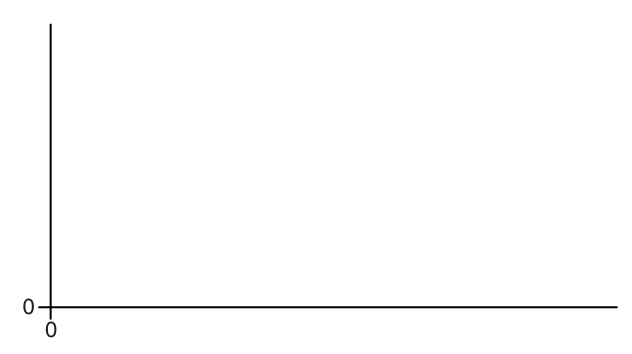
Answer
- Y-axis: moles of gas (or number of moles)
- X-axis: moles of
- Line 1: at (slope = 1)
- Line 2: at (slope = 3)
Two straight lines starting from the origin. Y-axis: moles of gas. X-axis: moles of NH4NO3. Line for 25°C has slope 1, line for 110°C has slope 3.
Background Concept
A direct proportionality between two variables is represented by a straight line passing through the origin (0,0) on a graph. The gradient (slope) of this line represents the constant of proportionality (the ratio). Sketch graphs must show correct relative slopes and clear labels, even if exact numerical values are not plotted.
Understanding the Question
Display the predictions from (a)(i) and (a)(ii) as sketch graphs on the provided axes (Fig 1.1). Both axes start at (0,0).
Approach
- Define the axes based on the variables being compared (moles of gas vs moles of reactant).
- Plot Line 1 for : 1 mol gas per 1 mol reactant (gradient = 1).
- Plot Line 2 for : 3 mol gas per 1 mol reactant (gradient = 3).
- Label both lines clearly.
Step-by-Step Reasoning
- The x-axis must be 'moles of ' (independent variable).
- The y-axis must be 'moles of gas' or 'number of moles' (dependent variable).
- At , only is gaseous. Ratio is 1:1. Draw a straight line from (0,0) with a moderate slope. Label it ' at ' or 'gas at '.
- At , both and are gaseous. Total ratio is 3:1. Draw a straight line from (0,0) with a steeper slope (exactly 3 times steeper). Label it ' at ' or 'total gas at '.
- Ensure neither line is curved or has a plateau; the decomposition is complete and stoichiometric.
Key Takeaways
Sketch graphs test your understanding of relationships. Correct labels and relative slopes are more important than exact data points.
Common Mistakes
- Drawing curves instead of straight lines.
- Forgetting to label the lines with the temperature or gas identity.
- Making the axes start at non-zero values (they must start at 0,0 as shown in Fig 1.1).
Things to Be Careful About
The mark scheme specifically looks for 'no curves or plateaus'. Both reactions are 100% complete decompositions, so the lines must continue linearly. The higher temperature line MUST have the greater slope.
In the experiment you are about to plan to test your prediction in (a)(i) at , identify the following.
the independent variable
Answer
The mass (or number of moles) of ammonium nitrate(V).
mass (or moles) of ammonium nitrate(V)
Background Concept
In an experiment, the independent variable is the factor that the experimenter deliberately changes or controls to observe its effect on another variable.
Understanding the Question
Identify the independent variable for the experiment planned in part (d), which tests how the amount of product changes as the mass of ammonium nitrate(V) changes.
Approach
The question stem states: 'confirm that it remains unchanged as the mass of ammonium nitrate(V) changes'. Therefore, the mass (or moles) of ammonium nitrate is the variable being changed.
Step-by-Step Reasoning
- The experiment varies the amount of reactant to see the effect on the product.
- The independent variable is the mass or number of moles of ammonium nitrate(V) heated.
Key Takeaways
The independent variable is what you change; the dependent variable is what you measure.
Common Mistakes
- Confusing independent and dependent variables.
- Stating 'temperature' as the independent variable (temperature is kept constant at for the gas measurement).
Things to Be Careful About
'Moles' or 'mass' are both acceptable. Do not just say 'ammonium nitrate'; specify the quantity (mass/moles).
the dependent variable
Answer
The volume (or number of moles) of nitrogen(I) oxide collected.
volume (or moles) of nitrogen(I) oxide
Background Concept
The dependent variable is the factor that is measured or observed in response to changes in the independent variable.
Understanding the Question
Identify the dependent variable for the experiment at .
Approach
The experiment measures the amount of nitrogen(I) oxide produced from different amounts of ammonium nitrate. In practice, this is measured as the volume of gas collected.
Step-by-Step Reasoning
- The goal is to investigate the molar ratio.
- You measure the volume of gas collected using a gas syringe or burette.
- This volume (which can be converted to moles) is the dependent variable.
Key Takeaways
The dependent variable is what you measure to test your hypothesis.
Common Mistakes
- Stating 'mass of ammonium nitrate' (this is the independent variable).
- Stating 'temperature' (this is a control variable).
Things to Be Careful About
'Volume' is the practical measurement; 'moles' is the calculated value. Both are acceptable as the dependent variable in this context.
Draw a diagram of the apparatus and the experimental set up you would use to carry out this experiment. Your apparatus should use only standard items found in a school or college laboratory and show clearly
(i) how the solid will be heated,
(ii) how the water vapour will be condensed into a liquid and collected. Ice is available,
(iii) how the nitrogen(I) oxide will be collected.
Label each piece of apparatus used, indicating its size or capacity.
Answer
Apparatus required:
- Hard glass boiling tube (or test tube) with rubber bung and delivery tube.
- Bunsen burner (or test tube holder in flame).
- U-tube or test tube in a beaker of crushed ice.
- Gas syringe (minimum , labelled with capacity) or measuring cylinder.
See diagram description: heated boiling tube with bung, connected to ice-cooled U-tube for water condensation, connected to a calibrated gas syringe (min 10 cm3) for N2O collection.
Background Concept
When decomposing a solid that produces both a condensable vapour and a permanent gas, the apparatus must: (1) safely heat the solid, (2) condense and collect the vapour to prevent it from interfering with gas volume measurement, and (3) accurately measure the volume of the permanent gas.
Understanding the Question
Draw a labelled diagram showing how to heat the solid, condense the water vapour using ice, and collect the nitrogen(I) oxide gas. Use standard school laboratory equipment.
Approach
- Heating: Use a hard glass boiling tube containing the solid, clamped and heated by a Bunsen burner. Seal with a rubber bung and delivery tube. (No water baths or hot plates as per mark scheme).
- Condensation: Route the delivery tube into a U-tube or test tube immersed in crushed ice. This cools the water vapour to liquid, which is collected here.
- Gas Collection: Route the remaining gas (now only ) into a calibrated gas collecting device. A gas syringe is ideal. It must be labelled with its capacity (e.g., ' gas syringe').
Step-by-Step Reasoning
- Heating apparatus: A hard glass boiling tube is essential as it can withstand direct flame heating without cracking. It must be closed (bunged) with a delivery tube to direct the products. Label: 'hard glass boiling tube', 'Bunsen burner'.
- Water condenser: The delivery tube from the boiling tube leads into a U-tube or a test tube placed in a beaker containing crushed ice. The ice cools the water vapour to liquid water (), which condenses and is trapped. Label: 'U-tube / test tube', 'crushed ice', 'beaker'. The connection to the gas collector must be gas-tight.
- Gas collector: A delivery tube from the ice-cooled condenser leads into a gas syringe. The syringe must be calibrated and labelled with its size (minimum , e.g., ' gas syringe'). Alternatively, an inverted burette or measuring cylinder could be used, but a syringe is cleaner and avoids water vapour issues if the condenser is effective.
Key Takeaways
Apparatus diagrams for multi-product decomposition must clearly show the sequence: reaction -> condensation -> gas collection. All key components must be labelled with names and sizes.
Common Mistakes
- Using a water bath or hot plate to heat the solid (mark scheme explicitly rejects this).
- Forgetting to label the gas collector with its capacity (e.g., just writing 'gas syringe' without '').
- Not making the connection between the condenser and gas collector gas-tight (if gas collection is attempted).
- Drawing a Liebig condenser without ensuring it is connected correctly and gas-tight to the collector.
Things to Be Careful About
The mark scheme requires 'minimum ' for the gas collector. A syringe is too small for practical experiments with multiple data points; a or syringe is more realistic. Ensure the ice is explicitly mentioned as the cooling agent for the water condenser.
Using the apparatus shown in (c) design a laboratory experiment to test your prediction in (a)(i) for an experiment at .
In addition to the standard apparatus present in a laboratory you are provided with the following materials.
- a sample of solid ammonium nitrate(V)
- crushed ice
Give a step-by-step description of how you would carry out the experiment,
(i) to produce enough results to give sufficient data to plot a graph as in (a)(iii),
(ii) by stating the volumes of nitrogen(I) oxide you would collect,
(iii) by calculating the mass of ammonium nitrate(V) needed to produce one of the volumes of nitrogen(I) oxide suggested in (ii),
(iv) by stating how you would ensure that decomposition was complete.
[: H, 1.0; N, 14.0; O, 16.0; the molar volume of a gas at , ]
Answer
(i) Procedure for sufficient data:
Perform at least five separate experiments. For each experiment, heat a different, pre-measured mass of solid ammonium nitrate(V) and record the maximum volume of nitrogen(I) oxide gas collected in the gas syringe.
(ii) Intended gas volumes:
Collect volumes ranging from to (e.g., ). The maximum volume must not exceed the capacity of the gas syringe (e.g., ).
(iii) Calculation for mass of :
To produce () of at :
From the 1:1 ratio, moles of .
(Use a similar calculation for other target volumes, adjusting the mass accordingly).
(iv) Ensuring complete decomposition:
Continue heating until the volume of gas in the syringe no longer increases (constant volume), or until all the solid white ammonium nitrate has disappeared from the boiling tube.
See working: 5 experiments, volumes 10-30 cm3, mass calculation (e.g., 0.100 g for 30 cm3), stop when gas volume is constant or solid disappears.
Background Concept
To establish a linear relationship experimentally, you need multiple data points (at least 5) covering a reasonable range of the independent variable. You must be able to predict the expected outcomes (volumes) and calculate the required starting materials (masses) to achieve those outcomes. The experiment must have a clear, observable end-point to ensure the reaction is complete before recording data.
Understanding the Question
Design the experiment to test the prediction in (a)(i). This involves: (i) planning enough data points for a graph, (ii) stating target gas volumes, (iii) calculating the mass of reactant needed for one target volume, and (iv) defining how you know the reaction is finished.
Approach
- Data points: Plan 5+ experiments with varying masses of .
- Volumes: Choose a range of gas volumes that fit within the gas syringe (e.g., in a syringe).
- Calculation: Use the molar volume ( at ) and stoichiometry to find the mass of needed for one of the target volumes.
- End-point: Define an observable sign that decomposition is complete (constant gas volume or solid gone).
Step-by-Step Reasoning
(i) Sufficient data:
To plot a meaningful graph as in (a)(iii), you need at least 5 data points. This means performing the experiment 5 times with 5 different masses of . Record the volume of gas for each.
(ii) Intended gas volumes:
Assume a gas syringe. A good range is to . The minimum should be to reduce percentage reading errors. The maximum should be to leave room in the syringe and avoid exceeding its capacity. State these volumes explicitly.
(iii) Calculation:
Let's calculate the mass needed to produce () of .
- Moles of .
- From the equation , the ratio is 1:1. So, moles of .
- .
- Mass = moles .
Show this working clearly. The mark scheme allows a volume from a stated mass, but calculating mass from volume is the standard approach.
(iv) Ensuring complete decomposition:
The mark scheme specifically requires an observation, not a deduction. You cannot just say 'wait until it's all decomposed'. You must say: 'heat until the volume reading on the gas syringe stops increasing (becomes constant)' OR 'heat until all the solid white powder has disappeared'.
Key Takeaways
Experimental design requires planning the range of data, calculating required quantities, and defining clear observable end-points.
Common Mistakes
- Planning only 2 or 3 experiments (need at least 5 for a reliable graph).
- Stating volumes outside the range (e.g., is too small for accurate reading; might exceed a small syringe).
- Calculating mass without showing the mole conversion from volume.
- Stating 'wait until no more gas is produced' as the end-point (this is a deduction/assumption, not an observation. The observation is 'the syringe plunger stops moving' or 'the volume reading is constant').
Things to Be Careful About
- Significant figures: The molar volume is given as (3 s.f.), so your mass should be to 3 s.f. (, not ).
- Units: Convert to when using the molar volume (). .
- The calculation is not restricted to the maximum capacity of the collector; you can calculate for any volume in your planned range.
State one hazard that must be considered when planning the experiment and describe a precaution that should be taken to minimise the risk from this hazard.
Answer
Hazard: Ammonium nitrate(V) is an oxidising agent and can be explosive when mixed with combustible material (or organic matter).
Precaution: Ensure the salt is not contaminated with organic matter / keep away from combustible materials. Wear chemical-resistant gloves (or use tongs to handle hot apparatus).
Hazard: oxidising/explosive with combustibles. Precaution: keep away from combustible material / wear resistant gloves.
Background Concept
Ammonium nitrate is a well-known oxidising agent used in fertilisers and explosives. When heated, it can decompose rapidly. The key hazard is its reactivity with combustible (organic) materials, which can lead to fire or explosion. Additionally, the apparatus becomes very hot during the experiment.
Understanding the Question
Identify one hazard from the provided information and state a practical precaution to minimise the risk.
Approach
Read the 'hazcard' information in the question stem. Extract the hazard (oxidising, explosive with organics) and match it with a standard laboratory safety procedure.
Step-by-Step Reasoning
- Hazard: The text states 'Oxidising: Contact with combustible material may cause fire. Explosive when mixed with combustible material. Do not allow the salt to become contaminated with organic matter'.
- Precaution 1 (Chemical hazard): Keep the ammonium nitrate away from any combustible materials (e.g., paper, wood, solvents). Do not grind it (as grinding can generate heat/sparks). Wear chemical-resistant gloves to prevent skin contact and contamination.
- Precaution 2 (Thermal hazard): The boiling tube will be very hot. Use heat-resistant gloves or tongs to handle the apparatus after heating.
Key Takeaways
Always read the provided hazard information. Match the specific hazard (oxidising, corrosive, flammable) with the correct PPE or handling procedure.
Common Mistakes
- Stating 'ammonium nitrate is flammable' (it is an oxidiser, not combustible itself).
- Giving a vague precaution like 'be careful' or 'use safety goggles' (must be specific to the hazard identified).
- Not linking the precaution to the hazard (e.g., saying 'wear gloves' without specifying chemical-resistant, or not mentioning keeping away from combustibles).
Things to Be Careful About
The mark scheme accepts 'hot apparatus' as a hazard with 'heat resistant gloves/tongs' as the precaution. However, the primary hazard highlighted in the text is the oxidising/explosive nature. Addressing the chemical hazard is safer.
Draw a table with appropriate headings to show the data you would record when carrying out your experiments and the values you would calculate in order to construct a graph to support or reject your prediction in (a)(i). The headings should include the appropriate units.
Answer
| Mass of / g | Volume of / | Number of moles of | Number of moles of |
|---|---|---|---|
| 0.050 | 6.0 | 0.000625 | 0.000625 |
| 0.100 | 12.0 | 0.00125 | 0.00125 |
| 0.150 | 18.0 | 0.00188 | 0.00188 |
| 0.200 | 24.0 | 0.00250 | 0.00250 |
| 0.250 | 30.0 | 0.00313 | 0.00313 |
(Note: The last two columns have no units. The volume can be in instead of .)
Table with 4 columns: Mass of NH4NO3 (g), Volume of N2O (cm3), Moles of NH4NO3 (no unit), Moles of N2O (no unit).
Background Concept
A data table for plotting a graph must include the raw measurements (with units) and the calculated values needed for the axes (without units, as axes are typically labelled with the quantity, e.g., 'moles'). The table should have clear headings with quantities and units.
Understanding the Question
Draw a table showing the data to be recorded and the values to be calculated to plot the graph from (a)(iii) (moles of gas vs moles of reactant).
Approach
- Raw data columns: Mass of (measured) and Volume of (measured). Both need units.
- Calculated columns: Moles of (from mass) and Moles of (from volume). These are dimensionless numbers (no units in the column heading).
- Format: Use a standard table with 4 columns and at least 5 rows of data (or placeholders).
Step-by-Step Reasoning
- Column 1: 'Mass of / g' or 'Mass of ammonium nitrate (g)'. This is the independent variable.
- Column 2: 'Volume of / ' or 'Volume of nitrogen(I) oxide ()'. This is the raw dependent variable.
- Column 3: 'Number of moles of ' (no unit). Calculated as mass / 80.0.
- Column 4: 'Number of moles of ' (no unit). Calculated as volume (in ) / 24.0.
- The graph will plot Column 4 (y-axis) against Column 3 (x-axis).
- Ensure the table has at least 5 rows to show sufficient data points.
Key Takeaways
Data tables must clearly separate raw measurements (with units) from calculated values (without units in the heading). The columns must directly correspond to the axes of the final graph.
Common Mistakes
- Including units in the calculated mole columns (e.g., 'moles / mol'). The heading should just be 'Number of moles'.
- Forgetting units in the raw data columns (e.g., 'Mass of NH4NO3' without '/ g').
- Using 'Amount of NH4NO3' instead of 'Mass' (amount is ambiguous; mass or moles is required, but mass is the raw measurement).
Things to Be Careful About
The mark scheme requires exactly four fully correct columns for 2 marks. Three correct columns give 1 mark. Ensure all four are present and correctly formatted. The unit for volume can be or , but if is used, the calculation to moles must convert to first (or use ).
The rest of this paper
1 more questions- Q2Analysis, Conclusions and Evaluation15M