Chemistry 9701/51 — May/June 2012
Cambridge A-Level · Planning, Analysis and Evaluation · worked solutions for every part, with the mark scheme
Topics Analysis, Conclusions and Evaluation · Planning
When an excess of aqueous sodium hydroxide, NaOH, is added to 100 cm³ of aqueous copper(II) sulfate, CuSO₄, a precipitate of copper(II) hydroxide, Cu(OH)₂, is produced.
The stoichiometric equation for this reaction is,
The following information gives some of the hazards associated with these reactants.
Copper(II) sulfate (solid hydrated copper(II) sulfate )
Harmful. Dangerous for the environment.
Harmful if swallowed. Irritating to eyes and skin.
Solutions of concentrations equal to or greater than 1 mol dm⁻³ should be labelled HARMFUL.
Sodium hydroxide (solid NaOH)
Corrosive. Solutions of concentrations equal to or greater than 0.5 mol dm⁻³ are CORROSIVE.
Solutions of concentrations equal to or greater than 0.05 mol dm⁻³ but less than 0.5 mol dm⁻³ are IRRITANT.
You are to plan an experiment to investigate the molar ratio of the equation above and confirm that it remains unchanged as the concentration of the copper(II) sulfate changes.
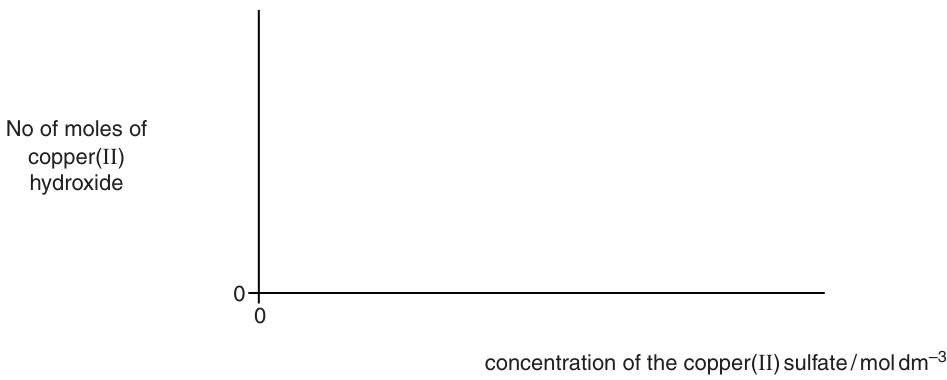
Predict quantitatively how the number of moles of the precipitated copper(II) hydroxide varies as the molar concentration of the copper(II) sulfate increases until saturation is reached.
Display your prediction in the form of a sketch graph. Remember that you are using 100 cm³ of aqueous copper(II) sulfate. Label clearly the point representing the saturated solution of copper(II) sulfate. A saturated solution at 25 °C has a concentration of 1.39 mol dm⁻³. Give appropriate numerical scales to the two axes.
In the experiment you are about to plan, identify the following.
the independent variable
the dependent variable
one other variable to be controlled
Design a laboratory experiment to investigate your prediction in (a).
In addition to the standard apparatus present in a laboratory you are provided with the following materials.
aqueous sodium hydroxide, NaOH (2.0 mol dm⁻³)
solid hydrated copper(II) sulfate,
Give a step-by-step description of how you would
prepare enough solutions of copper(II) sulfate of an appropriate range of concentrations to give sufficient data to plot a graph as in (a)(ii),
collect and dry the precipitated copper(II) hydroxide,
calculate the molar concentration of one of the solutions of copper(II) sulfate.
[: H, 1.0; O, 16.0; S, 32.1; Cu, 63.5]
State two hazards that must be considered when planning the experiment.
State a precaution that should be taken to minimise the risk of one of these hazards.
Draw up a table with appropriate headings to show the data you would record when carrying out your experiments and the values you would calculate in order to construct a graph to support or reject your prediction in (a). The headings should include the appropriate units.
The rest of this paper
1 more questions- Q2Analysis, Conclusions and Evaluation15M