Chemistry 9701/43 — May/June 2012
Cambridge A-Level · A Level Structured Questions · worked solutions for every part, with the mark scheme
Topics Nitrogen Compounds · Chemical Energetics · Group 2 · Introduction to A Level Organic Chemistry · Hydroxy Compounds · Hydrocarbons · +6 more
What is meant by the term lattice energy?
Write an equation to represent the lattice energy of .
The apparatus shown in the diagram can be used to measure the enthalpy change of formation of magnesium oxide, .
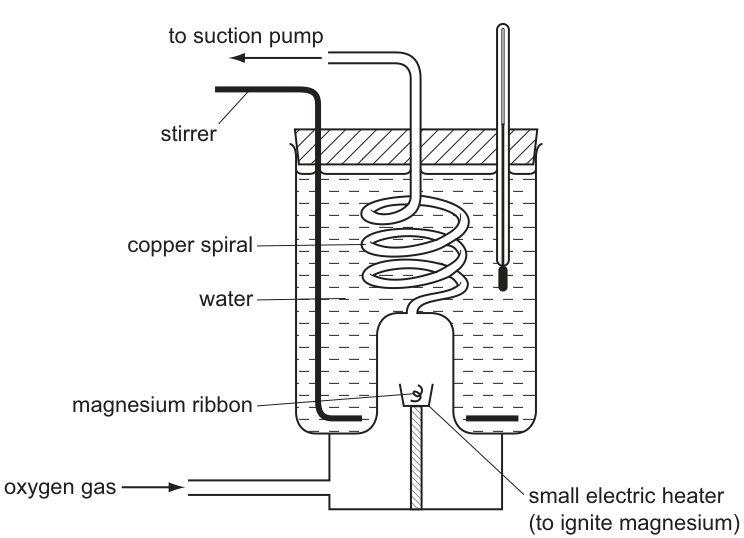
List the measurements you would need to make using this apparatus in order to calculate .
Use the following data, together with appropriate data from the Data Booklet, to calculate a value of .
Write equations, including state symbols, for the reactions, if any, of the following two oxides with water. Suggest values for the pH of the resulting solutions.
| oxide | equation | pH of resulting solution |
|---|---|---|
The rest of this paper
7 more questions- Q2Nitrogen Compounds · Chemical Energetics · Reaction Kinetics · Transition Elements17M
- Q3Introduction to A Level Organic Chemistry · Hydroxy Compounds · Hydrocarbons16M
- Q4Group 211M
- Q5Hydrocarbons · Hydroxy Compounds · Nitrogen Compounds · Carboxylic Acids and Derivatives14M
- Q6Polymerisation · Nitrogen Compounds10M
- Q7Nitrogen Compounds · Equilibria · Analytical Techniques10M
- Q8Polymerisation · Introduction to A Level Organic Chemistry10M