Chemistry 9701/41 — May/June 2012
Cambridge A-Level · A Level Structured Questions · worked solutions for every part, with the mark scheme
Topics Nitrogen Compounds · Chemical Energetics · Group 2 · Transition Elements · Introduction to A Level Organic Chemistry · Hydrocarbons · +8 more
Section A
Answer all the questions in the spaces provided.
What is meant by the term lattice energy?
Answer
The enthalpy change when 1 mole of an ionic lattice is formed from its gaseous ions.
The enthalpy change when 1 mole of an ionic lattice is formed from its gaseous ions.
Background Concept
Lattice energy is a measure of the strength of the ionic bonds in an ionic compound. It is defined specifically as the enthalpy change that occurs when one mole of a solid ionic compound is formed from its constituent gaseous ions under standard conditions. Because the process involves bringing oppositely charged ions together from an infinite separation, it is always highly exothermic (negative enthalpy change). It is important to distinguish this from the enthalpy of formation, which is the enthalpy change when 1 mole of a compound is formed from its elements in their standard states.
Understanding the Question
This part asks for the precise definition of 'lattice energy'. The command word 'what is meant by' requires a clear, textbook definition. You must specify the amount of substance (1 mole), the physical state of the product (solid ionic lattice), and the starting materials (gaseous ions).
Approach
Recall the standard IUPAC definition of lattice formation enthalpy. Ensure all three key components are present: '1 mole', 'ionic lattice', and 'from gaseous ions'.
Step-by-Step Reasoning
- 1 mole: The definition is always per mole of the compound formed. Without this, the value is ambiguous.
- Ionic lattice: The product must be specified as a solid ionic lattice (or solid ionic compound). Saying 'solid compound' is too vague.
- From gaseous ions: The reactants must be in the gas phase. This distinguishes lattice energy from other enthalpy changes like atomisation or formation.
Key Takeaways
Lattice energy is strictly defined as the formation of 1 mole of solid ionic lattice from gaseous ions. Memorise this definition exactly, as missing any component (like 'gaseous' or '1 mole') will cost marks.
Common Mistakes
- Writing 'formation from elements in standard states' (this is enthalpy of formation, not lattice energy).
- Saying 'ions' without specifying 'gaseous'.
- Saying 'solid' instead of 'ionic lattice' (though 'solid ionic compound' is usually acceptable, 'ionic lattice' is the precise term).
Things to Be Careful About
The mark scheme accepts 'enthalpy change/released'. If you say 'energy released', you might lose a mark because enthalpy change is the precise thermodynamic term. Always use 'enthalpy change' unless explicitly asked for 'energy'.
Write an equation to represent the lattice energy of MgO.
Answer
Mg^{2+}(g) + O^{2-}(g) -> MgO(s)
Background Concept
A Born-Haber cycle breaks down the formation of an ionic solid into a series of steps. The final step in this cycle is the formation of the solid lattice from the gaseous ions. This step corresponds to the lattice energy (specifically, the lattice formation enthalpy). Writing the equation for this step requires identifying the ions that make up the compound and ensuring they are in the gas phase as reactants, while the solid compound is the product.
Understanding the Question
You need to write the chemical equation that represents the lattice energy of magnesium oxide (MgO). This means showing the combination of the constituent ions in the gas phase to form one mole of solid MgO.
Approach
- Identify the ions in MgO: Magnesium forms Mg²⁺ and oxygen forms O²⁻.
- Write them as reactants with the state symbol (g).
- Write MgO as the product with the state symbol (s).
- Ensure the equation is balanced (it is, for 1 mole of product).
Step-by-Step Reasoning
- Magnesium is a Group 2 metal, so it forms a 2+ ion: .
- Oxygen is a Group 6 non-metal, so it forms a 2- ion: .
- The reactants must be gaseous ions: .
- The product is solid magnesium oxide: .
- Combining these gives the equation: .
Key Takeaways
When writing a lattice energy equation, always start with the gaseous ions and end with the solid ionic compound. The charges on the ions must match the formula of the compound (Mg²⁺ and O²⁻ for MgO).
Common Mistakes
- Writing the equation for the formation of MgO from its elements: . This is the enthalpy of formation, not lattice energy.
- Forgetting state symbols. The (g) and (s) are critical to defining the process.
- Using incorrect ion charges, such as Mg⁺ or O⁻.
Things to Be Careful About
State symbols are mandatory for this type of equation. The reactants must be (g) and the product must be (s). Do not include electrons or other species; this is a simple combination of ions.
The apparatus shown in the diagram can be used to measure the enthalpy change of formation of magnesium oxide, .
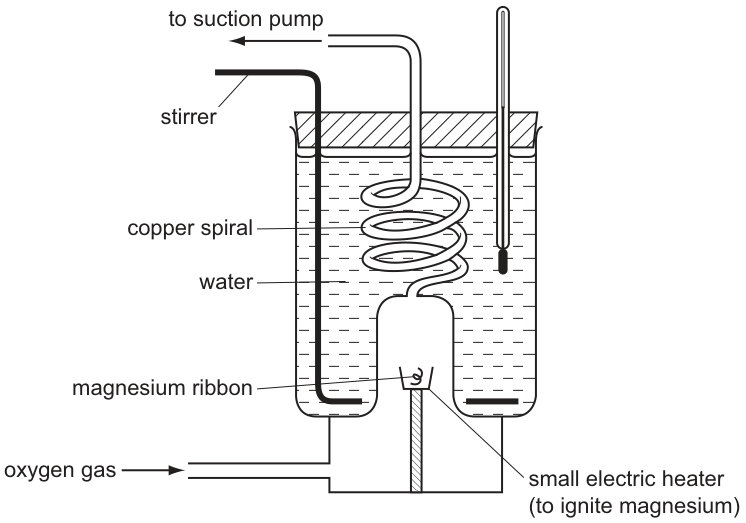
List the measurements you would need to make using this apparatus in order to calculate .
Answer
- Mass (or volume) of water in the calorimeter.
- Initial temperature and final temperature of the water (or the temperature change, ).
- Mass of magnesium used (or mass of MgO produced).
(Note: The volume/moles/mass of oxygen used is NOT required.)
Mass (or volume) of water; initial and final temperatures (or temperature change); mass of magnesium used.
Background Concept
To measure an enthalpy change experimentally, we use calorimetry. The basic equation used is , where is the heat energy transferred, is the mass of the substance absorbing the heat (usually water), is the specific heat capacity of water (4.18 J g⁻¹ K⁻¹), and is the temperature change. To find the enthalpy change per mole (), we divide by the number of moles of the limiting reactant (in this case, magnesium).
Understanding the Question
The question asks for the measurements needed using the provided calorimeter apparatus to calculate . The apparatus includes a reaction chamber, water bath, thermometer, stirrer, and oxygen supply. You need to list the physical quantities you would measure with instruments (balance, thermometer, measuring cylinder/pipette).
Approach
- Identify what is needed for the calculation: mass of water and temperature change.
- Identify what is needed to find the number of moles of reactant: mass of magnesium.
- Exclude irrelevant measurements (like oxygen volume, since oxygen is in excess from a continuous flow).
Step-by-Step Reasoning
- Water measurements: The heat from the reaction is absorbed by the water. We need the mass (or volume, assuming density = 1 g cm⁻³) of the water to use in . -> 1 mark
- Temperature measurements: We need to know how much the temperature changed. This requires measuring the initial temperature of the water before ignition and the final (maximum) temperature after the reaction. The difference is . -> 1 mark
- Reactant measurements: To calculate the enthalpy change per mole, we must know how many moles of magnesium reacted. We measure the mass of the magnesium ribbon before the experiment. -> 1 mark
- Oxygen is supplied continuously from a cylinder, so it is in excess. We do not need to measure its volume, mass, or moles.
Key Takeaways
In any calorimetry experiment to find , you always need: (1) mass of the solvent (water), (2) temperature change (), and (3) mass/moles of the limiting reactant. Excess reagents do not need to be measured.
Common Mistakes
- Including 'volume/moles/mass of oxygen' in the list. Oxygen is supplied in excess from a gas cylinder; its amount is not measured or needed for the calculation.
- Saying 'time' or 'rate of reaction'. This is a total enthalpy change experiment, not a kinetics experiment.
- Forgetting to specify 'initial AND final' temperature. Just saying 'temperature' is insufficient; you need the change.
Things to Be Careful About
- 'Mass or volume' of water is acceptable. If you say volume, you are implicitly using the density of water to find mass.
- Ensure you say 'mass of magnesium used', not 'mass of MgO produced', as you weigh the magnesium before the experiment.
- The mark scheme explicitly rejects oxygen measurements. Do not include them.
Use the following data, together with appropriate data from the Data Booklet, to calculate a value of .
Working
From the Data Booklet:
- 1st ionisation energy of Mg =
- 2nd ionisation energy of Mg =
- Bond dissociation enthalpy of =
Using the Born-Haber cycle for :
Substitute the values:
-552 kJ mol⁻¹
Background Concept
A Born-Haber cycle is a Hess's law cycle that calculates the lattice energy or enthalpy of formation of an ionic compound by breaking the process into measurable steps:
- Atomisation of the metal: ()
- Ionisation of the metal: ()
- Atomisation/dissociation of the non-metal: ()
- Electron affinity of the non-metal: ()
- Lattice formation: ()
The sum of these steps equals the enthalpy of formation from elements: .
Understanding the Question
You are given four values (lattice energy, Mg atomisation, EA1, EA2) and must calculate . You need to retrieve the missing values from the Data Booklet (ionisation energies of Mg and bond enthalpy of O₂) and apply Hess's law.
Approach
- Write the full Born-Haber cycle equation for .
- Retrieve , , and from the Data Booklet.
- Substitute all values, being careful with signs (EA2 is positive, lattice energy is negative).
- Calculate the final sum.
Step-by-Step Reasoning
- Data Booklet values:
- (Note: we need of this for 1 mole of O atoms)
- Given values:
- Equation:
- Calculation:
Key Takeaways
Always check the Data Booklet for values not given in the question. Remember that for diatomic molecules like , you only need half the bond dissociation enthalpy to get 1 mole of O atoms. Pay close attention to the signs of electron affinities (EA1 is negative, EA2 is positive) and lattice energy (negative for formation).
Common Mistakes
- Forgetting to divide the bond enthalpy by 2. The cycle requires 1 mole of O(g), which comes from mole of .
- Using the wrong sign for EA2. The second electron affinity is always endothermic (positive) because you are forcing an electron onto a negative ion.
- Adding lattice energy as a positive value. Lattice formation energy is exothermic (negative). If the question gave lattice dissociation energy, it would be positive, but 'lattice energy' without qualification in CIE usually means formation (negative).
Things to Be Careful About
- Significant figures: The given data has 3-4 sig figs. The final answer should be to 3 sig figs (-552).
- Ensure all units are kJ mol⁻¹.
- The mark scheme shows the full sum: . Showing this sum is crucial for method marks.
Write equations, including state symbols, for the reactions, if any, of the following two oxides with water. Suggest values for the pH of the resulting solutions.
| oxide | equation | pH of resulting solution |
|---|---|---|
Answer
| oxide | equation | pH of resulting solution |
|---|---|---|
| 12.5 – 14 | ||
| 8 – 10.5 |
(Note: is also accepted, but it is sparingly soluble.)
Na2O(s) + H2O(l) -> 2NaOH(aq), pH 12.5-14; MgO(s) + H2O(l) -> Mg(OH)2(s), pH 8-10.5
Background Concept
Metal oxides are basic oxides. When they react with water, they form metal hydroxides. The pH of the resulting solution depends on the solubility of the hydroxide and the strength of the base (how fully it dissociates).
- Group 1 oxides (like ) react vigorously with water to form highly soluble, strong alkalis (NaOH, KOH). These dissociate completely, giving a high concentration of ions and a high pH (12-14).
- Group 2 oxides (like ) react with water to form hydroxides that are increasingly soluble down the group. is only sparingly soluble (it forms a suspension/milk of magnesia). Because it is a weak base and only slightly soluble, the concentration is low, resulting in a weakly alkaline pH (around 9-10.5).
Understanding the Question
You need to write the equations for the reaction of sodium oxide () and magnesium oxide () with water, and suggest the pH of the resulting solutions. This tests your knowledge of the periodic trends in oxide reactivity and hydroxide solubility.
Approach
- Write the balanced equation for . Identify the product as a strong, soluble alkali.
- Estimate the pH for a strong alkali solution (12.5-14).
- Write the balanced equation for . Identify the product as a sparingly soluble, weak base.
- Estimate the pH for a weakly alkaline suspension (8-10.5).
Step-by-Step Reasoning
- Sodium oxide ():
- Equation:
- NaOH is a strong base and is very soluble. A typical solution will have a high , giving a pH between 12.5 and 14.
- Magnesium oxide ():
- Equation:
- is sparingly soluble. It forms a saturated solution with a low . The pH of saturated is around 9-10.5 (mark scheme allows 8-10.5).
- (Note: Writing is sometimes accepted, but (s) is more accurate as it is largely insoluble.)
Key Takeaways
Group 1 oxides form strong, soluble alkalis (high pH). Group 2 oxides form hydroxides that become more soluble down the group; Mg(OH)₂ is weakly alkaline and sparingly soluble. Always include state symbols in your equations.
Common Mistakes
- Writing the equation for MgO as producing as the primary product. While a small amount dissolves, the bulk product is a solid precipitate/suspension. (s) is preferred.
- Suggesting a neutral pH (7) for MgO. It is a basic oxide, so the pH must be > 7.
- Forgetting to balance the NaOH equation (need 2NaOH).
- Giving a pH of 14 for NaOH. While possible for very concentrated solutions, 12.5-14 is a safer, more realistic range for a typical reaction.
Things to Be Careful About
- State symbols are required for the equations: (s) for oxides, (l) for water, (aq) for NaOH, (s) for Mg(OH)₂.
- The pH range for Mg(OH)₂ is narrow and specific. 8-10.5 is the accepted range. Do not say 'pH 9' if the mark scheme expects a range, though a single value in the range is often accepted. Here, the mark scheme gives a range.
- Na₂O is a Group 1 oxide, not Group 2. Ensure you don't confuse its reactivity with MgO.
The rest of this paper
7 more questions- Q2Nitrogen Compounds · Chemical Energetics · Reaction Kinetics · Electrochemistry · Transition Elements17M
- Q3Introduction to A Level Organic Chemistry · Hydrocarbons16M
- Q4Halogen Compounds · Group 2 · Transition Elements11M
- Q5Hydrocarbons · Hydroxy Compounds · Nitrogen Compounds · Organic Synthesis14M
- Q6Polymerisation · Nitrogen Compounds10M
- Q7Nitrogen Compounds · Equilibria · Analytical Techniques10M
- Q8Polymerisation · Introduction to A Level Organic Chemistry10M