Chemistry 9701/53 — October/November 2011
Cambridge A-Level · Planning, Analysis and Evaluation · worked solutions for every part, with the mark scheme
Topics Analysis, Conclusions and Evaluation · Planning
If a container of gas has a tiny hole in it, the gas will gradually escape through the hole. This process is called effusion and the rate at which it occurs is called the rate of effusion.
You are to plan an experiment to investigate how the rate of effusion depends on the relative molecular mass, , of a gas.
At a constant temperature, the rate of effusion of a gas depends on the kinetic energy of the molecules of the gas. So, for a series of gases all at the same temperature, as the of a gas increases the speed of the molecules of the gas decreases.
Predict how the rate of effusion will change as the of the gas increases. Explain your prediction using the information in part (a) above.
prediction ..................................................................................................................
explanation .................................................................................................................
Answer
prediction: The rate of effusion decreases as the of the gas increases.
explanation: At a constant temperature, molecules with a higher have a lower speed. Slower molecules pass through the tiny hole less frequently, resulting in a lower rate of effusion.
The rate of effusion decreases as the of the gas increases.
Background Concept
Effusion is the process by which gas molecules escape through a tiny hole into a vacuum or lower-pressure region. According to the kinetic theory of gases, the average kinetic energy of gas molecules at a constant temperature is the same for all gases: . This means that if the mass () of the molecule increases (i.e., higher ), its average speed () must decrease to maintain the same kinetic energy.
Understanding the Question
Part (a)(i) asks you to predict how the rate of effusion changes as the relative molecular mass () increases, and to explain this prediction using the given information that higher leads to lower molecular speed at constant temperature.
Approach
Link the given premise (higher → lower speed) directly to the definition of rate of effusion (number of molecules escaping per unit time). Slower molecules take longer to reach the hole and hit the hole less often, so fewer molecules escape per second.
Step-by-Step Reasoning
- Prediction: As increases, molecular speed decreases. Therefore, the rate at which molecules escape through the hole must decrease. State clearly: "The rate of effusion decreases as the of the gas increases."
- Explanation: Use the kinetic theory relationship. At constant temperature, kinetic energy is constant. Higher means lower root-mean-square speed. Lower speed means molecules collide with the effusion hole less frequently per unit time. Thus, the rate of effusion is lower.
Key Takeaways
- The rate of effusion is inversely related to the speed of gas molecules.
- At constant temperature, molecular speed is inversely related to the square root of (Graham's Law context).
Common Mistakes
- Stating that heavier molecules are "slower to start" or confusing speed with kinetic energy.
- Forgetting to mention that temperature is constant when explaining why speed decreases with .
Things to Be Careful About
- The mark scheme awards 1 mark for the prediction. Ensure the wording clearly states "decreases" as "increases". Avoid ambiguous phrasing like "it gets slower".
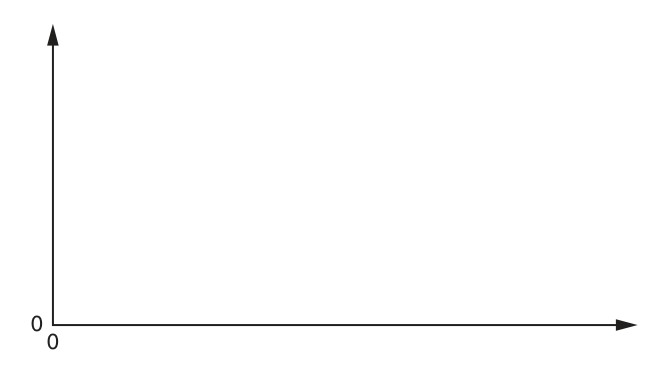
Display your prediction in the form of a sketch graph below, clearly labelling the axes.
Answer
Sketch graph with rate of effusion on y-axis and on x-axis, showing a decreasing curve that does not touch either axis.
Background Concept
When sketching a graph to represent a relationship between two variables, the independent variable goes on the x-axis and the dependent variable goes on the y-axis. The shape of the curve must reflect the mathematical or physical relationship. For effusion, Graham's Law states that the rate of effusion is inversely proportional to the square root of (). This produces a hyperbolic-like curve that decreases rapidly at first and then levels off, approaching the x-axis asymptotically but never touching it.
Understanding the Question
Part (a)(ii) asks you to display the prediction from (a)(i) as a sketch graph on the provided blank axes. You must label the axes correctly and draw a curve that matches the prediction (rate decreases as increases).
Approach
- Identify the axes: is the independent variable (x-axis), rate of effusion is the dependent variable (y-axis).
- Draw a curve that starts high on the y-axis (for low ) and decreases towards the x-axis as increases.
- Ensure the curve does not touch either axis (since neither rate nor can be zero in this context) and does not start vertical or have a positive gradient anywhere.
Step-by-Step Reasoning
- X-axis label: (or relative molecular mass).
- Y-axis label: rate of effusion (or , or volume/time).
- Curve shape: A smooth, decreasing curve. It should look like . It must not be a straight line with a positive gradient, nor should it start vertically (infinite gradient at x=0 is not physically realistic for this sketch, and the curve should not touch the y-axis). It should not touch the x-axis either, as rate never truly reaches zero for a finite .
Key Takeaways
- Always label axes with the quantity and, if possible, the unit or symbol.
- Sketch graphs must reflect the correct qualitative shape (increasing/decreasing, asymptotic behaviour).
Common Mistakes
- Swapping the axes (putting rate on x and on y).
- Drawing a straight line with a negative gradient that touches the x-axis (implies rate becomes zero at a finite , which is incorrect).
- Drawing a curve that starts vertically on the y-axis (implies infinite rate at ).
Things to Be Careful About
- The mark scheme explicitly rejects curves that start vertical, show a positive gradient at any stage, or touch either axis. Ensure your sketch is a smooth, strictly decreasing curve in the first quadrant.
In the experiment you are about to plan, identify the following.
the independent variable ..........................................................................................
Answer
independent variable: (relative molecular mass) of the gas
(relative molecular mass) of the gas
Background Concept
In any experiment, the independent variable is the factor that the experimenter deliberately changes or controls to observe its effect on another variable. The dependent variable is the factor that is measured or observed in response to changes in the independent variable.
Understanding the Question
Part (b) asks you to identify the independent and dependent variables in the planned experiment to investigate how the rate of effusion depends on the of a gas.
Approach
Read the aim of the experiment: "investigate how the rate of effusion depends on the relative molecular mass, , of a gas." The variable being changed (by selecting different gases) is . The variable being measured is the rate of effusion.
Step-by-Step Reasoning
- The experiment tests the effect of on the rate of effusion.
- Therefore, is the independent variable.
- The rate of effusion (or time taken for a fixed volume to effuse) is the dependent variable.
Key Takeaways
- The independent variable is what you change; the dependent variable is what you measure.
- In this case, you change the gas (which changes its ), so is independent.
Common Mistakes
- Confusing independent and dependent variables.
- Stating "type of gas" as the independent variable instead of . While you change the gas, the scientific variable being investigated is its .
Things to Be Careful About
- Be precise: write "" or "relative molecular mass", not just "gas type".
the dependent variable .............................................................................................
Answer
dependent variable: rate of effusion (or time taken for a fixed volume of gas to effuse)
rate of effusion (or time taken for a fixed volume of gas to effuse)
Background Concept
The dependent variable is the outcome being measured. It "depends" on the independent variable. In kinetics and effusion experiments, we often measure either the time taken for a fixed volume to escape, or the volume that escapes in a fixed time, to calculate the rate.
Understanding the Question
Part (b)(ii) asks for the dependent variable in the effusion experiment.
Approach
The aim is to find how the rate of effusion depends on . Therefore, the rate of effusion is the dependent variable. Practically, this is measured by recording a time or a volume.
Step-by-Step Reasoning
- The experiment measures how fast gas escapes.
- This is the rate of effusion.
- Practically, this could be recorded as the time taken for the syringe piston to fall from one mark to another (e.g., 100 cm³ to 50 cm³), or the volume effused in a fixed time.
- State: "rate of effusion" or "time for effusion of a fixed volume".
Key Takeaways
- The dependent variable is what you measure to test the hypothesis.
- In practice, you might measure time or volume, but the conceptual dependent variable is the rate.
Common Mistakes
- Writing "volume" or "time" alone without context. The dependent variable is the rate, which is derived from volume and time.
Things to Be Careful About
- Acceptable answers include "rate of effusion" or "time taken for a fixed volume to effuse". Be specific.
Using the apparatus shown below design a laboratory experiment to test your prediction in (a).
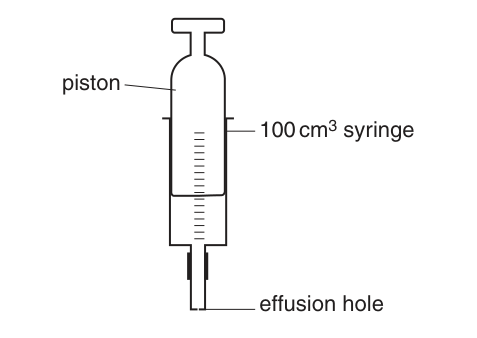
In addition to the standard apparatus present in a laboratory you are provided with the following materials,
- access to samples of the following gases; hydrogen, oxygen, carbon dioxide, butane and chlorine,
- a stop watch/clock.
Describe how you would carry out the experiment. You should
- ensure that the volume of gas measured is the same for each experiment,
- ensure that the syringe contains only the gas under investigation,
- ensure that the syringe is used under the same conditions throughout all of the experiments,
- measure the effusion time,
- produce reliable results.
Answer
- Purge the syringe: Flush out the gas syringe with the test gas at least once before filling it, to ensure it contains only the gas under investigation (or use a vacuum pump to remove air).
- Fill the syringe: Fill the 100 cm³ syringe with the test gas. Pull the piston down slightly below the start mark (e.g., to 100 cm³) and release it so it falls freely under its own weight.
- Measure time: Use the stop watch to measure the time taken for the piston to fall a fixed distance (e.g., from 100 cm³ to 50 cm³), ensuring the same volume is measured for each experiment.
- Control temperature: Carry out all experiments at the same constant temperature (e.g., in a thermostat-controlled room or water bath).
- Control orientation: Ensure the syringe is held vertical (or at the same angle) throughout all experiments to ensure consistent gravitational effects on the piston.
- Repeat: Repeat the measurement for each gas at least three times and calculate a mean effusion time to obtain reliable results and identify anomalies.
See working for method covering purging, free piston descent, fixed volume measurement, constant temperature, vertical orientation, and repeats.
Background Concept
Effusion experiments require careful control of variables to ensure that the rate of effusion depends only on the molecular mass of the gas. According to Graham's Law and kinetic theory, rate depends on temperature and molecular speed. Therefore, temperature must be kept constant. The apparatus (a gas syringe with a tiny hole) relies on the pressure difference and gravity to move the piston. To ensure consistent conditions, the syringe must be oriented the same way, and the piston must move freely (not pushed).
Understanding the Question
Part (c) asks you to describe a laboratory experiment using a 100 cm³ gas syringe with an effusion hole, a stopwatch, and five gases (H₂, O₂, CO₂, butane, Cl₂). You must address: ensuring pure gas, same volume measured, same conditions, measuring time, and reliability.
Approach
Break down the requirements from the question prompt and match them to mark scheme points:
- Pure gas: Flush/purge the syringe.
- Same conditions: Constant temperature, same orientation (vertical).
- Same volume / measure time: Start piston above a mark, let it fall freely, time the descent between two marks.
- Reliability: Repeat and average.
Step-by-Step Reasoning
- Ensure only the gas under investigation: Before filling the syringe with the test gas, flush it out with the test gas at least once to displace any air. Alternatively, use a vacuum pump. This earns the mark for purity.
- Ensure constant speed / free movement: Do not push the piston down to the start mark. Instead, pull it down slightly above the start volume (e.g., pull to 100 cm³ if starting at 90 cm³) and release it. This ensures the piston descends freely under its own weight and the pressure of the gas, giving a constant speed throughout the measurement. If you push it to the mark, the initial push might affect the initial rate.
- Ensure same volume measured: Measure the time taken for the piston to fall between two fixed volume marks (e.g., from 100 cm³ to 50 cm³). This ensures the volume of gas effused is the same for all experiments. (Alternatively, measure the volume effused in a fixed time, but fixing volume and timing is more common with syringes).
- Ensure same conditions (temperature): Gas effusion rate is highly temperature-dependent (). State that all experiments must be carried out at the same constant temperature.
- Ensure same conditions (orientation): The syringe must be held vertical (or at a consistent angle) throughout. If tilted, the weight of the piston and friction against the barrel will change, affecting the descent rate.
- Produce reliable results: Repeat the time measurement for each gas at least three times. Calculate a mean effusion time and discard any anomalous results. This improves reliability and precision.
Key Takeaways
- In gas syringe experiments, purging is essential to avoid air contamination.
- Letting the piston fall freely from above the start mark ensures consistent initial conditions and avoids人为 (manual) interference.
- Temperature and orientation are critical control variables in effusion/kinetics experiments.
Common Mistakes
- Saying "push the piston to the start mark" — this is wrong; it should be released from above to fall freely.
- Forgetting to mention temperature control.
- Not specifying that the syringe must be vertical.
- Writing "do the experiment twice" — you need to repeat to get a mean and check for anomalies.
Things to Be Careful About
- The mark scheme specifically rewards: flushing the syringe, starting above the start volume for free movement, using the same volume (or same two marks), constant temperature, vertical orientation, and repeats. Hit all six points for full marks.
- Do not just say "use the same conditions"; specify which conditions (temperature, orientation).
State a hazard that must be considered when planning the experiment and describe precautions that should be taken to keep risks to a minimum.
Answer
Hazard: Hydrogen (or butane) is flammable/explosive, or chlorine is poisonous/toxic.
Precaution: Keep away from naked flames/sparks (if using H₂/butane), or carry out the experiment in a fume cupboard / wear a gas mask (if using Cl₂). The precaution must match the named gas.
(Example: Hazard: Chlorine is poisonous. Precaution: Carry out the experiment in a fume cupboard to prevent inhalation of toxic gas.)
Hazard: flammability of H₂/butane or toxicity of Cl₂. Precaution: keep away from flames or use a fume cupboard/gas mask accordingly.
Background Concept
When planning experiments involving gases, especially in a school or teaching laboratory, risk assessment is a critical part of the planning process. Common hazards with gases include flammability (e.g., hydrogen, butane, methane) and toxicity (e.g., chlorine, hydrogen chloride, sulfur dioxide). Precautions must directly address the specific hazard identified.
Understanding the Question
Part (d) asks you to state a hazard from the five gases provided (hydrogen, oxygen, carbon dioxide, butane, chlorine) and describe a precaution to minimize the risk. The mark scheme emphasizes that the hazard and precaution must be linked to a named gas.
Approach
- Choose a gas with a clear, significant hazard: hydrogen (flammable/explosive), butane (flammable/explosive), or chlorine (toxic/poisonous). Oxygen is an oxidant but not typically the primary hazard here; CO₂ is an asphyxiant but less critical in small quantities.
- State the hazard clearly (flammable, explosive, poisonous).
- State the precaution (no naked flames, fume cupboard, gas mask).
- Ensure the precaution matches the hazard.
Step-by-Step Reasoning
- Option 1 (Hydrogen/Butane):
- Hazard: Hydrogen (and butane) is highly flammable and can form explosive mixtures with air.
- Precaution: Ensure there are no naked flames, hot surfaces, or sparks in the vicinity. Work in a well-ventilated area to prevent accumulation of gas.
- Option 2 (Chlorine):
- Hazard: Chlorine gas is poisonous (toxic) and can cause severe respiratory damage if inhaled.
- Precaution: Carry out the experiment in a fume cupboard to extract toxic fumes, or wear an appropriate gas mask/respirator if handling outside a fume cupboard. Handle in a well-ventilated area.
Note: The mark scheme explicitly states that if a candidate only says "some gases are poisonous" without naming one, and then suggests a fume cupboard, they get no marks. The gas MUST be named.
Key Takeaways
- Always name the specific substance when stating a hazard.
- Precautions must be specific and appropriate to the named hazard (e.g., "no flames" for flammability, "fume cupboard" for toxicity).
- General statements like "be careful" or "wear gloves" (not relevant for inhalation hazards) do not score.
Common Mistakes
- Naming a gas that doesn't have a major hazard in this context (e.g., saying CO₂ is poisonous — it's an asphyxiant, but not typically the expected answer here).
- Stating "oxygen is flammable" — oxygen supports combustion but is not itself flammable.
- Giving a precaution that doesn't match the hazard (e.g., hazard: hydrogen is flammable; precaution: wear a gas mask. While not dangerous, it doesn't address the fire risk).
- Not naming the gas at all (e.g., "gases are dangerous; use a fume cupboard").
Things to Be Careful About
- The mark scheme requires the gas to be named for the hazard mark. The precaution mark is conditional on the gas being named correctly.
- Acceptable hazards: flammability/explosiveness of H₂ or butane; poisonous nature of Cl₂.
- Acceptable precautions: keep away from flames/naked sparks (for H₂/butane); use a fume cupboard or gas mask (for Cl₂).
Draw a table with appropriate headings to show the data you would record when carrying out your experiments and the values you would calculate in order to construct a graph to support or reject your prediction in (a). The headings must include the appropriate units. Ensure that the table covers all the detail relating to the five gases listed in (c).
Answer
| Gas / Formula | Effusion time / s | Rate of effusion / (cm³ s⁻¹) | |
|---|---|---|---|
| Hydrogen () | 2.0 | ||
| Oxygen () | 32.0 | ||
| Carbon dioxide () | 44.0 | ||
| Butane () | 58.0 | ||
| Chlorine () | 71.0 |
Note: The table could alternatively record 'Volume effused / cm³' for a fixed time, and calculate 'Rate / (cm³ s⁻¹)' or 'Time / s' for a fixed volume. The units must be consistent.
Table with columns: Gas/Formula, , Effusion time/s, Rate of effusion/(cm³ s⁻¹), and rows for all 5 gases with correct values.
Background Concept
A well-designed data table for an experiment must include:
- Headings: Clearly stating what is being measured or calculated, including units.
- Columns/Rows: Covering all variables (independent, dependent, and derived).
- Data to be recorded: Raw measurements (e.g., time, volume).
- Data to be calculated: Derived quantities (e.g., rate, mean).
For this experiment, the independent variable is , and the dependent variable is the rate of effusion. The rate is calculated from raw measurements of volume and time.
Understanding the Question
Part (e) asks for a table to record data for the five gases (H₂, O₂, CO₂, butane, Cl₂) and the values to calculate to construct a graph. The table must include appropriate units and cover all five gases. values are given: H=1.0, C=12.0, O=16.0, Cl=35.5.
Approach
- Calculate the for each gas using the given values.
- Decide on the raw measurement: time for a fixed volume (e.g., 50 cm³) to effuse, or volume effused in a fixed time. The mark scheme accepts either, but fixing volume and timing is standard for syringes.
- Calculate the rate of effusion: (in cm³ s⁻¹) or use if volume is constant.
- Structure the table with columns for Gas/Formula, , raw data (time), and calculated data (rate).
Step-by-Step Reasoning
-
Calculate values:
- Hydrogen ():
- Oxygen ():
- Carbon dioxide ():
- Butane ():
- Chlorine ():
-
Table structure:
- Column 1: Gas name and formula (e.g., Hydrogen, ).
- Column 2: (no units, as it is a relative mass).
- Column 3: Raw data — Effusion time (s). If repeating, include sub-columns for repeats 1, 2, 3 and a mean time column.
- Column 4: Calculated data — Rate of effusion. If a fixed volume (e.g., 50 cm³) was used, rate . Unit: cm³ s⁻¹.
-
Units:
- Time: seconds (s)
- Rate: cm³ s⁻¹ (or m³ s⁻¹, but cm³ is consistent with the 100 cm³ syringe)
- : unitless
-
Alternative method: If measuring volume effused in a fixed time (e.g., 60 s), the columns would be: Gas, , Volume effused (cm³), Rate (cm³ s⁻¹). The mark scheme accepts this variation.
Key Takeaways
- Always calculate correctly using the given values.
- Include units in column headings, not in every cell.
- Raw data and calculated data should be in separate columns.
- Repeats and means improve the table's utility for reliability.
Common Mistakes
- Calculating incorrectly (e.g., forgetting to multiply by the number of atoms, like instead of ).
- Forgetting units in the column headings (e.g., writing "Time" instead of "Time / s").
- Not including all five gases in the table.
- Writing "rate" without defining how it's calculated or giving it units.
- Including units inside the data cells instead of the heading.
Things to Be Careful About
- The mark scheme awards 2 marks for all five correct gases/formulae, correct s, effusion time (or volume), rate of effusion, and relevant units.
- If an incorrect formula is given, ecf (error carried forward) is allowed for .
- Ensure the table is clear, with headings at the top and rows for each gas. Sub-columns for repeats (e.g., Time 1, Time 2, Time 3, Mean Time) are excellent practice and show understanding of reliability.
The rest of this paper
1 more questions- Q2Analysis, Conclusions and Evaluation15M