Chemistry 9701/51 — May/June 2011
Cambridge A-Level · Planning, Analysis and Evaluation · worked solutions for every part, with the mark scheme
Topics Analysis, Conclusions and Evaluation · Planning
The carbonates of group II in the periodic table decompose on heating forming an oxide and carbon dioxide.
X is any group II cation (e.g. )
This decomposition occurs because the positively charged cations polarise (distort) the C—O bond in the carbonate ion causing the ion to break up. The charge density of the group II cations decreases down the group. This affects the decomposition rate.
You are to plan an experiment to investigate how the rate of decomposition of a group II carbonate varies as the group is descended. The rate can be conveniently measured by finding the time taken to produce the same volume of carbon dioxide from each carbonate.
Predict how the rate of decomposition of the group II carbonates will change as the group is descended.
Explain this prediction in terms of the charge density of the cation as the group is descended.
prediction ..................................................................................................................
explanation ...............................................................................................................
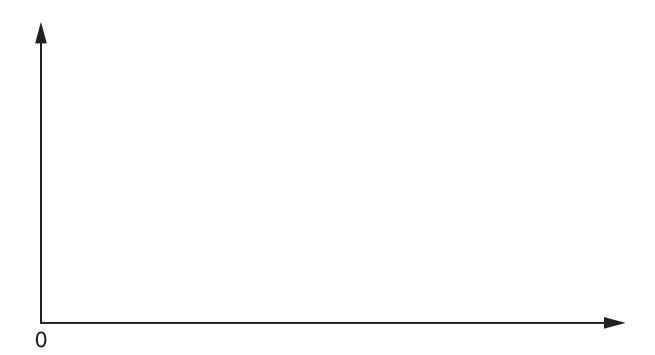
Display your prediction in the form of a sketch graph, clearly labelling the axes.
In the experiment you are about to plan, identify the following.
the independent variable ..........................................................................................
the dependent variable .............................................................................................
Draw a diagram of the apparatus and experimental set up you would use to carry out this experiment. Your apparatus should use only standard items found in a school or college laboratory and show clearly the following.
the apparatus used to heat the carbonate
how the carbon dioxide will be collected
Label each piece of apparatus used, indicating its size or capacity.
Using the apparatus shown in (c) design a laboratory experiment to test your prediction in (a).
In addition to the standard apparatus present in a laboratory you are provided with the following materials,
samples of the carbonates of magnesium, calcium, strontium and barium,
a stop-watch/clock with second hand.
Give a step-by-step description of how you would carry out the experiment by stating
the gas volume you would collect from each carbonate,
how you would calculate the mass of each carbonate to ensure that this volume of carbon dioxide is produced,
how you would control the factors in the heating so that different carbonates can be compared.
State a hazard that must be considered when planning the experiment and describe precautions that should be taken to keep risks to a minimum.
Draw a table with appropriate headings to show the data you would record when carrying out your experiments and the values you would calculate in order to construct a graph to support or reject your prediction in (a). The headings must include the appropriate units.
This simple experiment is likely to produce only approximate results.
Suggest an improvement to your apparatus or an alternative apparatus that may improve the reliability of the results.
The rest of this paper
1 more questions- Q2Analysis, Conclusions and Evaluation14M