Chemistry 9701/43 — May/June 2011
Cambridge A-Level · A Level Structured Questions · worked solutions for every part, with the mark scheme
Topics Electrochemistry · Nitrogen Compounds · Transition Elements · Introduction to A Level Organic Chemistry · Hydroxy Compounds · Equilibria · +7 more
Section A
Answer all questions in the spaces provided.
Hydrogen fluoride, HF, behaves as a weak acid in water, with .
Calculate the pH of a solution of HF.
Gaseous ammonia and hydrogen fluoride react together to give solid ionic ammonium fluoride.
What type of reaction is this?
Draw dot-and-cross diagrams (outer shells only) describing the bonding in the three compounds involved in this reaction.
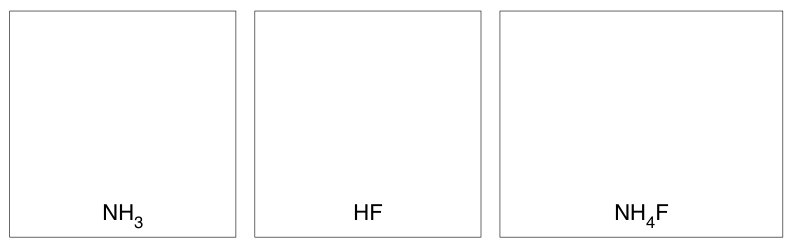
There are three types of bonding in .
Give the names of each of the three types, and state where in the compound each type occurs.
The reaction between and is reversible. What conditions of temperature and pressure would favour the reverse reaction, i.e. the dissociation of ? Explain your answer.
Many commercial copper and brass polishes contain ammonia. The tarnish that forms on the surface of copper is often copper sulfide, CuS. In the presence of from the air, can combine with this copper sulfide to produce the soluble cuprammonium sulfate, .
Construct an equation for this reaction.
State the colour of cuprammonium sulfate solution.
Describe what you would see if a solution of cuprammonium sulfate was diluted with water. Explain your answer.
When sulfuric acid is added to , no colour change occurs, but when concentrated hydrochloric acid is added to , the solution turns yellow-green. The solution reverts to its original colour when it is diluted with water.
Suggest the type of reaction occurring with , suggest what is formed during the reaction, and write an equation for the change.
The rest of this paper
7 more questions- Q2Group 2 · Hydrocarbons · Electrochemistry10M
- Q3Electrochemistry15M
- Q4Polymerisation · Carboxylic Acids and Derivatives · Introduction to A Level Organic Chemistry · Hydroxy Compounds15M
- Q5Hydroxy Compounds · Organic Synthesis13M
- Q6Nitrogen Compounds · Reaction Kinetics10M
- Q7Analytical Techniques10M
- Q8Transition Elements · Introduction to A Level Organic Chemistry · Electrochemistry10M