Chemistry 9701/51 — October/November 2010
Cambridge A-Level · Planning, Analysis and Evaluation · worked solutions for every part, with the mark scheme
Topics Analysis, Conclusions and Evaluation · Planning
When aqueous sodium chloride, , is added to aqueous lead nitrate, , a white precipitate of lead chloride, , is produced. A suggested stoichiometric equation is
In separate experiments, different volumes of aqueous sodium chloride are added to a fixed volume of aqueous lead nitrate. In each case, the precipitate is filtered, washed with distilled water and thoroughly dried. The mass of the precipitate is recorded.
You are to plan an experiment to investigate this reaction in order to confirm or reject the stoichiometry of the equation.
By considering the suggested stoichiometric equation, predict and explain how the number of moles of the precipitate, , will change as the number of moles of added increases.
Prediction
Explanation
State a limiting factor that must be taken into account when increasing the volume of the aqueous sodium chloride added.
Sketch the graph which would result if, after some of the experiments, the is in excess. Start your graph with no added.
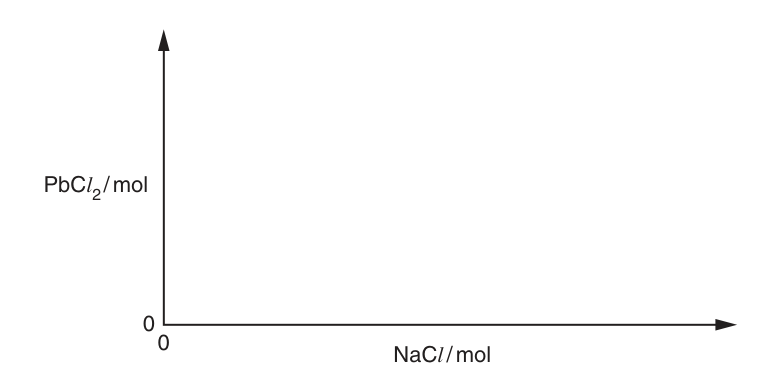
In the experiment you are about to plan, identify the following.
the independent variable
the dependent variable
another variable to be controlled
Design a laboratory experiment to test your prediction in (a).
You are provided with of aqueous sodium chloride.
Outline how you would prepare of aqueous lead nitrate.
[: N, 14; O, 16; Pb, 207]
Give a step by step description of how you would carry out one experiment.
You should state:
- the volumes of each solution to be used,
- how the volumes will be measured,
- how you would dry the precipitate.
In the table below:
- enter appropriate headings to show additional data you would record when carrying out your experiments and the values you would calculate in order to construct a graph to support or reject your prediction in (a). The headings should include the appropriate units,
- enter the volumes from your plan in (d),
- enter suitable volumes for four further experiments.

How would you ensure that at the end of each experiment the precipitate was thoroughly dried?
The rest of this paper
1 more questions- Q2Analysis, Conclusions and Evaluation14M