Chemistry 9701/52 — May/June 2010
Cambridge A-Level · Planning, Analysis and Evaluation · worked solutions for every part, with the mark scheme
Topics Analysis, Conclusions and Evaluation · Planning
At any temperature, equilibrium can be established between a liquid X and the vapour given off by that liquid.
As the temperature of the system is raised, so the pressure exerted by the vapour increases. When the vapour pressure becomes equal to the surrounding (ambient) air pressure, the liquid boils.
When the liquid contains a dissolved solid (solute), the vapour pressure above the liquid is reduced.
You are to plan an experiment to investigate how the boiling point of an aqueous solution of potassium chloride depends on the concentration of the solution.
By considering how the vapour pressure changes as the concentration of the aqueous potassium chloride increases, predict and explain how the boiling point of the solution will be affected by the concentration of the solution.
Predict how the boiling point will change ..................................................................
Explanation ..............................................................................................................
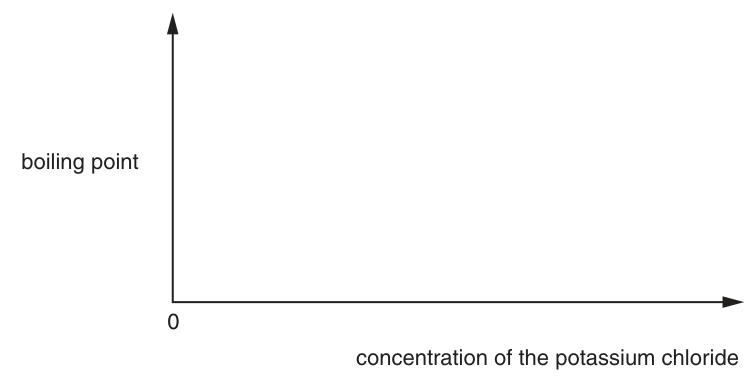
Display your prediction in the form of a sketch graph, labelling clearly the point representing the boiling point of pure water and its value.
In the experiment you are about to plan, identify the following.
the independent variable ..........................................................................................
the dependent variable .............................................................................................
Draw a diagram of the apparatus you would use in the experiment. Your apparatus should use only standard items found in a school or college laboratory and should show clearly
Label each piece of apparatus used, indicating its size or capacity and the temperature range that the thermometer should cover.
(i) how the solution will be heated and over-heating of the solution prevented,
(ii) how the thermometer will be positioned. Remember you are investigating an equilibrium.
When investigating how the boiling point of a solution changes with concentration, it is convenient to represent the concentrations of the solute as a molality.
The molality of a solution is defined as the number of moles of a solute dissolved in one kilogram of water e.g. a one molal solution has one mole of solute dissolved in one kilogram of water.
In addition to the standard apparatus present in a laboratory you are provided with the following materials.
- 100 g of distilled/deionised water (you should take particular note of this limited supply of water)
- solid potassium chloride, KCl
Give a step-by-step description of how you would
(i) prepare a series of solutions of potassium chloride that can be used in the apparatus you have shown in (c) to give sufficient data to plot a graph as in (a)(ii),
(ii) show how you would calculate the molality of one of these solutions.
[: K, 39.1; Cl, 35.5]
State a hazard that must be considered when planning the experiment.
State a limiting factor that must be taken into account when increasing the concentration of the aqueous potassium chloride.
Draw up a table with appropriate headings to show the data you would record when carrying out your experiments and the values you would calculate in order to construct a graph to support or reject your prediction in (a). The headings should include the appropriate units.
The rest of this paper
1 more questions- Q2Analysis, Conclusions and Evaluation · Planning15M