Chemistry 9701/51 — May/June 2010
Cambridge A-Level · Planning, Analysis and Evaluation · worked solutions for every part, with the mark scheme
Topics Analysis, Conclusions and Evaluation · Planning
The neutralisation of an acid by a base is exothermic.
In this experiment the following solutions are available.
The equation for the reaction is:
is gradually added to a fixed volume of in a plastic cup, while stirring continuously. The temperature of the solution, measured with a thermometer, increases until the alkali is just neutralised. On further addition of the cold acid the temperature of the solution slowly falls.
Select an appropriate volume, , of to use in the experiment.
Calculate the volume of that will just neutralise of NaOH.
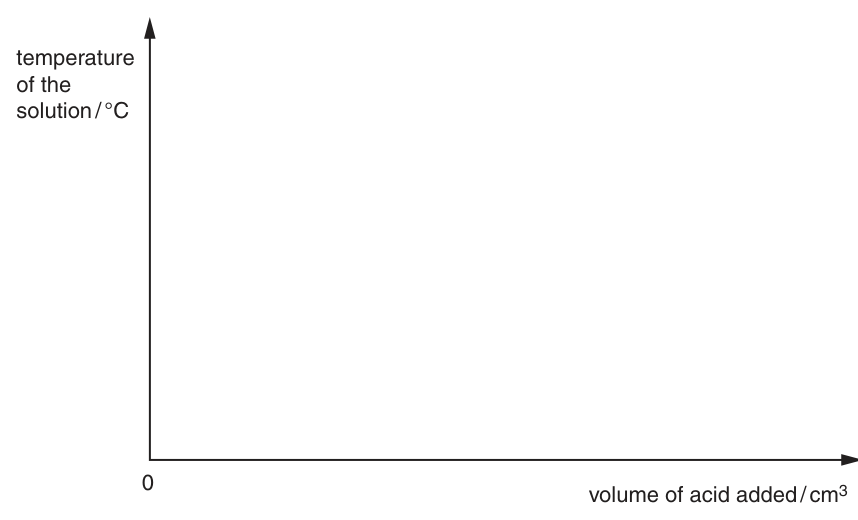
Sketch the graph you would expect to obtain as the acid is added. Label the neutralisation point.
Answer
Volume of NaOH = 50 cm³
Moles of NaOH =
From the equation , the mole ratio is 2:1.
Moles of H₂SO₄ =
Volume of H₂SO₄ =
Graph
The graph should show temperature on the y-axis and volume of acid added on the x-axis.
- The curve starts at the initial temperature of the NaOH.
- It rises linearly (or in a curve) to a maximum temperature at 37.5 cm³.
- After 37.5 cm³, it falls linearly (or in a curve) as excess cold acid is added.
- The neutralisation point is marked at the maximum temperature (37.5 cm³, max temp).
Volume of NaOH = 50 cm³; Volume of H₂SO₄ = 37.5 cm³; Graph peaks at 37.5 cm³
Background Concept
In an exothermic neutralisation reaction, the temperature of the mixture increases as the acid and base react. Once one of the reactants is completely used up (the equivalence point or neutralisation point), no more heat is produced. Any further addition of the other reactant (which is typically at room temperature and cooler than the hot mixture) will cause the overall temperature of the solution to decrease. Plotting temperature against the volume of titrant added yields a characteristic graph with a distinct peak.
Understanding the Question
The question asks you to design the quantitative basis for a calorimetry experiment. You must choose a starting volume of NaOH, calculate the exact volume of H₂SO₄ needed to neutralise it using stoichiometry, and sketch the expected temperature-volume graph, clearly marking the neutralisation point.
Approach
- Choose a volume of NaOH between 10 and 80 cm³. A round number like 50 cm³ is practical and easy to measure.
- Use the given concentrations and the balanced equation to find the moles of NaOH, then the moles of H₂SO₄ required, and finally the volume of H₂SO₄.
- Sketch the graph: rising temperature up to the calculated volume, then falling temperature afterwards. Mark the peak.
Step-by-Step Reasoning
- Selecting the volume: The mark scheme allows any volume between 10 and 80 cm³. Let's select of NaOH.
- Calculating the acid volume:
- Moles of NaOH = concentration × volume = .
- The balanced equation is . The stoichiometric ratio of NaOH to H₂SO₄ is 2:1.
- Moles of H₂SO₄ needed = .
- Volume of H₂SO₄ = .
- Alternatively, using the ratio directly: Volume of H₂SO₄ = .
- Sketching the graph:
- Axes: y-axis is 'temperature of the solution / °C', x-axis is 'volume of acid added / cm³'.
- Shape: Start at an initial temperature (e.g., 20°C). Draw a line going up to the point (37.5, max temp). Then draw a line going down from that peak. Straight lines or curves are both acceptable.
- Label: Mark the peak of the graph and label it 'neutralisation point' or indicate that it occurs at 37.5 cm³.
Key Takeaways
- Always choose a volume that is easy to measure and leaves room for the titrant volume to be reasonable.
- The peak of a temperature vs. volume graph in a neutralisation experiment indicates the exact stoichiometric equivalence point.
- After the equivalence point, the temperature drops because excess reactant is added at a lower temperature, cooling the mixture.
Common Mistakes
- Choosing a volume of NaOH outside the 10-80 cm³ range.
- Forgetting to use the 2:1 mole ratio from the balanced equation and assuming a 1:1 ratio.
- Sketching a graph that plateaus instead of peaking, or failing to mark the neutralisation point.
- Drawing the temperature continuing to rise after the neutralisation point.
Things to Be Careful About
- Ensure the volume units are consistent (convert cm³ to dm³ when using ).
- The graph must clearly show the maximum temperature and link it to the calculated volume of acid.
This experiment can be used to determine the enthalpy change of neutralisation for the reaction. To ensure reliable results the experiment should be repeated a number of times.
When sulfuric acid is added to the fixed volume of aqueous sodium hydroxide in this experiment:
the independent variable is ..................................................................................... ,
Answer
The independent variable is the volume of acid added.
volume of acid added
Background Concept
In any experiment, the independent variable is the factor that the experimenter deliberately changes or controls to observe its effect on another variable. The dependent variable is the factor that is measured or observed in response to changes in the independent variable.
Understanding the Question
The experiment involves gradually adding sulfuric acid to a fixed volume of sodium hydroxide and measuring the temperature. We need to identify which variable is being manipulated by the experimenter.
Approach
Identify what is being changed on purpose. The text states ' is gradually added'. Therefore, the volume of acid is the independent variable.
Step-by-Step Reasoning
- The experimenter controls how much acid is added to the base.
- This is measured and recorded as the x-axis variable in the experiment.
- Thus, the independent variable is the volume of acid added.
the dependent variable is ........................................................................................ ,
Answer
The dependent variable is the temperature (or temperature increase / temperature change) of the solution.
temperature of the solution
Background Concept
The dependent variable is the outcome being measured. It 'depends' on the changes made to the independent variable.
Understanding the Question
As the acid is added, the experimenter is measuring the temperature of the solution to find the neutralisation point.
Approach
Identify what is being measured. The text states 'The temperature of the solution, measured with a thermometer, increases...'.
Step-by-Step Reasoning
- The temperature changes in response to the amount of acid added.
- It is the data being recorded.
- Thus, the dependent variable is the temperature (or the temperature change, ).
the other variables that need to be controlled are .....................................................
................................................................................................................................ .
Answer
Controlled variables include:
- The volume and concentration of NaOH (already fixed in the procedure).
- The type of container used (e.g., same plastic cup) to control heat loss.
- The initial temperatures of both the acid and the base before mixing.
- The rate of stirring.
heat loss / use of same cup / apparatus; same initial temperatures of both solutions
Background Concept
Controlled variables (or constants) are factors that could affect the dependent variable but are kept the same throughout the experiment to ensure a fair test. In calorimetry, heat loss to the surroundings is a major factor that can skew temperature readings.
Understanding the Question
We need to list variables other than the independent and dependent ones that must be kept constant to ensure the results are reliable and comparable.
Approach
Think about what could cause the temperature to change for reasons other than the neutralisation reaction, or what could cause heat loss to vary between repeats.
Step-by-Step Reasoning
- Heat loss: Different cups or different room temperatures could affect heat loss. Using the same cup and apparatus controls this.
- Initial conditions: If the acid and base start at different temperatures, the final maximum temperature will be different. They must start at the same initial temperature.
- Volumes/concentrations: The volume and concentration of the NaOH are fixed by the experimental design, so they are inherently controlled.
- Stirring: Ensures uniform temperature distribution and consistent reaction rate.
In carrying out the experiment, what apparatus would you use to accurately measure the independent variable?
.................................................................................................................................
Answer
A burette (or a pipette) should be used to accurately measure and add the acid.
burette
Background Concept
In quantitative experiments, different apparatus is used depending on the required precision. A measuring cylinder is for rough measurements, while a burette or pipette is used for accurate volumetric measurements.
Understanding the Question
The independent variable is the volume of acid added. We need an apparatus that can measure this volume accurately and allow for gradual addition.
Approach
Identify the standard laboratory equipment used for accurate, variable volume additions in titrations and calorimetry.
Step-by-Step Reasoning
- A burette allows for precise measurement of the volume added (to 0.05 cm³) and controlled, gradual addition.
- A pipette could also be used if adding in fixed, accurate portions (e.g., a 10 cm³ pipette used multiple times).
- A measuring cylinder is not accurate enough for this type of quantitative experiment.
Explain how you would use this apparatus to control the independent variable.
.........................................................................................................................................
.................................................................................................................................
Answer
The acid should be added in successive, measured volume portions (e.g., using the burette to add 5 cm³ at a time) rather than dropwise, allowing time for the temperature to stabilise after each addition.
add in successive volume portions
Background Concept
To accurately find the maximum temperature (neutralisation point), you cannot just add the acid all at once, nor can you add it dropwise (which would take too long and allow too much heat loss). You need to add it in controlled increments.
Understanding the Question
How do you use the burette/pipette to control the independent variable effectively to capture the peak temperature?
Approach
Describe the practical technique of adding the titrant in portions and recording the temperature after each portion.
Step-by-Step Reasoning
- If you add dropwise, heat loss to the surroundings will be significant, and the peak will be missed or flattened.
- If you add it all at once, you won't know the exact volume at which neutralisation occurred.
- Therefore, you add the acid in successive portions (e.g., 5 cm³ or 10 cm³ increments using the burette).
- After each addition, you stir and record the highest temperature reached before it starts to fall.
- This allows you to plot the graph and interpolate the exact volume at the peak.
Identify and assess
a risk associated with the plastic cup used in this experiment,
..................................................................................................................................
..................................................................................................................................
Answer
The plastic cup may become very hot during the exothermic reaction, posing a burn risk to the experimenter. Additionally, a plastic cup is unstable and could easily be knocked over, causing chemical spills on the person or the work surface.
getting very hot / burns; unstable / chemical spills
Background Concept
Risk assessment in chemistry involves identifying both chemical hazards (toxicity, corrosivity) and physical/apparatus hazards (breakage, heat, instability).
Understanding the Question
We need to identify risks specifically associated with using a plastic cup as the reaction vessel in an exothermic experiment.
Approach
Think about the physical properties of plastic and the conditions of the experiment (exothermic reaction, liquid in a cup).
Step-by-Step Reasoning
- Heat: The reaction is exothermic. The solution gets hot. Plastic is a poor conductor but can melt or become hot enough to cause burns if touched.
- Stability: A plastic cup is lightweight and has a wide mouth. It is easily knocked over. If it falls, hot corrosive liquid (NaOH/H₂SO₄ mixture) will spill on the experimenter or the bench.
- Note: Simply saying 'temperature increase' is not a risk; the risk is the consequence (burns, spills).
a risk associated with the .
..................................................................................................................................
..................................................................................................................................
Answer
NaOH is a concentrated alkali and is corrosive. It can cause severe chemical burns and damage to the skin and eyes.
corrosive / burns / damage to skin
Background Concept
Sodium hydroxide is a strong base. Concentrated solutions (like ) are highly corrosive and can cause rapid tissue damage (alkali burns) on contact with skin or eyes.
Understanding the Question
Identify the specific hazard associated with the chemical NaOH.
Approach
Recall the safety data for strong alkalis.
Step-by-Step Reasoning
- NaOH is not typically classified as toxic or flammable in this context.
- Its primary hazard is corrosivity.
- Contact with skin causes chemical burns. Contact with eyes can cause blindness.
- Therefore, the risk is corrosive damage to skin/eyes.
Describe how the risks in (e) can be kept to a minimum for
the plastic cup,
..................................................................................................................................
..................................................................................................................................
Answer
- To prevent spills: Place the plastic cup inside a larger beaker or clamp it securely to a retort stand.
- To prevent burns: Use tongs or a heat-resistant mat to handle the cup after the reaction, and allow it to cool before washing.
put in beaker / clamp for stability; handle hot cup carefully
Background Concept
Risk mitigation strategies should directly address the hazards identified. If the hazard is instability, add stability. If the hazard is heat, add thermal protection.
Understanding the Question
How do we prevent the plastic cup from tipping over or burning the experimenter?
Approach
Propose standard laboratory safety practices for handling unstable, hot containers.
Step-by-Step Reasoning
- Stability: A plastic cup is light. Placing it inside a heavier beaker adds stability and catches spills if the cup tips. Clamping it to a stand is even better.
- Heat: Plastic melts or conducts heat. Using tongs to move it, or placing it on a heat-resistant mat, protects the experimenter from burns.
the .
..................................................................................................................................
..................................................................................................................................
Answer
Wear appropriate Personal Protective Equipment (PPE), including:
- Safety goggles or a face shield to protect eyes from splashes.
- A lab coat or apron to protect skin and clothing.
- Gloves (e.g., nitrile) to protect hands from direct contact.
goggles / face shield; lab coat; gloves
Background Concept
PPE is the last line of defence in the hierarchy of risk control. For corrosive chemicals, eye and skin protection are essential.
Understanding the Question
How do we protect ourselves from corrosive NaOH?
Approach
List standard PPE for handling corrosive liquids.
Step-by-Step Reasoning
- Eyes: Splashes are the biggest danger. Safety goggles or a face shield are mandatory.
- Skin/Clothing: A lab coat or apron prevents the chemical from reaching skin or ruining clothes.
- Hands: Gloves provide a barrier against direct contact. (Note: standard latex gloves may not be sufficient for concentrated NaOH; nitrile is better, but 'gloves' is generally accepted at this level).
In the space below draw a table to show column headings for all of the measurements you would make during the experiment.
Include in the table one or more columns for any calculated values needed to determine the enthalpy change of neutralisation.
Answer
| Repeat | Volume of H₂SO₄ added / cm³ | Initial temperature / °C | Final temperature / °C | Temperature change, / °C |
|---|---|---|---|---|
| 1 | 5.0 | |||
| 1 | 10.0 | |||
| ... | ... | |||
| 1 | 37.5 | |||
| 2 | 5.0 | |||
| ... | ... |
(Note: The table must show volume of acid added, initial temperature, final temperature, and temperature change, all with units. Repeats should be indicated.)
Table with columns for volume of acid, initial temp, final temp, and temp change, all with units
Background Concept
A good data table organises raw measurements and calculated values logically. It must include column headings with quantities and units, consistent decimal places, and provisions for repeats to allow calculation of a mean.
Understanding the Question
Draw a table to record all measurements needed to determine the enthalpy change of neutralisation.
Approach
Identify the raw data (volumes, temperatures) and the calculated data (temperature change) needed. Structure it for multiple repeats.
Step-by-Step Reasoning
- Raw data: We need to record the volume of acid added (in portions) and the temperature of the solution after each addition.
- Initial temperature: We need the starting temperature of the NaOH before any acid is added (at 0 cm³ acid).
- Calculated data: The temperature change, (or max temp - initial temp), is needed for the heat calculation .
- Repeats: The experiment should be repeated at least 3 times to identify anomalies and calculate a mean .
- Units: Every column heading must include the unit (e.g., 'Volume of H₂SO₄ added / cm³').
- Alternative layout: A separate column for 'Initial temperature' if it's assumed constant, or recording it for each repeat.
Key Takeaways
- Always include units in column headings.
- Include columns for raw data and derived data.
- Structure the table to clearly show repeats.
Show how you would calculate the total heat energy produced in the plastic cup up to the point when the sulfuric acid has just neutralised the sodium hydroxide.
You may use to represent the temperature change.
[ of heat energy raise the temperature of of any solution by .]
Working
The total volume of the solution is the sum of the volumes of NaOH and H₂SO₄ at the neutralisation point.
Total volume = Volume of NaOH + Volume of H₂SO₄
Using the values from part (a):
Total volume =
The heat energy produced, , is calculated using the given constant ( per cm³ per °C):
Answer
Total heat energy =
(50 + 37.5) * 4.3 * ΔT
Background Concept
In simple calorimetry, the heat energy absorbed or released by the solution is calculated using the formula:
where:
- is the mass of the solution (in grams or cm³, assuming density ).
- is the specific heat capacity (in J g⁻¹ °C⁻¹ or J cm⁻³ °C⁻¹).
- is the temperature change (in °C).
The question simplifies this by giving a combined constant: raises the temperature of of solution by . This effectively gives .
Understanding the Question
Show how to calculate the total heat energy produced up to the neutralisation point, using and the values from part (a).
Approach
- Calculate the total volume of the mixture at neutralisation.
- Multiply by the given constant (4.3) and the temperature change ().
Step-by-Step Reasoning
- Total volume: At the neutralisation point, all the NaOH and the calculated volume of H₂SO₄ have been mixed. Total volume = .
- Heat energy: .
- Substitute the values: .
- The mark scheme accepts the expression with the numerical values added: .
- Units are not strictly required in the expression, but the result is in Joules (J).
The enthalpy change of neutralisation is the energy change associated with the reaction shown by the following equation.
Show how you would convert the energy change expressed in (h) into a value, in , for the enthalpy change of neutralisation, .
Show clearly the sign and the expression for the enthalpy change.
Working
The enthalpy change of neutralisation is defined per mole of water formed (or per mole of NaOH reacted in this context).
From part (a), moles of NaOH = .
Moles of H₂O formed = (from the 2:2 ratio in the main equation, or 1:1 with NaOH in the target equation).
Energy change from (h) is in Joules. Convert to kJ:
Energy in kJ =
Enthalpy change,
Since the reaction is exothermic, is negative.
Answer
sign: negative ()
expression: or
sign: -; expression: -(answer to h in kJ) / 0.15
Background Concept
The enthalpy change of neutralisation, , is the heat energy change when 1 mole of water is formed from the reaction of an acid and a base (or equivalently, 1 mole of H⁺ reacts with 1 mole of OH⁻).
where is the heat energy in Joules (or kJ) and is the number of moles of water formed (or moles of limiting reactant that determines the moles of water).
The sign of is negative for exothermic reactions (heat is released).
Understanding the Question
Convert the energy calculated in part (h) (which is in Joules) into in kJ mol⁻¹ for the given equation:
Show the sign and the expression.
Approach
- Determine the number of moles relevant to the equation (moles of NaOH or moles of H₂O).
- Convert the energy from J to kJ.
- Divide energy by moles.
- Add the negative sign because neutralisation is exothermic.
Step-by-Step Reasoning
- Moles: The target equation shows 1 mole of NaOH producing 1 mole of H₂O. In our experiment, we used of NaOH, which produces of H₂O. (Alternatively, moles of H₂SO₄ = . The equation uses mole of H₂SO₄, so moles of 'reactions' = . Same result).
- Energy conversion: The energy from (h) is in Joules. To get kJ, divide by 1000: .
- Calculation: .
- Sign: Must be explicitly stated as negative (–) because the reaction is exothermic.
Key Takeaways
- Always check the definition of the enthalpy change (per mole of what? Here, per mole of H₂O or per mole of NaOH).
- Remember to convert J to kJ by dividing by 1000.
- Exothermic reactions have a negative .
Common Mistakes
- Forgetting to convert Joules to kJ (resulting in a value 1000 times too large).
- Using the wrong number of moles (e.g., using moles of H₂SO₄ without multiplying by 2, or using total moles of ions).
- Forgetting the negative sign for an exothermic reaction.
- Using the total volume in the denominator instead of moles.
Things to Be Careful About
- The expression must clearly show the division by moles and the conversion to kJ.
- The mark scheme allows 'moles of NaOH' or 'moles of H₂O' in the denominator. Using 'moles of H₂SO₄' is only acceptable if multiplied by 2.
The rest of this paper
2 more questions- Q2Analysis, Conclusions and Evaluation9M
- Q3Analysis, Conclusions and Evaluation6M