Chemistry 9701/43 — May/June 2010
Cambridge A-Level · A Level Structured Questions · worked solutions for every part, with the mark scheme
Topics Halogen Compounds · Nitrogen Compounds · Carboxylic Acids and Derivatives · Transition Elements · Electrochemistry · Hydrocarbons · +9 more
Phenacyl chloride has been used as a component of some tear gases. Its lachrymatory and irritant properties are due to it reacting with water inside body tissues to produce hydrochloric acid.
It undergoes a nucleophilic substitution reaction with NaOH(aq).
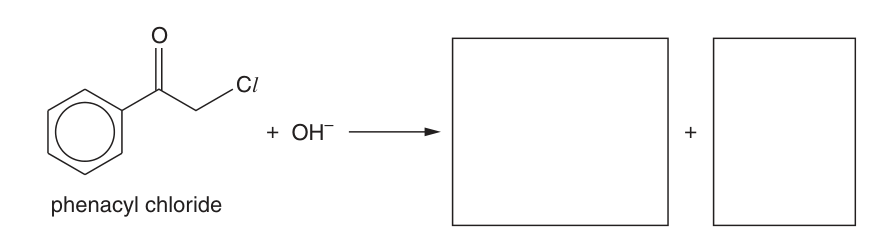
Write the formulae of the products of this reaction in the two boxes above.
When the rate of this reaction was measured at various concentrations of the two reagents, the following results were obtained.
| experiment number | [phenacyl chloride] | [NaOH] | relative rate |
|---|---|---|---|
| 1 | 0.020 | 0.10 | 1.0 |
| 2 | 0.030 | 0.10 | 1.5 |
| 3 | 0.025 | 0.20 | 2.5 |
What is meant by the term order of reaction?
Use the above data to deduce the order with respect to each reactant. Explain your reasoning.
Write the overall rate equation for the reaction.
Describe the mechanism for this reaction that is consistent with your overall rate equation.
You should show all intermediates and/or transition states and partial charges, and you should represent the movements of electron pairs by curly arrows.
Describe an experiment that would show that reacts with water at a much faster rate than phenacyl chloride. Include the reagents you would use, and the observations you would make with each chloride.
Suggest an explanation for this difference in reactivity.
The rest of this paper
7 more questions- Q2Group 2 · Chemical Energetics · Equilibria14M
- Q3Halogen Compounds · Analytical Techniques11M
- Q4Transition Elements · Electrochemistry · Hydrocarbons · Hydroxy Compounds17M
- Q5Introduction to A Level Organic Chemistry · Hydrocarbons · Organic Synthesis · Nitrogen Compounds · Halogen Compounds · Carboxylic Acids and Derivatives15M
- Q6Nitrogen Compounds10M
- Q7Nitrogen Compounds10M
- Q8Electrochemistry · Transition Elements · Polymerisation10M