Chemistry 9701/42 — May/June 2010
Cambridge A-Level · A Level Structured Questions · worked solutions for every part, with the mark scheme
Topics Carboxylic Acids and Derivatives · Nitrogen Compounds · Halogen Compounds · Chemical Energetics · Transition Elements · Electrochemistry · +7 more
Phenacyl chloride has been used as a component of some tear gases. Its lachrymatory and irritant properties are due to it reacting with water inside body tissues to produce hydrochloric acid.
It undergoes a nucleophilic substitution reaction with .
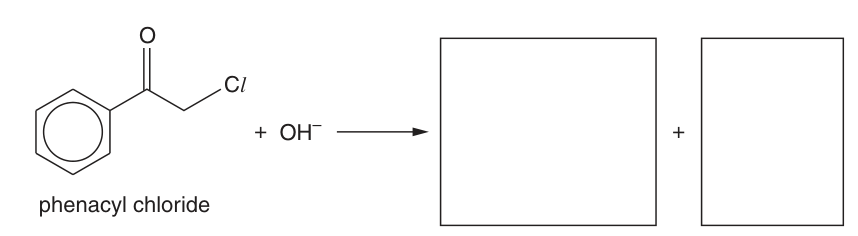
Write the formulae of the products of this reaction in the two boxes above.
Answer
Box 1: (2-hydroxy-1-phenylethanone)
Box 2: (or )
C₆H₅COCH₂OH and Cl⁻
Background Concept
Nucleophilic substitution occurs when a nucleophile attacks an electron-deficient carbon bearing a leaving group (halide ion). In phenacyl chloride (), there are two carbons that could potentially be attacked: the carbonyl carbon (which would be addition–elimination, characteristic of acyl chlorides) and the carbon bonded to Cl (which undergoes standard substitution as in a halogenoalkane). The question states it undergoes nucleophilic substitution with , and the structure shows Cl on the group, so the hydroxide ion replaces the chloride at that carbon.
Understanding the Question
The reaction scheme in Fig. 1.1 shows phenacyl chloride reacting with to give two products (indicated by the two empty boxes separated by a plus sign). The command word is "write the formulae" — the answer must be the chemical formulae of both products.
Approach
Identify the carbon bearing the leaving group (Cl on the ). The replaces Cl, giving an alcohol-type product () and a chloride ion (). The carbonyl group remains unchanged.
Step-by-Step Reasoning
- Phenacyl chloride has the structure: benzene ring – C(=O) – CH₂ – Cl.
- The nucleophilic substitution occurs at the –Cl bond (a primary halogenoalkane-type carbon).
- attacks the carbon, Cl⁻ leaves.
- Organic product: — the ketone carbonyl is unaffected, but the Cl is replaced by OH.
- Inorganic product: (or as if considering the full equation with NaOH).
Key Takeaways
- In molecules with multiple functional groups, identify which carbon bears the leaving group for substitution.
- The carbonyl group in phenacyl chloride is not the site of substitution here — it is the group that reacts.
- Always write both products in a substitution reaction.
Common Mistakes
- Attacking the carbonyl carbon instead (which would give addition–elimination, as in acyl chlorides). The Cl is on the , not directly on the C=O.
- Forgetting to include the chloride ion as the second product.
- Writing the molecular formula of the organic product incorrectly (e.g. losing the carbonyl group).
Things to Be Careful About
- The mark scheme accepts either or for the inorganic product.
- The organic product can be written as a structural formula or molecular formula ().
When the rate of this reaction was measured at various concentrations of the two reagents, the following results were obtained.
| experiment number | [phenacyl chloride] | [NaOH] | relative rate |
|---|---|---|---|
| 1 | 0.020 | 0.10 | 1.0 |
| 2 | 0.030 | 0.10 | 1.5 |
| 3 | 0.025 | 0.20 | 2.5 |
What is meant by the term order of reaction?
Answer
The order of reaction with respect to a reactant is the exponent (power) to which its concentration term is raised in the rate equation.
The exponent/power to which a concentration is raised in the rate equation
Background Concept
The rate equation expresses the relationship between the rate of a reaction and the concentrations of the reactants: rate = . The values of and are the orders with respect to A and B respectively. The overall order is . Orders are determined experimentally and are not necessarily related to the stoichiometric coefficients in the balanced equation.
Understanding the Question
The command word is "what is meant by" — this requires a precise definition. The term is "order of reaction".
Approach
State the definition clearly, referring to the rate equation and the exponent/power to which a concentration is raised.
Step-by-Step Reasoning
The order of reaction with respect to a particular reactant is the power to which its concentration is raised in the rate equation. For example, in rate = , the order with respect to A is and with respect to B is . The overall order is .
Key Takeaways
- Order is an experimental quantity, not derived from the balanced equation.
- It describes how sensitive the rate is to changes in that reactant's concentration.
Common Mistakes
- Saying "the number of molecules involved" — this confuses order with molecularity.
- Saying "the coefficient in the balanced equation" — orders are determined experimentally and often differ from stoichiometric coefficients.
Things to Be Careful About
- The definition must refer specifically to the rate equation (not the balanced equation) and to the exponent/power (not just "the concentration").
Use the above data to deduce the order with respect to each reactant. Explain your reasoning.
Answer
With respect to phenacyl chloride: Comparing experiments 1 and 2, [NaOH] is constant. [phenacyl chloride] increases by a factor of , and the rate increases by a factor of . Since rate [phenacyl chloride], the order with respect to phenacyl chloride is 1.
With respect to NaOH: Comparing experiments 1 and 3, [phenacyl chloride] changes by a factor of , and [NaOH] changes by a factor of . The rate changes by a factor of . Since , the order with respect to NaOH is 1.
First order with respect to phenacyl chloride and first order with respect to NaOH
Background Concept
The order of reaction with respect to a reactant is found by observing how the rate changes when only that reactant's concentration changes. If doubling the concentration doubles the rate, the order is 1; if it quadruples the rate, the order is 2; if the rate is unchanged, the order is 0. When two concentrations change simultaneously (as in experiments 1 and 3 here), we must account for the known order of one reactant to isolate the effect of the other.
Understanding the Question
The data table gives three experiments with different concentrations and relative rates. The command word is "deduce" and "explain your reasoning" — so both the answer and the method of obtaining it are required.
Approach
First find the order with respect to phenacyl chloride by comparing experiments where [NaOH] is constant (experiments 1 and 2). Then use that known order to deduce the order with respect to NaOH from experiments 1 and 3, where both concentrations change.
Step-by-Step Reasoning
Order w.r.t. phenacyl chloride (experiments 1 and 2):
- [NaOH] is constant at 0.10 mol dm⁻³ in both.
- [phenacyl chloride] ratio:
- Rate ratio:
- Since rate increases by the same factor as concentration, rate [phenacyl chloride] → first order.
Order w.r.t. NaOH (experiments 1 and 3):
- Both concentrations change, so we must account for the effect of phenacyl chloride.
- [phenacyl chloride] ratio:
- [NaOH] ratio:
- Rate ratio:
- Expected effect from phenacyl chloride alone (first order):
- Remaining effect:
- Therefore rate [NaOH] → first order.
Key Takeaways
- When comparing experiments where only one concentration changes, the order of that reactant can be read off directly.
- When both change, use the known order of one to 'divide out' its contribution and isolate the other.
- The mark scheme accepts reasoning from experiments 1 and 3 in a single step: , giving .
Common Mistakes
- Comparing experiments 2 and 3 directly without accounting for both concentration changes.
- Assuming the order equals the stoichiometric coefficient.
- Stating the answer without showing the reasoning (the mark scheme requires explanation).
Things to Be Careful About
- The mark scheme awards separate marks for each order, each requiring the correct reasoning.
- The reasoning must explicitly state which experiments are being compared and what is held constant (or how the changing concentration is accounted for).
Write the overall rate equation for the reaction.
Answer
rate = k[phenacyl chloride][OH⁻]
Background Concept
The rate equation combines the orders with respect to each reactant into a single expression: rate = , where is the rate constant. The overall order is the sum of the individual orders.
Understanding the Question
The command word is "write" — simply state the rate equation using the orders deduced in part (b)(ii).
Approach
Since both reactants are first order, both concentration terms appear to the power 1 (which is not written explicitly).
Step-by-Step Reasoning
From part (b)(ii): order w.r.t. phenacyl chloride = 1, order w.r.t. NaOH (i.e. OH⁻) = 1.
Therefore: rate = =
The overall order is 2 (second order reaction).
Key Takeaways
- The rate equation follows directly from the deduced orders.
- The overall order (2) tells us this is a bimolecular rate-determining step, consistent with an mechanism.
Common Mistakes
- Including the Na⁺ ion in the rate equation (the reactive species is OH⁻, not NaOH as a whole molecule).
- Forgetting to include both reactants (a common error if students assume one must be zero order).
Things to Be Careful About
- The mark scheme accepts either [NaOH] or [OH⁻] for the hydroxide term.
- Square brackets denote concentration.
Describe the mechanism for this reaction that is consistent with your overall rate equation.
You should show all intermediates and/or transition states and partial charges, and you should represent the movements of electron pairs by curly arrows.
Answer
The mechanism is (bimolecular nucleophilic substitution), consistent with the second-order rate equation:
Key features:
- on the carbon attached to Cl, on Cl
- Lone pair shown on oxygen of , with negative charge indicated
- Curly arrow from lone pair on to the carbon
- Curly arrow from the C–Cl bond to Cl (showing heterolytic fission)
- Transition state in square brackets with overall negative charge, showing partial (dashed) bonds from carbon to both OH and Cl
SN2 mechanism: OH⁻ attacks carbon via curly arrow from lone pair, C-Cl bond breaks via curly arrow to Cl, transition state shown with partial bonds in brackets with negative charge
Background Concept
The mechanism is a single-step bimolecular nucleophilic substitution. The nucleophile attacks the electrophilic carbon from the side opposite the leaving group (backside attack) while the leaving group departs simultaneously. This gives a single transition state in which the carbon is partially bonded to both the incoming nucleophile and the outgoing leaving group. Because both reactants are involved in the rate-determining step, the rate equation is second order — first order in each reactant.
The transition state is not a real intermediate (it cannot be isolated); it is the highest-energy point on the reaction coordinate. It is shown in square brackets with partial (dashed) bonds.
Understanding the Question
The command word is "describe" and the question explicitly asks to "show all intermediates and/or transition states and partial charges, and represent the movements of electron pairs by curly arrows." The mechanism must be consistent with the rate equation from part (b)(iii), which shows both reactants are first order — hence .
Approach
Draw the mechanism with:
- The substrate showing partial charges ( on C, on Cl)
- The nucleophile () with its lone pair and negative charge shown
- Curly arrow from the lone pair on O to the carbon
- Curly arrow from the C–Cl bond to Cl
- The transition state in square brackets with dashed bonds and overall negative charge
- The products: RCH₂OH and Cl⁻
Step-by-Step Reasoning
Mark 1 — Partial charges: The C–Cl bond is polarised because Cl is more electronegative than C. This gives on carbon and on chlorine, making the carbon electrophilic and susceptible to nucleophilic attack.
Mark 2 — Lone pair and charge on OH⁻: The hydroxide ion must be shown with its lone pair on oxygen (the electron source for the curly arrow) and its negative charge (indicating it is the nucleophile).
Mark 3 — Curly arrows and transition state: A curly arrow starts at the lone pair on O and ends at the carbon (showing the nucleophile donating electrons to form a new C–O bond). A second curly arrow starts at the C–Cl bond and ends at Cl (showing the bond breaking heterolytically, with both electrons going to Cl). The transition state is shown with dashed lines from C to both OH and Cl, enclosed in square brackets with an overall negative charge (since one negative charge is distributed over the system).
Alternative (SN1): If a student's rate equation had shown first order overall (only [RCl]), an mechanism would be accepted, with a curly arrow showing C–Cl bond breaking and a carbocation intermediate. However, this is not consistent with the correct rate equation here.
Key Takeaways
- The rate equation determines the mechanism: second order → (both species in the transition state).
- In , there is no intermediate — only a transition state.
- Curly arrows always start at an electron source (lone pair or bond) and end at an electron destination.
- The transition state carries the overall charge of the system (here, –1 from OH⁻).
Common Mistakes
- Drawing an mechanism with a carbocation intermediate when the rate equation clearly shows second order.
- Forgetting to show the lone pair on oxygen (the curly arrow must start from it).
- Drawing the curly arrow from the carbon to the oxygen (wrong direction — arrows follow electron flow, from nucleophile to electrophile).
- Omitting partial charges or showing full charges instead.
- Drawing the transition state without square brackets or without the overall charge.
- Using solid lines instead of dashed lines in the transition state (though the mark scheme notes "can be a solid line").
Things to Be Careful About
- The mark scheme explicitly states the transition state line "can be a solid line" — dashed or solid both accepted.
- The charge on the transition state is –1 (overall), not on individual atoms.
- The question says "ignore charge" on the transition state for the third mark, meaning the charge is not required for that specific mark but is good practice to include.
Describe an experiment that would show that reacts with water at a much faster rate than phenacyl chloride. Include the reagents you would use, and the observations you would make with each chloride.
Answer
Add both chlorides separately to aqueous silver nitrate () (or to water with a pH probe / indicator such as methyl orange).
With : a white precipitate of AgCl forms rapidly (or the solution turns acidic / pH drops quickly).
With phenacyl chloride: a white precipitate forms much more slowly (or pH decrease is slower).
The faster appearance of the precipitate (or faster pH change) with shows it reacts faster with water.
Add each chloride to aqueous AgNO₃; white precipitate (AgCl) appears faster with CH₃COCl than with phenacyl chloride
Background Concept
When an acyl chloride or a halogenoalkane reacts with water, chloride ions () are released into solution. These can be detected by adding aqueous silver nitrate, which forms a white precipitate of AgCl. The rate at which the precipitate appears reflects the rate at which Cl⁻ is released, and hence the rate of hydrolysis. Alternatively, since hydrolysis produces HCl (or H₃O⁺), the rate of pH decrease can be monitored with a pH probe or indicator.
Acyl chlorides react vigorously with water at room temperature, while halogenoalkanes react very slowly (often requiring heating under reflux).
Understanding the Question
The command word is "describe an experiment" — a method must be given with reagents and observations. The key requirement is that the experiment must show the difference in rate, so observations must be comparative (faster vs slower).
Approach
Choose a detection method for Cl⁻ release or acidity increase: aqueous AgNO₃ is the standard test. Describe adding each compound to water (or aqueous AgNO₃) and comparing how quickly the observation appears.
Step-by-Step Reasoning
- Reagent: Aqueous silver nitrate () — this detects Cl⁻ ions released by hydrolysis. Alternatively, a pH probe or indicator (e.g. methyl orange) detects the acid produced.
- Method: Add a small amount of each chloride separately to the reagent (or to water, then test for Cl⁻/acidity).
- Observation with CH₃COCl: White precipitate (AgCl) forms rapidly / pH drops quickly / indicator turns red immediately.
- Observation with phenacyl chloride: White precipitate forms much more slowly / pH drops gradually.
- Conclusion: The faster observation with CH₃COCl demonstrates its greater reactivity toward water.
Note on mark scheme: If water is the only reagent mentioned (no AgNO₃, no pH meter), the mark scheme awards only the observation mark for "steamy/white fumes" (HCl gas evolved). The reagent mark requires AgNO₃ or a named indicator or pH probe.
Key Takeaways
- The test for chloride ions (AgNO₃ giving white ppt) can be adapted to compare rates of hydrolysis.
- A comparative experiment needs observations for both substances, not just one.
- Acyl chlorides produce HCl fumes immediately in moist air; halogenoalkanes do not.
Common Mistakes
- Only describing the test for one compound without comparison.
- Saying "a precipitate forms" without indicating the rate difference (faster/slower).
- Forgetting that the reagent must be aqueous AgNO₃ (not just "silver nitrate" without specifying aqueous).
- Not mentioning observations for both chlorides.
Things to Be Careful About
- The mark scheme requires the reagent (AgNO₃ or indicator/pH probe) for one mark and the comparative observation for another.
- "White precipitate" must be linked to AgCl specifically.
- The observation must clearly indicate a rate difference ("faster" or "more slowly"), not just presence/absence.
Suggest an explanation for this difference in reactivity.
Answer
In , the carbon of the C=O group is more (more electrophilic) than the carbon in phenacyl chloride's C–Cl bond, because the oxygen in the carbonyl group is highly electronegative and strongly polarises the C=O bond. Additionally, the acyl chloride carbon can react via the addition–elimination mechanism, which has a lower activation energy than the pathway available to the halogenoalkane.
The carbonyl carbon in CH₃COCl is more δ+ (more electrophilic) than the CH₂ carbon in phenacyl chloride due to the strongly polarised C=O bond
Background Concept
The reactivity of a carbon toward nucleophilic attack depends on how electrophilic (how positive) it is. In an acyl chloride, the carbon is doubly activated: it is bonded to the highly electronegative oxygen (in the C=O) and to chlorine, both of which withdraw electron density. This makes the carbonyl carbon strongly . In a halogenoalkane, the carbon is bonded to only one electronegative atom (Cl), so it is less .
Furthermore, acyl chlorides react by addition–elimination (the nucleophile adds to the planar carbonyl carbon, forming a tetrahedral intermediate, then Cl⁻ is eliminated). This mechanism has a lower activation energy than the backside attack required for the Cl carbon in phenacyl chloride.
Understanding the Question
The command word is "suggest an explanation" — a reason for the observed rate difference must be given. The mark scheme accepts: the C=O is polarised / the carbon is more δ+ than in R-Cl / RCOCl can react via addition-elimination. Simply mentioning electronegativity without connecting it to the carbon's electrophilicity is not enough.
Approach
Compare the electrophilicity of the relevant carbon in each molecule. The carbonyl carbon in CH₃COCl is more positive because it is bonded to both O (very electronegative, in a double bond) and Cl. The CH₂ carbon in phenacyl chloride is bonded to only one Cl and is therefore less electrophilic.
Step-by-Step Reasoning
-
In : the carbon is part of a C=O group. Oxygen is highly electronegative (3.44) and pulls electron density from carbon through the double bond, making the carbon strongly . Chlorine also withdraws electron density. The result is a very electrophilic carbon.
-
In phenacyl chloride (): the carbon bearing Cl is an carbon. It is bonded to one Cl (electronegative) but also to two H atoms and the carbonyl carbon. The net is much smaller than on the acyl chloride carbon.
-
Therefore, the nucleophile (water) attacks the acyl chloride carbon more readily — lower activation energy — and the reaction is faster.
-
Additionally, the acyl chloride undergoes addition–elimination (a two-step mechanism through a tetrahedral intermediate), which is inherently faster for this type of substrate than the concerted mechanism required at the Cl carbon.
Key Takeaways
- Greater electrophilicity (more ) means faster nucleophilic attack.
- The carbonyl group in acyl chlorides makes the carbon much more electrophilic than a simple alkyl halide carbon.
- Mechanism type also matters: addition–elimination at a carbonyl is generally faster than at an carbon.
Common Mistakes
- Saying only "chlorine is more electronegative than carbon" without explaining how this makes the carbon more electrophilic — the mark scheme explicitly rejects this.
- Confusing the two carbons in phenacyl chloride (the carbonyl carbon is not the one undergoing substitution; the CH₂ carbon is).
- Attributing the difference solely to the presence of the carbonyl group without connecting it to electrophilicity.
Things to Be Careful About
- The explanation must refer to the carbon being more (or more electrophilic/positive), not just mention electronegativity in isolation.
- The mark scheme accepts either the polarisation argument OR the addition-elimination mechanism argument.
The rest of this paper
7 more questions- Q2Group 2 · Chemical Energetics · Equilibria14M
- Q3Halogen Compounds · Carboxylic Acids and Derivatives · Analytical Techniques11M
- Q4Transition Elements · Electrochemistry · Hydrocarbons · Introduction to A Level Organic Chemistry17M
- Q5Introduction to A Level Organic Chemistry · Hydrocarbons · Organic Synthesis · Nitrogen Compounds · Carboxylic Acids and Derivatives15M
- Q6Nitrogen Compounds10M
- Q7Nitrogen Compounds10M
- Q8Electrochemistry · Transition Elements · Chemical Energetics10M