Biology 9700/34 — October/November 2023
Cambridge AS Level · Advanced Practical Skills · worked solutions for every part, with the mark scheme
Topics Manipulation, Measurement and Observation · Presentation of Data and Observations · Analysis, Conclusions and Evaluation · Use of the Light Microscope
The progress of some enzyme-catalysed reactions can be followed by measuring the time taken for the substrate to be hydrolysed.
The enzyme amylase catalyses the hydrolysis of starch to maltose.
You will investigate the effect of different concentrations of amylase on the hydrolysis of starch.
You are provided with the materials shown in Table 1.1.
Table 1.1
| labelled | contents | hazard | volume / | risk |
|---|---|---|---|---|
| E | 2.0% amylase solution | irritant | 50 | ............................ |
| S | 1.0% starch solution | none | 50 | ............................ |
| W | distilled water | none | 100 | |
| iodine | iodine solution | irritant | 25 | ............................ |
| U | unknown concentration of amylase solution | irritant | 10 |
If any solution comes into contact with your skin, wash off immediately under cold water.
It is recommended that you wear suitable eye protection.
Think about the hazards of using the materials in Table 1.1 and decide whether the risk of using E, S and iodine is low, medium or high.
Complete Table 1.1, using the words low, medium or high, to state the risk of using E, S and iodine. You may use each word once, more than once or not at all.
You will need to:
- prepare different concentrations of amylase solution
- record the time taken for the amylase to hydrolyse starch
- use your results to estimate the concentration of an unknown solution of amylase, U.
You will need to use proportional dilution to make different concentrations of amylase solution, E.
You will need to prepare of each concentration, using E and W.
Table 1.2 shows how to prepare two of the concentrations you will use.
Decide which other concentrations of amylase solution you will use.
Complete Table 1.2 to show how you will prepare the other concentrations.
Table 1.2
| percentage concentration of amylase solution | volume of E / | volume of W / |
|---|---|---|
| 2.0 | 10.0 | 0.0 |
| 0.4 | 2.0 | 8.0 |
During the investigation you will be sampling at intervals and using iodine solution to test for the presence of starch. The end-point is reached when the iodine solution is a dark yellow-brown. There may also be some specks of blue-black present in the iodine solution. These specks can be ignored.
Carry out step 1 to step 14.
step 1 Prepare the concentrations of amylase solution as shown in Table 1.2, in the beakers provided. Mix well.
step 2 Label test-tubes with the concentrations of amylase solution prepared in step 1.
step 3 Label the white tile with the numbers shown in Fig. 1.1.
The numbers indicate the sampling times in seconds.
step 4 Put one drop of iodine on the white tile at each sampling time, as shown in Fig. 1.1.
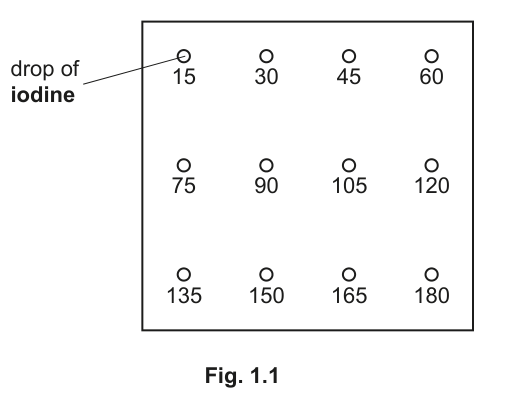
step 5 Put of S into each of the test-tubes labelled in step 2.
step 6 Put of the 2.0% amylase solution, E, into the test-tube labelled 2.0%. Use a glass rod to mix.
step 7 Start timing.
step 8 After 15 seconds, use the glass rod to transfer a drop of the mixture from the test-tube onto the drop of iodine that is labelled 15, on the white tile.
step 9 Clean the glass rod with a paper towel.
step 10 Repeat step 8 to step 9 at 15-second intervals until the end-point is reached.
step 11 Record in (a)(iii) the time when the end-point is first observed.
If the end-point is not reached at 180 seconds, record as 'more than 180'.
step 12 Clean the white tile with a damp paper towel and then dry the white tile. Make sure all the numbers are still visible.
step 13 Put one drop of iodine on the white tile at each sampling time, as shown in Fig. 1.1.
step 14 Repeat step 6 to step 13 using the other concentrations of amylase solution you prepared in step 1.
Record your results in an appropriate table.
State the independent variable in this investigation.
Carry out step 15 to step 23.
step 15 Put one drop of iodine on the white tile at each sampling time, as shown in Fig. 1.1.
step 16 Label a test-tube with the letter U.
step 17 Put of S into this test-tube.
step 18 Put of solution U into the same test-tube. Use a glass rod to mix.
step 19 Start timing.
step 20 After 15 seconds, use the glass rod to transfer a drop of the mixture from the test-tube onto the drop of iodine that is labelled 15, on the white tile.
step 21 Clean the glass rod with a paper towel.
step 22 Repeat step 20 to step 21 at 15-second intervals until the end-point is reached.
step 23 Record, in (a)(v), the time when the end-point is first observed.
If the end-point is not reached at 180 seconds, record as 'more than 180'.
State the result for U.
result for U = ______
Using your results in (a)(iii) and (a)(v), estimate the concentration of amylase in U.
Suggest one source of error in the procedure described in step 10 of this investigation.
Suggest how you could make one improvement to reduce the source of error stated in (a)(vii).
Describe how you would modify the procedure to investigate the effect of pH on the time taken for amylase to hydrolyse starch.
A student investigated the effect of different substrate concentrations on the activity of an enzyme in the presence of an inhibitor.
The concentration of the inhibitor was standardised.
The results are shown in Table 1.3.
Table 1.3
| concentration of substrate / | rate of reaction / arbitrary units |
|---|---|
| 0.0 | 0.000 |
| 0.2 | 0.750 |
| 0.4 | 1.375 |
| 0.6 | 1.800 |
| 0.8 | 2.175 |
| 1.0 | 2.250 |
Plot a graph of the data in Table 1.3 on the grid in Fig. 1.2.
Use a sharp pencil.
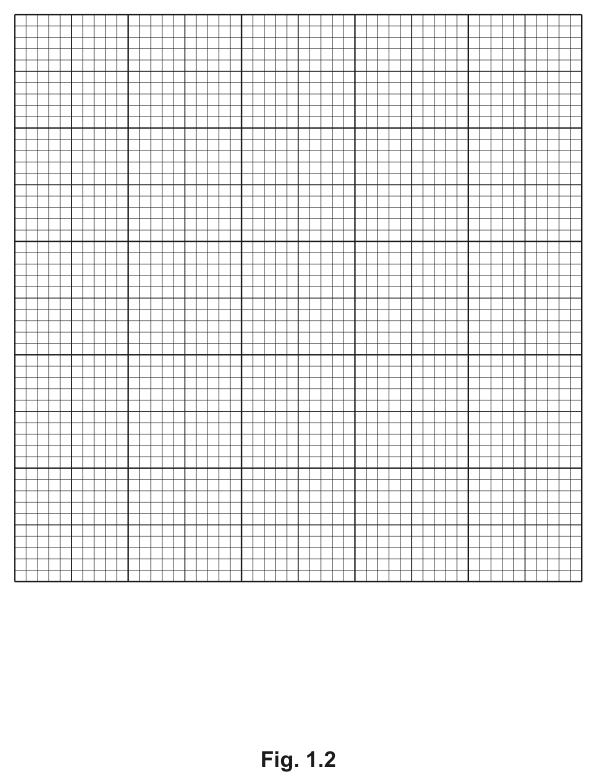
Use your graph in Fig. 1.2 to determine the rate of reaction when the concentration of substrate is .
rate of reaction = ______ arbitrary units
The of this enzyme is 2.250 arbitrary units.
Using this information and the graph in Fig. 1.2, state whether the inhibitor is a competitive inhibitor or a non-competitive inhibitor.
Explain your answer.
The rest of this paper
1 more questions- Q2Use of the Light Microscope18M