Biology 9700/33 — October/November 2023
Cambridge AS Level · Advanced Practical Skills · worked solutions for every part, with the mark scheme
Topics Manipulation, Measurement and Observation · Analysis, Conclusions and Evaluation · Presentation of Data and Observations · Use of the Light Microscope
Yeast cells contain enzymes that hydrolyse sucrose into reducing sugars, as shown in Fig. 1.1.
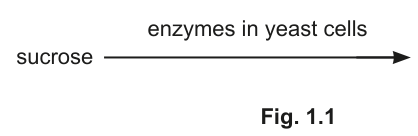
You will investigate the activity of the enzymes in yeast cells.
The yeast cells will be immobilised in sodium alginate beads.
You are provided with the materials shown in Table 1.1.
Table 1.1
| labelled | contents | hazard | volume / |
|---|---|---|---|
| Y | yeast cell suspension | none | 30 |
| A | sodium alginate solution | harmful irritant | 20 |
| C | calcium chloride solution | harmful irritant | 30 |
| S | sucrose solution | none | 100 |
| B | Benedict's solution | harmful irritant | 30 |
If any solution comes into contact with your skin, wash off immediately under cold water.
It is recommended that you wear suitable eye protection.
You will investigate the activity of yeast enzymes by using different numbers of beads of immobilised yeast cells in sucrose solution, S.
Carry out step 1 to step 9 to immobilise the yeast cells in sodium alginate beads.
step 1 Put of A into a beaker.
step 2 Stir the yeast cell suspension Y with a glass rod.
step 3 Put of Y into the beaker containing A and mix well.
step 4 Put of C into another beaker.
step 5 Use a syringe to collect of the mixture of A and Y.
step 6 Hold this syringe over the beaker containing of C (step 4), as shown in Fig. 1.2.
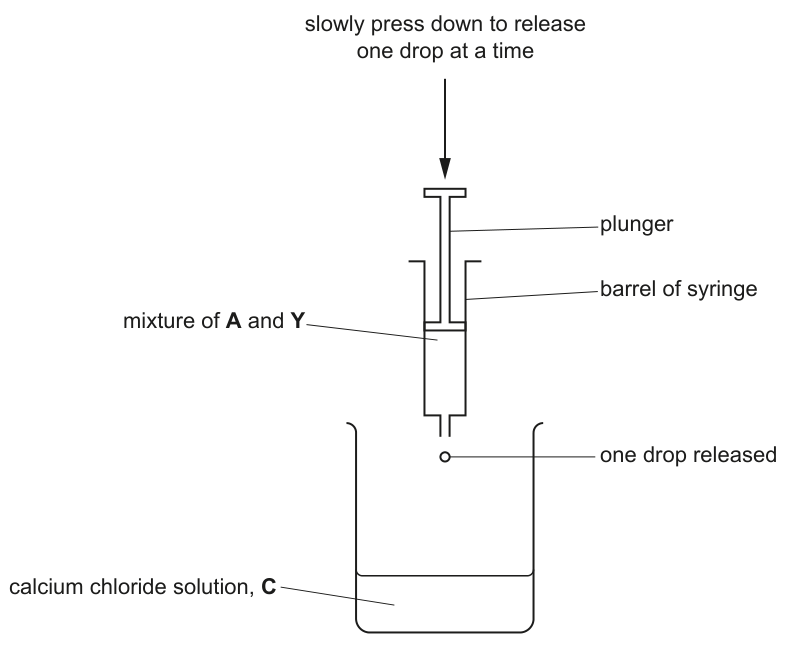
step 7 Hold the barrel of the syringe with one hand while slowly pressing down on the plunger with the other hand so that a drop of the mixture is released into solution C. The drop will form a bead.
step 8 Repeat step 7 to make at least 31 beads.
The immobilised yeast beads must be left in the beaker for 5 minutes.
step 9 After 5 minutes tip the beads and the solution into a Petri dish.
You will test the activity of the yeast enzymes by using different numbers of beads (1, 2, 4, 8 and 16) in sucrose solution.
Carry out step 10 to step 20.
step 10 Label five beakers 1, 2, 4, 8 and 16 and label five test-tubes 1, 2, 4, 8 and 16.
step 11 Put 1, 2, 4, 8 or 16 beads into each of the appropriately labelled beakers, as shown in Fig. 1.3.
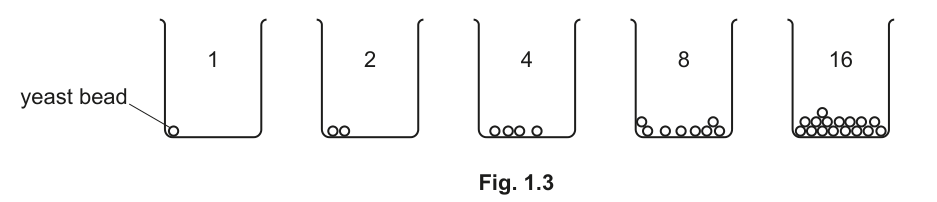
step 12 Put of sucrose solution, S, into each of the beakers containing the beads.
step 13 Start timing and leave for 5 minutes. While you are waiting set up a water-bath ready for step 14 and step 19.
In step 19 you will use the water-bath to carry out the test for reducing sugars using Benedict's solution, B.
State the temperature you will use for the water-bath.
temperature = ______
step 14 Heat the water-bath to the temperature stated in (a)(i).
step 15 At the end of 5 minutes (step 13) stir the contents of each beaker.
step 16 Use a syringe to transfer of the solution from beaker 1 into the test-tube labelled 1.
step 17 Repeat step 16 for each of the beakers and test-tubes labelled 2, 4, 8 and 16.
step 18 Put of Benedict's solution, B, into each of the test-tubes labelled 1, 2, 4, 8 and 16.
step 19 Put test-tube 1 into the water-bath at the temperature stated in (a)(i) and time how long before the appearance of the first colour change. If there is no colour change after 2 minutes, stop timing and record as 'more than 120'.
Record your result in (a)(ii).
step 20 Repeat step 19 for the other test-tubes, 2, 4, 8 and 16.
Record your results in an appropriate table.
State the independent variable in this investigation.
State one main source of error in this investigation.
A student set up a beaker as a control experiment. The result of the control experiment showed that the sucrose was hydrolysed by an enzyme.
Suggest what substances the student put in the beaker for the control experiment.
The procedure described in step 1 to step 20 investigated the effect of changing the number of yeast beads on the rate of hydrolysis of sucrose.
Describe how you would modify the procedure to investigate the effect of changing the concentration of the sucrose solution on the rate of hydrolysis of sucrose.
Pectinases are enzymes that are used to increase the volume of fruit juice extracted from apples. Pectinases can be immobilised and placed inside a container with apple pulp as shown in Fig. 1.4. The fruit juice is then collected.
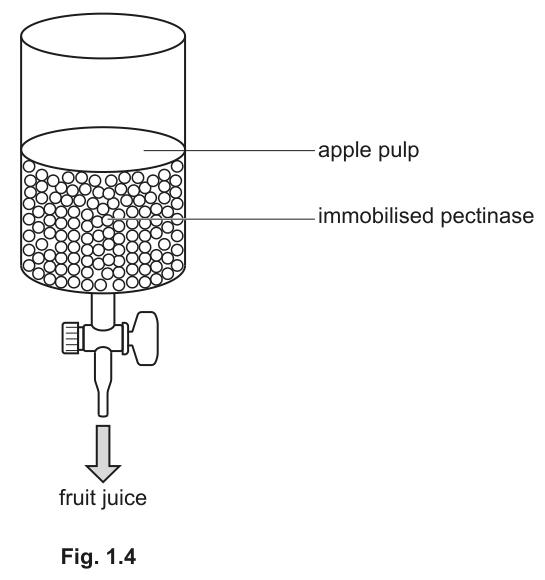
A scientist carried out an investigation to determine the effect of temperature on the activity of immobilised pectinase by measuring the volume of fruit juice extracted.
All other variables were kept constant.
The results are shown in Table 1.2.
Table 1.2
| immobilised pectinase | |
|---|---|
| temperature / | volume of fruit juice / |
| 30 | 38 |
| 40 | 54 |
| 50 | 79 |
| 60 | 98 |
| 70 | 62 |
| 80 | 4 |
Plot a graph of the data in Table 1.2 on the grid in Fig. 1.5.
Use a sharp pencil.
Use your graph in Fig. 1.5 to estimate the volume of fruit juice extracted at .
Show on your graph how you obtained your answer.
volume of fruit juice = ______
Describe the change in volume of fruit juice shown by your graph in Fig. 1.5.
The scientist repeated the investigation replacing the immobilised pectinase with the same amount of pectinase but not immobilised in beads (free pectinase).
The results are shown in Table 1.3.
Table 1.3
| free pectinase (not immobilised) | |
|---|---|
| temperature / | volume of fruit juice / |
| 30 | 52 |
| 40 | 85 |
| 50 | 98 |
| 60 | 41 |
| 70 | 12 |
| 80 | 4 |
Suggest an explanation for why more fruit juice was obtained when using the free pectinase between the temperatures of and than when using immobilised pectinase.
Suggest an explanation for why more fruit juice was obtained when using immobilised pectinase between the temperatures of and than when using the free pectinase.
The rest of this paper
1 more questions- Q2Use of the Light Microscope · Manipulation, Measurement and Observation · Analysis, Conclusions and Evaluation18M