Biology 9700/23 — October/November 2023
Cambridge AS Level · AS Level Structured Questions · worked solutions for every part, with the mark scheme
Topics Infectious Diseases · Biological Molecules · Transport in Mammals · The Mitotic Cell Cycle · Immunity · Enzymes · +4 more
The malarial pathogen, Plasmodium falciparum, enters red blood cells after a person becomes infected. After some time, each cell of P. falciparum divides to form daughter cells.
Fig. 1.1 shows a cell of P. falciparum that is forming many daughter cells.
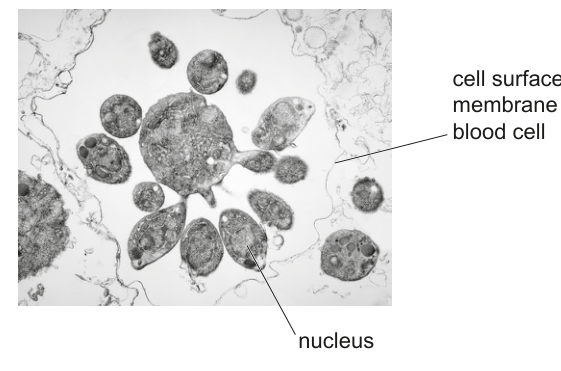
With reference to Fig. 1.1, suggest how the presence of P. falciparum affects a red blood cell.
When P. falciparum divides there is unequal division of the cytoplasm to form small, genetically identical daughter cells.
Outline the events that occur in the cell of P. falciparum to form the daughter cells shown in Fig. 1.1.
In 2013, the World Health Organization (WHO) set a target for researchers to create a vaccine for malaria. WHO required the vaccine to show 75% efficacy and be ready for use by 2030.
Efficacy is a measure of the effectiveness of a vaccine in reducing the number of new cases of malaria.
A trial of the vaccine in Burkina Faso in 2020 achieved a 77% efficacy over a 12-month period. A control group received a vaccine for rabies.
Vaccines stimulate an immune response with the production of antibodies.
Explain how antibodies will reduce the spread of the malarial pathogen through the bloodstream.
Some vaccination programmes have been more successful than others.
Discuss the factors that contribute to the success of a vaccination programme.
The rest of this paper
5 more questions- Q2Enzymes · Biological Molecules8M
- Q3Biological Molecules · Transport in Mammals11M
- Q4Nucleic Acids and Protein Synthesis · Cell Structure · Cell Membranes and Transport11M
- Q5Transport in Plants · Infectious Diseases10M
- Q6Transport in Mammals6M