Biology 9700/22 — February/March 2023
Cambridge AS Level · AS Level Structured Questions · worked solutions for every part, with the mark scheme
Topics Biological Molecules · Cell Membranes and Transport · Gas Exchange · Cell Structure · The Mitotic Cell Cycle · Nucleic Acids and Protein Synthesis · +5 more
Table 1.1 lists cell structures that can be found in eukaryotic cells or prokaryotic cells. Some of these cell structures can be found in both types of cell.
Complete the table using a tick (✓) to show that the cell structure can be present in a particular type of cell and a cross (✗) to show that the cell structure cannot be present.
Put a tick or a cross in every box.
The top row has been completed for you.
Table 1.1
| cell structure | eukaryotic cells | prokaryotic cells |
|---|---|---|
| nucleus | ✓ | ✗ |
| Golgi body | ||
| circular DNA | ||
| 70S ribosome |
All cells have a cell surface membrane. Fig. 1.1 shows a transmission electron micrograph of part of two adjacent animal cells, cell 1 and cell 2.
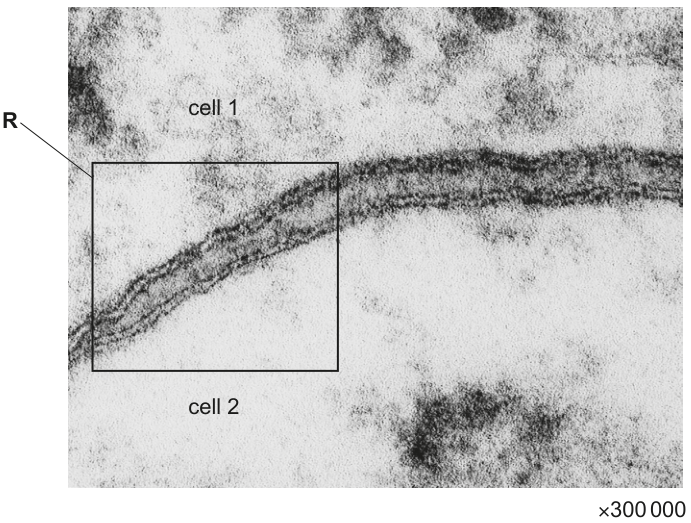
In the space provided, draw a diagram of the region in the box labelled R on Fig. 1.1. Your diagram should show the four dark lines.
Label the diagram to identify what is shown by the dark lines and each of the three spaces between them.
space for diagram:
Mitogens are short chains of amino acids that function as cell-signalling molecules. Mitogens are released from secretory cells and travel in the blood to target cells, where the mitogens bind to cell surface receptors. The target cells respond by progressing from the phase to the S phase of the mitotic cell cycle.
Outline what happens in the phase and S phase of the mitotic cell cycle.
phase
S phase
As a result of mutation, the production and release of mitogens into the blood can be greatly increased.
Suggest a possible consequence for target cells of increased concentrations of mitogens in the blood.
The rest of this paper
5 more questions- Q2Biological Molecules · Cell Membranes and Transport · Gas Exchange · Nucleic Acids and Protein Synthesis13M
- Q3Transport in Plants · Biological Molecules13M
- Q4Infectious Diseases · Immunity11M
- Q5Transport in Mammals · Gas Exchange10M
- Q6Biological Molecules · Enzymes5M