Biology 9700/31 — October/November 2022
Cambridge AS Level · Advanced Practical Skills · worked solutions for every part, with the mark scheme
Topics Manipulation, Measurement and Observation · Presentation of Data and Observations · Analysis, Conclusions and Evaluation · Use of the Light Microscope
Some fruit contains large quantities of ascorbic acid (vitamin C). Ascorbic acid can be absorbed through the partially permeable wall of the gut.
You will investigate the rate at which ascorbic acid from a ascorbic acid solution diffuses across a partially permeable membrane. Dialysis (Visking) tubing acts as a partially permeable membrane.
You are provided with the materials shown in Table 1.1.
Table 1.1
| labelled | contents | hazard | quantity |
|---|---|---|---|
| A | ascorbic acid solution | irritant | |
| W | distilled water | none | |
| D | dialysis tubing in distilled water | none | |
| I | iodine solution | irritant | |
| S | starch solution | none |
It is recommended that you wear suitable eye protection.
You will need to:
- allow ascorbic acid to diffuse out of the dialysis tubing into the distilled water surrounding the dialysis tubing
- estimate the concentration of ascorbic acid that has diffused out of the dialysis tubing.
Carry out step 1 to step 27.
step 1 Tie a knot in the dialysis tubing as close as possible to one end, so that the end is sealed.
step 2 To open the other end, wet the dialysis tubing and rub the tubing gently between your fingers and thumb.
step 3 Put of ascorbic acid solution A into the open end of the dialysis tubing.
step 4 Rinse the outside of the dialysis tubing by dipping it in the container of water labelled D.
step 5 Carefully place the filled dialysis tubing bag into the large test-tube and secure in position using an elastic band, as shown in Fig. 1.1.
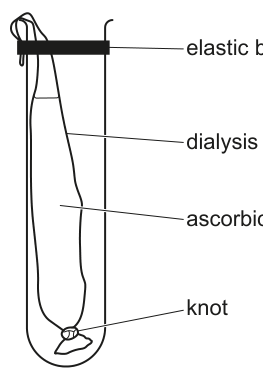
You will need to fill the large test-tube with a known volume of distilled water so that it just covers the liquid in the dialysis tubing.
step 6 Use a syringe to add the distilled water to the large test-tube and record in (a)(i) the volume you added.
State the volume of distilled water you added.
volume of water = ______
step 7 Start timing and leave the dialysis tubing bag in the distilled water for at least 15 minutes. While you are waiting continue with this question.
You will need to dilute the ascorbic acid solution, A, to provide a range of known concentrations.
You will need to make up of each concentration of ascorbic acid.
Table 1.2 shows how to make up two of the concentrations you should use.
Decide which other concentrations of ascorbic acid to make and complete Table 1.2.
Table 1.2
| concentration of ascorbic acid / | volume of ascorbic acid solution / | volume of distilled water / |
|---|---|---|
| 0.0 | 0.0 | 20.0 |
| 2.0 | 20.0 | 0.0 |
step 8 Using the beakers provided, make up the concentrations of ascorbic acid stated in Table 1.2.
step 9 Put of starch solution S into a clean test-tube.
step 10 Put of the ascorbic acid solution (distilled water) into the same test-tube. Shake gently to mix.
step 11 Fill a syringe with iodine solution I.
step 12 Add one drop of I to the mixture of S and ascorbic acid solution, as shown in Fig. 1.2. Mix gently.
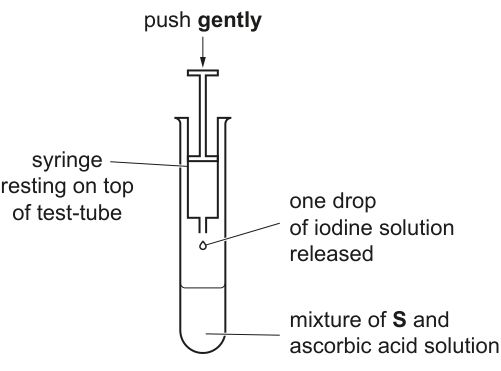
step 13 You should see a blue colour. This is the end-point you are looking for when you test the remaining ascorbic acid solutions (step 21).
step 14 Record the volume of iodine solution you have added.
step 15 Put of starch solution S into a clean test-tube.
step 16 Put of the lowest concentration of the remaining ascorbic acid solutions into the same test-tube. Shake gently to mix.
step 17 Fill the syringe containing iodine solution I to the level again.
step 18 Add one drop of I to the mixture of S and ascorbic acid solution as shown in Fig. 1.2. Mix well.
step 19 Continue adding drops one at a time, mixing after each drop, until you see a blue colour.
step 20 As soon as you see a blue colour, wait 10 seconds. If the blue colour disappears then add another drop.
step 21 Continue adding drops until the mixture stays blue for at least 10 seconds. This is the end-point.
step 22 Record the volume of iodine solution you have added.
step 23 Repeat step 15 to step 22 with the other concentrations of ascorbic acid you prepared in step 8.
Record your results in (a)(iii).
Record your results in an appropriate table.
step 24 Remove the dialysis tubing from the large test-tube and place it in the beaker labelled For waste. Stop timing and record the time that the dialysis tubing has been left in the distilled water (time from step 7 to step 24).
time = ______
step 25 Pour the solution from the large test-tube into a small beaker.
step 26 Use a syringe to remove a sample of the solution from the small beaker.
step 27 Repeat step 15 to step 22 using this sample. Record your result in (a)(iv).
Record the volume of iodine added.
volume of iodine = ______
Use your results in (a)(iii) and (a)(iv) to estimate the concentration of ascorbic acid in the solution outside the dialysis tubing bag.
concentration of ascorbic acid = ______
Calculate the rate of diffusion of ascorbic acid out of the dialysis tubing.
Show your working.
rate of diffusion = ______
Identify two significant sources of error when finding the concentration of ascorbic acid in the sample from the large test-tube.
Suggest how you would make two improvements to this investigation.
Fruit can be preserved by reducing its water content. This can be done by cutting the fruit into small cubes and soaking the cubes in concentrated sucrose solution.
Cubes of melon were soaked in 45% sucrose solution for 20 hours at a temperature of .
The water content of the melon was determined every 4 hours.
The results are shown in Table 1.3.
Table 1.3
| time / hours | water content / g of water for each g of melon |
|---|---|
| 0 | 1.44 |
| 4 | 0.83 |
| 8 | 0.42 |
| 12 | 0.25 |
| 16 | 0.20 |
| 20 | 0.20 |
Plot a graph of the data in Table 1.3 on the grid in Fig. 1.3.
Use a sharp pencil.

Explain the change in water content of the melon cubes between 16 hours and 20 hours.
The rest of this paper
1 more questions- Q2Use of the Light Microscope18M