Biology 9700/35 — May/June 2022
Cambridge AS Level · Advanced Practical Skills · worked solutions for every part, with the mark scheme
Topics Presentation of Data and Observations · Analysis, Conclusions and Evaluation · Manipulation, Measurement and Observation · Use of the Light Microscope
The enzyme invertase catalyses the hydrolysis (breakdown) of sucrose to fructose and glucose.
You will investigate the effect of enzyme concentration on this enzyme-catalysed reaction.
You are provided with the materials shown in Table 1.1.
Table 1.1
| labelled | contents | hazard | volume / |
|---|---|---|---|
| R | reducing sugar solution | none | 50 |
| B | Benedict's solution | harmful irritant | 50 |
| W | distilled water | none | 200 |
| E | invertase solution | harmful irritant | 20 |
| S | sucrose solution | none | 50 |
If B or E come into contact with your skin, wash off immediately under cold water.
It is recommended that you wear suitable eye protection.
You will need to:
- prepare a range of reducing sugar solutions to use as standards
- investigate the effect of invertase concentration on the breakdown of sucrose.
Carry out step 1 to step 10.
step 1 Set up a water-bath and heat to boiling ready for step 7.
step 2 Label four small beakers 60, 30, 6 and 0.6.
Table 1.2 shows the instructions for making four solutions of different reducing sugar concentration.
Table 1.2
| reducing sugar concentration / | instructions |
|---|---|
| 60 | transfer of solution R into the beaker labelled 60 |
| 30 | put of solution R into the beaker labelled 30, add of distilled water, W, and mix well |
| 6 | put of solution R into the beaker labelled 6, add of distilled water, W, and mix well |
| 0.6 | put of the reducing sugar solution (from the beaker labelled 6) into the beaker labelled 0.6, add distilled water, W, and mix well |
step 3 Follow the instructions shown in Table 1.2 to produce the four reducing sugar concentrations shown.
step 4 Label 4 test-tubes 60, 30, 6 and 0.6.
step 5 Put of each reducing sugar concentration into the appropriately labelled test-tube.
step 6 Add of B to each test-tube and shake gently to mix.
step 7 Put all four test-tubes into the boiling water-bath for 2 minutes.
step 8 After 2 minutes turn off the water-bath. You will need this again in step 11.
step 9 Remove the test-tubes from the water-bath and shake gently to mix the contents.
step 10 Observe the final colour of the contents of each test-tube and record your observations in (a).
Record the colour of the contents of each test-tube in Table 1.3.
Table 1.3
| reducing sugar concentration / | colour after 2 minutes |
|---|---|
| 60 | |
| 30 | |
| 6 | |
| 0.6 |
Carry out step 11 to step 19.
step 11 Heat the water-bath to boiling ready for step 18.
You will need to carry out a serial dilution of the invertase solution, E, to reduce the concentration by a factor of ten between each successive dilution.
You will need to prepare four concentrations of invertase in addition to the invertase solution, E.
After the serial dilution is completed, you will need to have at least of each concentration available to use.
Complete Fig. 1.1 to show how you will prepare your serial dilution.
Fig. 1.1 shows the first two beakers you will use to make your serial dilution. You will need to draw three additional beakers.
For each beaker, add labelled arrows to show:
- the volume of invertase solution transferred
- the volume of distilled water, W, added.
Under each beaker, state the concentration of invertase solution.
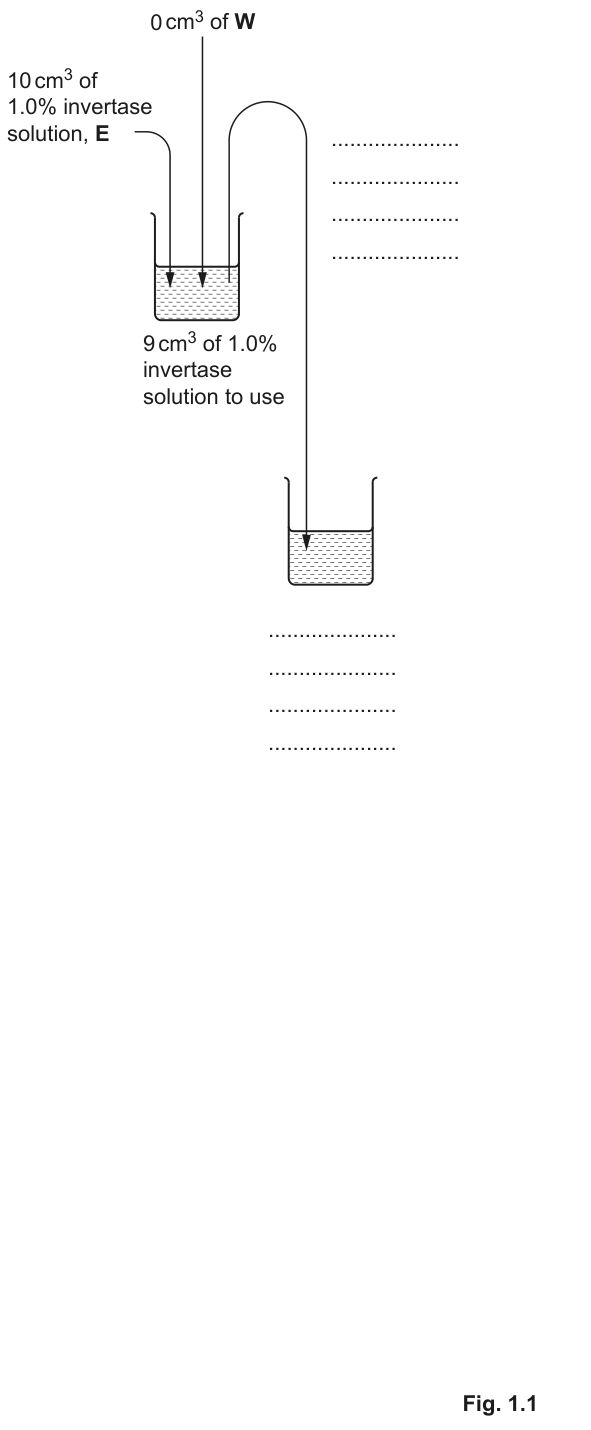
step 12 Prepare the concentrations of invertase solution, E, as decided in (b)(i), in the beakers provided.
step 13 Label test-tubes with the concentrations of invertase solution decided in (b)(i).
step 14 Put of each of the concentrations of invertase into the appropriately labelled test-tube.
step 15 Add of the sucrose solution, S, to each of the test-tubes and shake gently to mix.
step 16 Start timing and leave the test-tubes at room temperature for 3 minutes.
Record room temperature.
room temperature = ______
step 17 After 3 minutes, add of B to each test-tube and shake gently to mix.
step 18 Put all of the test-tubes into the boiling water-bath and leave them for 2 minutes.
step 19 After 2 minutes, carefully remove the test-tubes from the water-bath and shake gently to mix the contents. Record your results in (b)(iii).
Record your results in an appropriate table.
Using your results in (a) and (b)(iii), estimate the concentration of reducing sugar for the highest concentration of invertase solution () and for the lowest concentration of invertase solution, including appropriate units.
highest concentration () = ______
lowest concentration = ______
Describe how changing the concentration of invertase affects the concentration of reducing sugar produced.
Suggest and explain how increasing the temperature by above room temperature would affect the results you obtained in (b)(iii).
Complete Table 1.4 by identifying two significant sources of error in this investigation.
Suggest how you would improve the procedure to reduce the effect of these errors.
Table 1.4
| source of error | improvement |
|---|---|
The rest of this paper
1 more questions- Q2Use of the Light Microscope · Analysis, Conclusions and Evaluation · Presentation of Data and Observations20M