Biology 9700/22 — May/June 2022
Cambridge AS Level · AS Level Structured Questions · worked solutions for every part, with the mark scheme
Topics Cell Structure · Cell Membranes and Transport · Transport in Mammals · The Mitotic Cell Cycle · Infectious Diseases · Immunity · +5 more
Epithelial cells in the small intestine have cell structures known as microvilli. The microvilli of these cells are found only on the surface that borders the gut lumen.
Fig. 1.1 shows images of microvilli of intestinal epithelial cells. These images have been obtained using a scanning electron microscope and a transmission electron microscope.
Fig. 1.1A is at a different magnification to Fig. 1.1B.
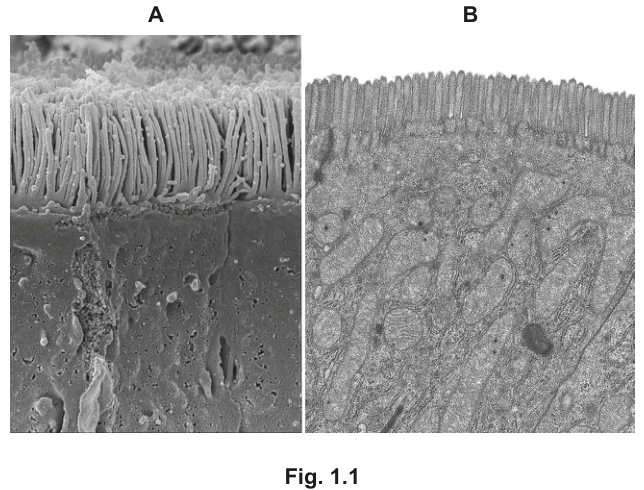
Fig. 1.1
With reference to Fig. 1.1, state how it is possible to distinguish between a scanning electron micrograph and a transmission electron micrograph.
The approximate length of a microvillus is .
Outline the method you would use to estimate the magnifications of the images shown in Fig. 1.1.
One role of an intestinal epithelial cell is the absorption of glucose from the gut lumen into the circulatory system. This involves different membrane transport proteins.
The events occurring in an intestinal epithelial cell during the absorption of glucose are summarised in Fig. 1.2.
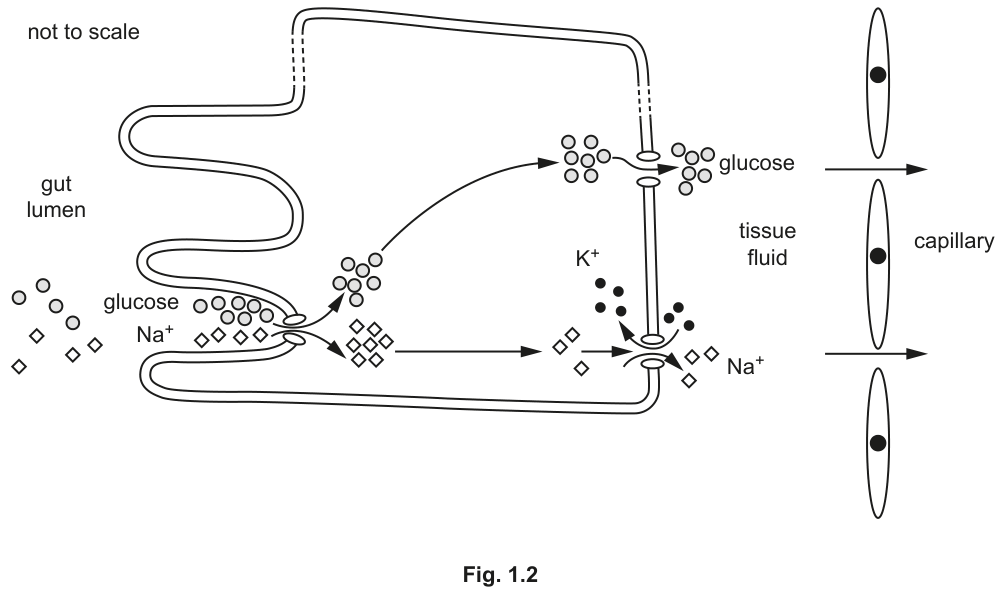
Fig. 1.2
• Sodium ions () are removed from the cell by active transport through a transport protein known as a sodium-potassium () pump.
• This decreases the concentration of in the cell compared to the gut lumen.
• Glucose molecules are cotransported with into the cell from the gut lumen.
• Glucose molecules are transported out of the cell into the tissue fluid down a concentration gradient.
Active transport involves water-soluble substances, such as and , and the use of ATP to provide the energy needed for their transport through carrier proteins.
Outline other features of active transport.
Glucose molecules enter the cell through a membrane protein.
Suggest why glucose molecules need to be cotransported with when it enters the cell through the membrane protein.
Explain how microvilli increase the uptake of glucose into an intestinal epithelial cell.
Stem cells are also located in the wall of the small intestine. These cells divide by mitosis continuously.
Suggest and explain the importance of mitosis by stem cells in the small intestine.
The rest of this paper
5 more questions- Q2Infectious Diseases · Immunity11M
- Q3Biological Molecules · Transport in Mammals12M
- Q4Enzymes · Nucleic Acids and Protein Synthesis · Transport in Mammals · Cell Membranes and Transport12M
- Q5Gas Exchange · Cell Structure6M
- Q6Transport in Plants6M