Biology 9700/22 — February/March 2022
Cambridge AS Level · AS Level Structured Questions · worked solutions for every part, with the mark scheme
Topics Cell Membranes and Transport · Transport in Plants · The Mitotic Cell Cycle · Biological Molecules · Enzymes · Infectious Diseases · +5 more
Table 1.1 shows three of the processes by which substances in solution can move across cell membranes. It also lists five statements that may apply to each of these three processes.
Complete Table 1.1 to show which of the statements apply to each of the three processes shown.
Use a tick () to show that the statement applies or a cross () to show that the statement does not apply.
Each box must contain a tick or a cross.
The first row has been completed for you.
Table 1.1
| statement | process: active transport | process: facilitated diffusion | process: simple diffusion |
|---|---|---|---|
| movement of oxygen into a red blood cell | |||
| occurs in both animal and plant cells | |||
| uses carrier proteins | |||
| movement of non-polar molecules between the fatty acid tails of the phospholipid molecules | |||
| movement of ions down a concentration gradient |
Fig. 1.1 is a simplified diagram representing a transverse section of part of a young root. The diagram is not to scale.
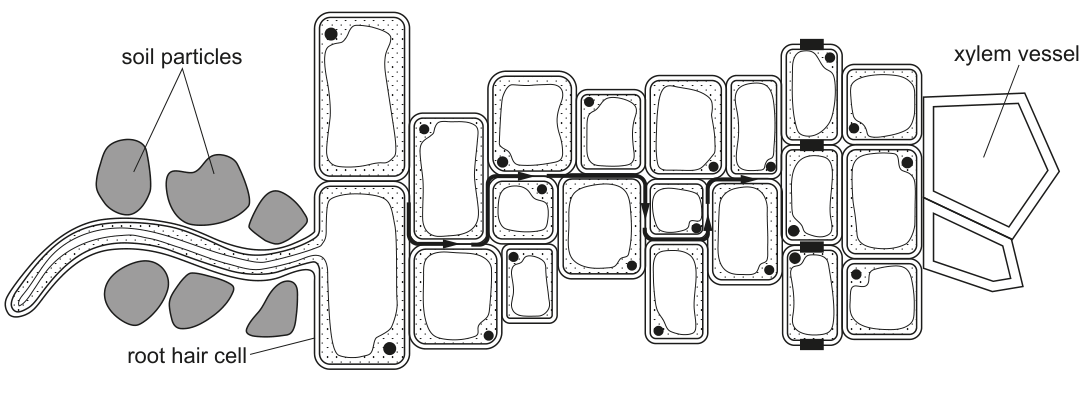
On Fig. 1.1 draw a label line and label with the letter C to identify the Casparian strip.
Root hairs measure approximately in diameter and in length.
Explain how this adapts root hairs for the absorption of water.
Name the pathway for the movement of water shown by the arrows in Fig. 1.1.
Water enters the xylem vessels shown in Fig. 1.1.
Explain how water moves up the xylem vessels to the leaves in a continuous column.
The rest of this paper
5 more questions- Q2The Mitotic Cell Cycle7M
- Q3Biological Molecules · Enzymes8M
- Q4Infectious Diseases · Cell Structure · Immunity11M
- Q5Transport in Mammals · Gas Exchange12M
- Q6Nucleic Acids and Protein Synthesis12M