Biology 9700/13 — October/November 2021
Cambridge AS Level · Multiple Choice (AS Level) · answer key with instant marking and worked solutions
Topics Biological Molecules · Cell Structure · Transport in Mammals · Transport in Plants · The Mitotic Cell Cycle · Infectious Diseases · +5 more
Tap an option under each question to check it — your score builds as you go.
A student was asked to use the scale bar shown to calculate the magnification of a cell on a photomicrograph.
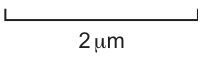
Which method could the student use to calculate the magnification of the cell?
Options
A divide the diameter of the cell by the length of the scale bar, with both measured in the same units of length
B measure the diameter of the cell in millimetres, multiply by 2000 and divide by the length of the scale bar measured in millimetres
C measure the length of the scale bar in millimetres, convert to micrometres and divide by 2
D measure the length of the scale bar in millimetres, convert to micrometres and multiply by 2
Working
The magnification of an image is given by:
The scale bar on the photomicrograph represents an actual length of . The image size of the scale bar is read directly from the page in millimetres and must be converted to the same units (micrometres) as the actual length before dividing:
This is exactly: measure the scale bar in mm, convert to µm, then divide by 2.
Answer
C
C
Background Concept
A photomicrograph is an enlarged photograph taken down a microscope. The magnification of the photograph tells you how many times larger the image is than the real specimen. It is calculated using the formula:
A scale bar is a short line printed on the micrograph with a label giving the real (actual) length that the line represents. In this question, the scale bar represents of real specimen. So if the scale bar is millimetres long on the printed image, then of image corresponds to of actual specimen.
Because the magnification compares like-with-like, both the image size and the actual size must be in the same units. This is why the millimetre measurement has to be converted to micrometres (multiply by 1000) before the division.
Understanding the Question
The student has a photomicrograph of a cell with a scale bar labelled and must decide which of four manipulations of the scale bar length will give the magnification of the cell. The command word is implicit but clear: choose the correct method.
Approach
Use the magnification formula on the scale bar itself. The image size of the scale bar (measured in mm on the page) divided by the actual size it represents (2 µm) gives the magnification. Convert the mm measurement to µm so that the two quantities in the formula share units, then divide by 2.
Step-by-Step Reasoning
- State the formula. Magnification = image size / actual size.
- Identify image and actual sizes for the scale bar. Image size = measured length of scale bar on the page (mm). Actual size = 2 µm (printed next to the bar).
- Convert units. Convert the image size from mm to µm by multiplying by 1000.
- Divide by the actual size. Divide the converted image size by 2 (the actual size in µm).
- Check option C. "Measure the length of the scale bar in millimetres, convert to micrometres and divide by 2" matches the procedure exactly.
- Eliminate the others:
- A divides the cell's image size by the scale bar's image size. Both are in image units, so this gives a dimensionless ratio of two lengths on the page — not the magnification.
- B has the wrong structure: it multiplies the cell's image size by 2000 and divides by the scale bar's image size. This combines a conversion factor and a ratio in a way that does not produce a magnification.
- D multiplies by 2 instead of dividing by 2, which inverts the result and gives an answer 4× too large.
Key Takeaways
- Magnification = image size / actual size, with both quantities in the same units.
- A scale bar is a direct way of finding the magnification of the whole photograph: measure the bar on the page, convert to the same units as the printed actual length, then divide.
- Always check the units — a mm/µm mix-up is the most common error.
Common Mistakes
- Treating the scale bar as if it gives the cell's magnification directly, rather than the image's overall magnification.
- Forgetting to convert mm to µm and so dividing, say, 10 by 2 and writing "5" as the magnification, when the real answer is 5000×.
- Multiplying by 2 instead of dividing by 2 (option D) — the scale bar represents 2 µm, so the actual size in the denominator is 2, not the multiplier.
- Dividing the cell's image size by the scale bar's image size (option A) — this gives a relative size, not a magnification.
Things to Be Careful About
- The magnification found from the scale bar applies to the whole photograph, not just the cell. It can then be used to find any structure's actual size: actual size = image size / magnification.
- Always state the magnification with an "×" (e.g. ×5000) so it is not confused with an absolute size.
- Use proper unit notation: mm, µm, nm — note the Greek mu (µ) in micrometres, not the English 'u'.
The rest of this paper
39 more questions- Q2Cell Structure1M
- Q3Cell Structure1M
- Q4Cell Structure · Infectious Diseases1M
- Q5Cell Structure1M
- Q6Nucleic Acids and Protein Synthesis1M
- Q7Biological Molecules1M
- Q8Biological Molecules1M
- Q9Biological Molecules1M
- Q10Biological Molecules1M
- Q11Biological Molecules1M
- Q12Biological Molecules1M
- Q13Biological Molecules1M
- Q14Enzymes1M
- Q15Cell Membranes and Transport1M
- Q16Cell Membranes and Transport1M
- Q17Cell Membranes and Transport1M
- Q18The Mitotic Cell Cycle1M
- Q19The Mitotic Cell Cycle1M
- Q20The Mitotic Cell Cycle1M
- Q21Nucleic Acids and Protein Synthesis1M
- Q22Nucleic Acids and Protein Synthesis1M
- Q23Transport in Plants1M
- Q24Transport in Plants1M
- Q25Transport in Plants1M
- Q26Transport in Plants1M
- Q27Transport in Plants1M
- Q28Transport in Mammals1M
- Q29Transport in Mammals1M
- Q30Transport in Mammals1M
- Q31Transport in Mammals1M
- Q32Transport in Mammals1M
- Q33Transport in Mammals · Immunity1M
- Q34Gas Exchange1M
- Q35Gas Exchange1M
- Q36Cell Structure1M
- Q37Infectious Diseases1M
- Q38The Mitotic Cell Cycle · Infectious Diseases1M
- Q39Immunity1M
- Q40Immunity1M