Biology 9700/34 — October/November 2018
Cambridge AS Level · Advanced Practical Skills · worked solutions for every part, with the mark scheme
Topics Manipulation, Measurement and Observation · Presentation of Data and Observations · Analysis, Conclusions and Evaluation · Use of the Light Microscope
Manufacturers of fruit juice need to know the concentration of ascorbic acid (vitamin C) in fruit. The fruit is picked when the juice contains the highest concentration of ascorbic acid.
The concentration of ascorbic acid can be estimated in a fruit extract by carrying out a test using starch solution and iodine solution.
Iodine solution will be added one drop at a time using a syringe.
To practise releasing drops from a syringe:
- Fill a syringe with distilled water.
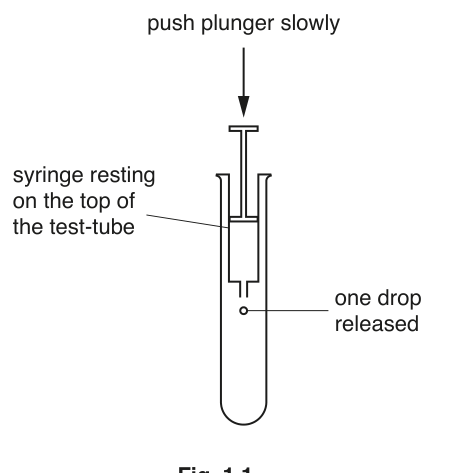
- Hold the syringe over an empty test-tube as shown in Fig. 1.1 and push the plunger slowly to release one drop.
- Repeat this until you can release one drop at a time.
You are provided with the materials shown in Table 1.1.
Table 1.1
| labelled | contents | hazard | volume/ |
|---|---|---|---|
| A | 0.10% ascorbic acid | none | 100 |
| W | distilled water | none | 100 |
| iodine | iodine solution | none | 20 |
| S | starch solution | none | 20 |
If any solutions come into contact with your skin, wash off immediately under cold water.
It is recommended that you wear suitable eye protection.
You will now carry out a test on A and W to practise the method and to find the volume of iodine solution that needs to be added for the end-point to be reached.
The end-point is when the blue colour remains after 10 seconds.
- Put of S into a test-tube.
- Put of A into the same test-tube.
- Shake the test-tube gently to mix the contents.
- Fill a syringe with exactly of iodine.
- Wipe off any iodine from the outside of the syringe with a paper towel.
- Put one drop of iodine, as shown in Fig. 1.1, into the mixture of S and A in the test-tube.
- Mix gently and observe any colour change.
- Repeat step 9 and step 10 until a blue colour appears. You may need to refill the syringe with iodine as in step 7.
- When the blue colour appears, shake the test-tube gently for 10 seconds and see if the end-point has been reached.
- If the blue colour disappears then repeat step 9 to step 12 until the mixture stays blue for at least 10 seconds.
- Record in (a)(i) the volume of iodine solution added.
- Repeat step 4 to step 14 using W instead of A (in step 5).
Record the volume of iodine solution added to sample A and sample W.
volume added to A = ______
volume added to W = ______
You will need to:
- prepare known concentrations of ascorbic acid using simple (proportional) dilution
- carry out a test to find the volume of iodine solution added to the test samples.
Make simple (proportional) dilutions of the ascorbic acid, A (0.10%), by reducing the concentration by 0.02% between each successive dilution.
You will need to prepare of each concentration.
Table 1.2 shows how to make up two of the concentrations you will use, 0.10% and 0.00%.
Decide which other concentrations of ascorbic acid to prepare using simple (proportional) dilutions of A.
Complete Table 1.2 to show how you will prepare the other concentrations.
Table 1.2
| percentage concentration of ascorbic acid | volume of A / | volume of W / |
|---|---|---|
| 0.10 | 20.00 | 0.00 |
| 0.00 | 0.00 | 20.00 |
- Prepare the concentrations of ascorbic acid as shown in Table 1.2.
- Repeat step 4 to step 13 using one of the concentrations in Table 1.2 instead of A (in step 5).
- Record your result in (a)(iii).
- Repeat step 17 and step 18 for each of the other concentrations as shown in Table 1.2.
Record your results in an appropriate table for the known concentrations of ascorbic acid.
You will need to estimate the concentration of ascorbic acid in X and Y.
You are provided with the materials shown in Table 1.3.
Table 1.3
| labelled | contents | hazard | volume/ |
|---|---|---|---|
| X | fruit extract with unknown concentration of ascorbic acid | none | 20 |
| Y | fruit extract with unknown concentration of ascorbic acid | none | 20 |
- Repeat step 4 to step 13 using X instead of A (in step 5).
- Record your result in (a)(iv).
- Repeat step 20 and step 21 using Y.
Record the volume of iodine solution added to X and Y.
volume added to X = ______
volume added to Y = ______
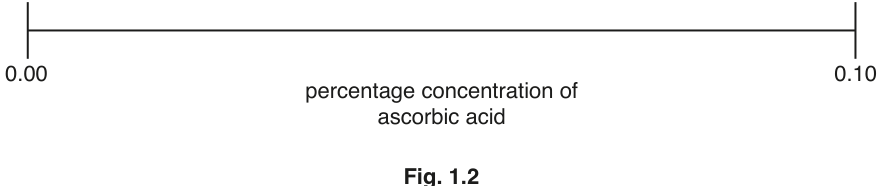
Complete Fig. 1.2 to show the position on the line of each of the percentage concentrations of ascorbic acid shown in Table 1.2.
Using your results in (a)(iv), put the labels X and Y on Fig. 1.2 to show an estimate of the concentrations of ascorbic acid in X and Y.
Identify one significant source of error in this investigation.
Suggest how you would make three improvements to this investigation in order to obtain a more accurate estimate of the concentration of ascorbic acid in X and Y.
A student carried out further investigations on ascorbic acid to test its effect on the reaction of amylase on starch. Maltose is a product of the hydrolysis of starch.
Different concentrations of ascorbic acid were added to standard mixtures of amylase and starch. The student measured the mass of maltose produced.
The results are shown in Table 1.4.
Table 1.4
| percentage concentration of ascorbic acid | mass of maltose produced/mg |
|---|---|
| 0.000 | 97 |
| 0.002 | 52 |
| 0.004 | 42 |
| 0.006 | 33 |
| 0.008 | 25 |
| 0.010 | 19 |
Plot a graph of the data in Table 1.4 on the grid in Fig. 1.3.
Use a sharp pencil for drawing graphs.
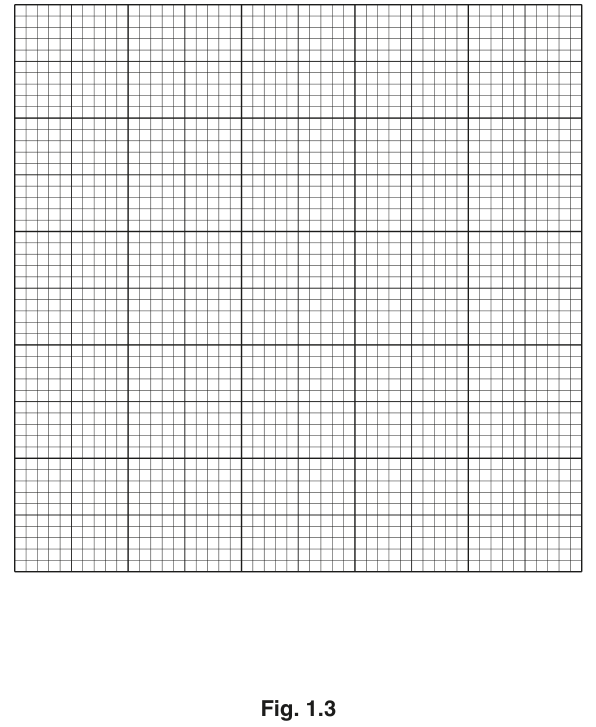
Use your graph to find the mass of maltose produced when 0.005% of ascorbic acid was used.
Show on the graph how you determined your answer.
mass of maltose = ______
Suggest one explanation for the results between 0.000% and 0.010%.
The rest of this paper
1 more questions- Q2Use of the Light Microscope · Manipulation, Measurement and Observation · Presentation of Data and Observations18M