Biology 9700/23 — October/November 2018
Cambridge AS Level · AS Level Structured Questions · worked solutions for every part, with the mark scheme
Topics Cell Structure · The Mitotic Cell Cycle · Immunity · Transport in Plants · Biological Molecules · Nucleic Acids and Protein Synthesis · +3 more
Aphids are small insects which feed directly on phloem sap.
The salivary glands of aphids have secretory cells that make and release a variety of proteins that assist in feeding.
Fig. 1.1 is a transmission electron micrograph of a small area of a salivary gland cell of an aphid.
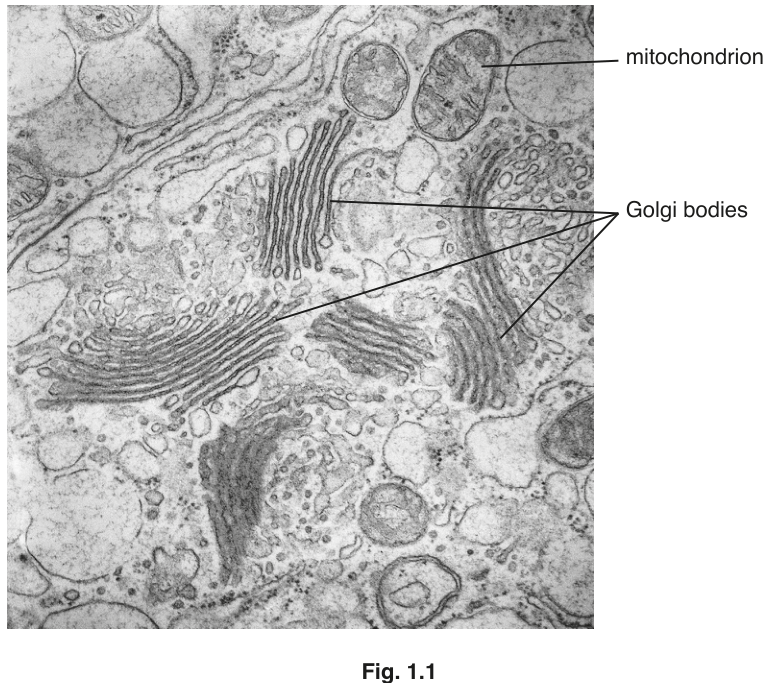
Describe the role of Golgi bodies in secretory cells, such as the salivary gland cells of aphids.
Explain why secretory cells have large numbers of mitochondria.
Mitochondria are partly controlled by the nucleus, but can also function independently.
Suggest the features of mitochondria that allow them to function independently of the nucleus.
Aphids are important vectors of plant viral diseases.
Describe the structure of a typical virus.
Suggest how viruses are able to pass from one plant cell to the next without crossing membranes.
The rest of this paper
5 more questions- Q2Biological Molecules11M
- Q3Nucleic Acids and Protein Synthesis · Cell Structure · The Mitotic Cell Cycle11M
- Q4Transport in Mammals · Cell Membranes and Transport10M
- Q5Infectious Diseases · Immunity9M
- Q6The Mitotic Cell Cycle · Immunity8M