Biology 9700/22 — May/June 2018
Cambridge AS Level · AS Level Structured Questions · worked solutions for every part, with the mark scheme
Topics Biological Molecules · Cell Structure · Gas Exchange · Nucleic Acids and Protein Synthesis · Immunity · Transport in Plants · +5 more
Fig. 1.1 is a drawing of a photomicrograph of a spongy mesophyll cell from a leaf.
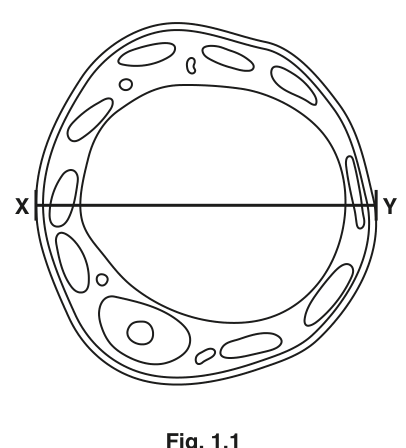
Fig. 1.1
On Fig. 1.1, add a label line and the correct letter for each of the three cell structures listed.
• nucleolus = N
• tonoplast = T
• chloroplast = C
The drawing in Fig. 1.1 is 2000 times larger than the actual size of the cell.
Describe the steps you would follow to determine the actual diameter of the cell in micrometres (µm), at X—Y.
The drawing in Fig. 1.1 was made using the high power objective lens of a light microscope. Some of the structures in Fig. 1.1 confirm that the cell is eukaryotic.
An electron micrograph of the same cell would reveal additional cell structures that are found in eukaryotes and not in prokaryotes.
List two examples of these additional cell structures.
1 ______
2 ______
Some of the water that moves out of the xylem within the leaves takes an apoplastic pathway to the spongy mesophyll cells. There is a film of water on the external surfaces of these cells. This allows the intercellular air spaces to become saturated with water vapour.
State, in terms of water movement from the xylem to the spongy mesophyll cells in the leaf, what is meant by the apoplastic pathway.
Outline the properties of water that contribute to the apoplastic movement of water to the spongy mesophyll cells and to the movement of water into the intercellular air spaces.
Describe what happens to the water vapour in the intercellular air spaces during the day and explain why this happens.
The rest of this paper
5 more questions- Q2Nucleic Acids and Protein Synthesis · Biological Molecules8M
- Q3Cell Structure · Cell Membranes and Transport · Nucleic Acids and Protein Synthesis · Biological Molecules · Immunity15M
- Q4The Mitotic Cell Cycle6M
- Q5Gas Exchange · Transport in Mammals · Infectious Diseases11M
- Q6Enzymes · Immunity5M