Biology 9700/31 — May/June 2017
Cambridge AS Level · Advanced Practical Skills · worked solutions for every part, with the mark scheme
Topics Manipulation, Measurement and Observation · Analysis, Conclusions and Evaluation · Presentation of Data and Observations · Use of the Light Microscope
Some plant cells contain vitamin C (ascorbic acid), which has many functions for maintaining human health.
To find the best source of vitamin C may require estimating its concentration in plant extracts.
You are required to estimate the concentration of vitamin C in a solution of plant extract, X, using the indicator DCPIP.
DCPIP (blue) reacts with vitamin C in a sample and becomes colourless. The end-point is when the DCPIP remains blue, so all the vitamin C has reacted with DCPIP.
The greater the volume of DCPIP added to reach the end-point, the higher the concentration of vitamin C in the sample.
You are required to:
- prepare different concentrations of vitamin C solution, V, using a serial dilution of a solution of V
- record the volume of DCPIP required to reach the end-point for each of the concentrations of V.
You are provided with:
| labelled | contents | hazard | volume / |
|---|---|---|---|
| V | vitamin C solution | none | 50 |
| W | distilled water | none | 100 |
| X | unknown concentration of vitamin C in a plant extract | none | 20 |
| DCPIP | indicator | none | 50 |
It is recommended that you wear suitable eye protection.
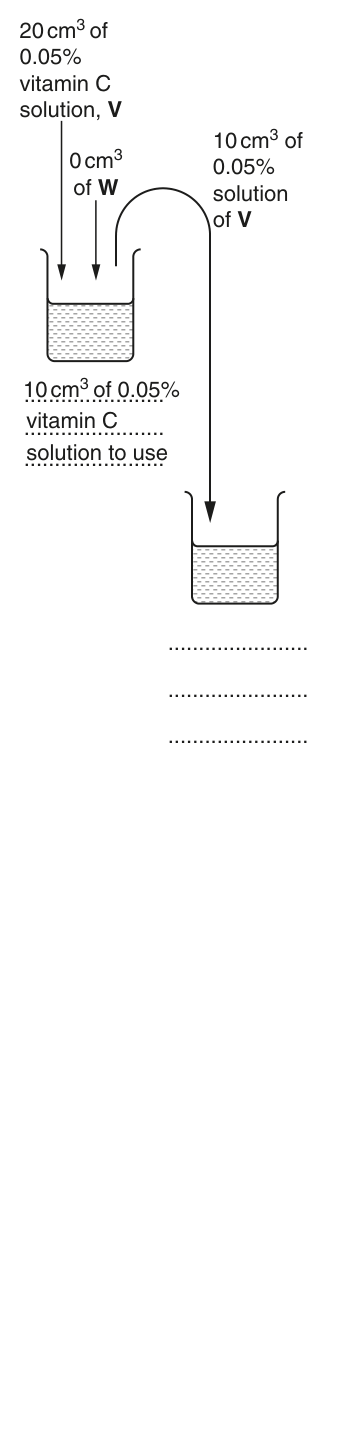
You are required to prepare a serial dilution of the vitamin C solution, V, which reduces the concentration of V by half between each successive dilution.
You will need to prepare of each concentration.
Fig. 1.1 shows the first two beakers you will use to make your serial dilution.
Complete Fig. 1.1 by drawing as many extra beakers as you need for your serial dilution.
For each beaker:
- state, under the beaker, the volume and concentration of the solution available for use in the investigation
- use one arrow, with a label above the beaker, to show the volume and concentration of vitamin C solution added to prepare the concentration
- use another arrow, with a label above the beaker, to show the volume of W added to prepare the concentration.
Proceed as follows:
- Prepare the concentrations of vitamin C solution as decided in (a)(i) and Fig. 1.1.
You are required to find the volume of DCPIP needed to reach the end-point for each of the concentrations of vitamin C solution prepared in (a)(i).
- Put of the lowest concentration of vitamin C solution into a test-tube.
- Put of DCPIP into the syringe, labelled D.
- Wipe off any drops of DCPIP from the outside of the syringe with a paper towel.
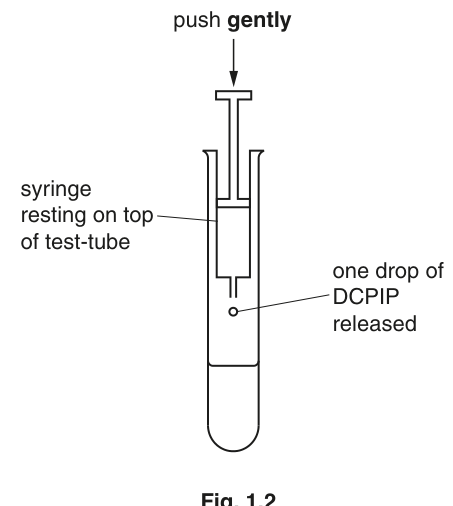
- Hold the syringe over the test-tube and push the plunger gently to release one or two drops of DCPIP as shown in Fig. 1.2.
- Shake the test-tube to mix the contents.
- Repeat step 5 and step 6 until the blue colour remains (does not disappear). This is the end-point.
- Record in (a)(ii) the volume of DCPIP needed to reach the end-point.
If the colour does not remain blue after adding of DCPIP, stop putting in DCPIP and record as 'more than 5'.
- Repeat step 2 to step 8 for each of the concentrations of vitamin C solution that you prepared in step 1.
Prepare the space below and record your results.
Describe one significant source of error when carrying out steps 3 to 9.
You are now required to estimate the concentration of vitamin C in a sample of plant extract, X, using DCPIP.
- Repeat step 2 to step 8 with X. Record in (a)(iv) the volume of DCPIP needed to reach the end-point.
State the volume of DCPIP needed to reach the end-point for X.
volume of DCPIP = ______
Use your results in (a)(ii) and (a)(iv) to estimate the concentration of vitamin C in X.
Describe how you could use this procedure to produce a more accurate estimate of the concentration of vitamin C in the sample of plant extract X than the one given in (a)(v).
Vitamin C is important in the human diet. It is essential for the growth and repair of tissues in the body.
Some vegetables contain vitamin C and can be eaten either uncooked (raw) or cooked.
A scientist carried out an investigation to determine the effect of heating on the vitamin C content of selected vegetables. The scientist measured the vitamin C content in of each food sample when raw and after boiling for 10 minutes.
All other variables were kept constant.
The results are shown in Table 1.1.
Table 1.1
| vitamin C content / mg per | ||
|---|---|---|
| vegetable | raw | after boiling |
| kale (K) | 48 | 45 |
| broccoli (B) | 79 | 44 |
| red pepper (R) | 126 | 89 |
Use a sharp pencil for charts.
Plot a chart of the data shown in Table 1.1.
Each pair of bars should be separated for each type of vegetable.

Calculate the percentage loss of vitamin C in broccoli as a result of boiling.
You may lose marks if you do not show your working.
percentage loss = ______
In raw vegetables vitamin C is contained within the cells of the tissues.
Suggest how boiling causes the loss of vitamin C in broccoli.
The rest of this paper
1 more questions- Q2Use of the Light Microscope · Manipulation, Measurement and Observation · Analysis, Conclusions and Evaluation19M