Biology 9700/34 — October/November 2016
Cambridge AS Level · Advanced Practical Skills · worked solutions for every part, with the mark scheme
Topics Analysis, Conclusions and Evaluation · Presentation of Data and Observations · Manipulation, Measurement and Observation · Use of the Light Microscope
When plant cells are placed into different concentrations of sodium chloride solution, water moves between the cells and the solutions. This will affect how much a piece of plant tissue can bend.
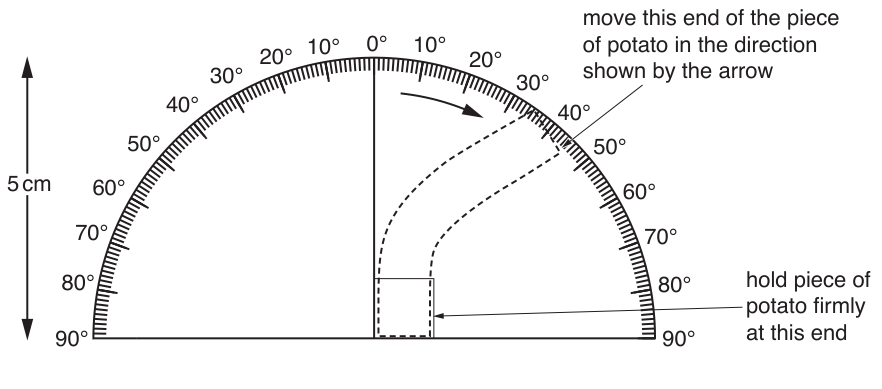
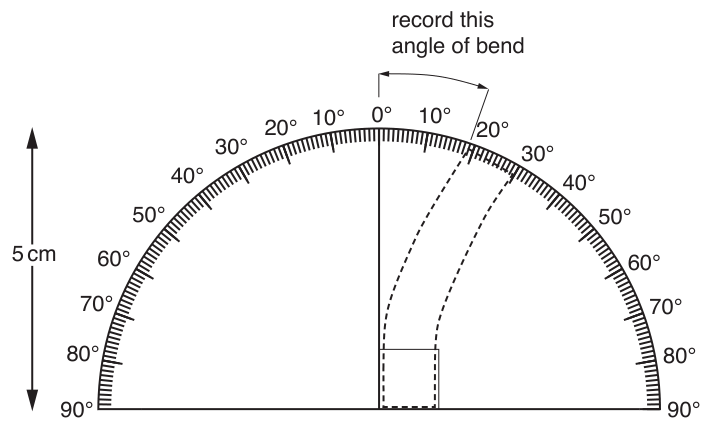
Fig. 1.1, Fig. 1.2 and Fig. 1.3 show the method you will use to measure the angle of bend of a piece of plant tissue (potato).
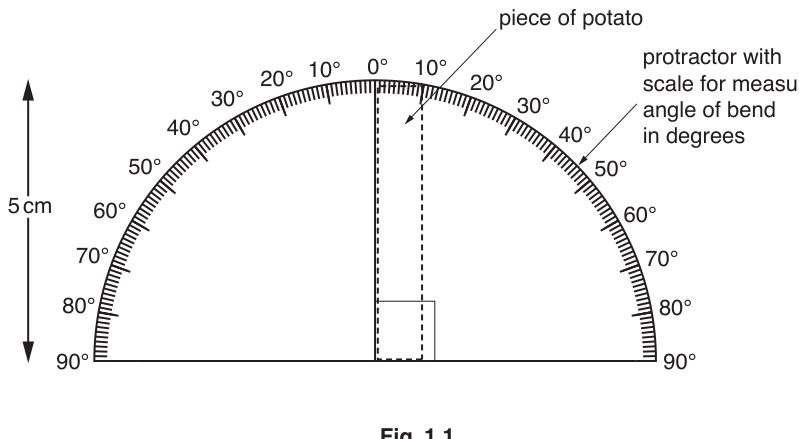
Note: you are provided with a sheet showing 4 protractors.
Do not cut these into separate protractors. Do not remove from the plastic covering.
You may use one or more of these to obtain your results.
Method of measuring the angle of bend
- Put the piece of potato in the starting position on one of the protractors provided, as shown in Fig. 1.1.
- Hold the bottom of the piece of potato firmly as shown in Fig. 1.2.
- Move the top of the piece of potato until there is some resistance.
- Release the top of the piece of potato.
- Measure the angle of bend, after releasing the top of the piece of potato, as shown in Fig. 1.3. The maximum angle of bend is .
Note: before measuring, remove excess liquid from the piece of potato and make sure the plastic covering on the page of protractors is dry.
You are provided with four different concentrations of sodium chloride solution labelled S1, S2, S3 and S4. Each concentration of sodium chloride solution contains two pieces of potato.
S1, S2 and S3 each contain one of the concentrations of sodium chloride solution, , and but not necessarily in that order.
S4 has an unknown concentration of sodium chloride solution.
Complete the sentence by selecting the correct word from: least or most or same.
The piece of potato soaked in the lowest concentration of sodium chloride solution will have the ______ angle of bend when compared to the other concentrations of sodium chloride solution.
You are required to:
- measure the angle of bend for each of the pieces of potato from S1, S2 and S3
- use these results to identify the concentrations of the sodium chloride solutions, S1, S2 and S3.
The size of the pieces of potato is a variable which needs to be standardised.
Decide how you will make sure that the pieces of potato are a standard size.
State the size you will use.
Describe how you will obtain accurate results to record the angle of bend.
Proceed as follows:
- Cut the pieces of potato as stated in (a)(ii) and return to the appropriate solution.
- Before measuring the angle of bend, remove excess liquid from the piece of potato using the paper towel.
- Measure the angle of bend of the pieces of potato from S1, S2 and S3 using the Method of measuring the angle of bend as described on page 3.
Note: before measuring, remove excess liquid from the piece of potato and make sure the plastic covering on the page of protractors is dry.
- Record your results in (a)(iv).
Prepare the space below and record your results.
Using your results in (a)(iv) state the concentration of sodium chloride solution in S1, S2 and S3.
S1 = ______
S2 = ______
S3 = ______
- Repeat step 3 using the pieces of potato from S4 and record your result in (a)(vi).
Record the angle of bend for the pieces of potato from S4.
Estimate the concentration of the sodium chloride solution in S4 using your results in (a)(iv), (a)(v) and (a)(vi).
You are expected to use a sharp pencil to draw graphs.
A student recorded angles of bend of for pure water ( sodium chloride solution) and for sodium chloride solution.
Plot a graph to show the relationship between the concentration of sodium chloride solution and the angle of bend using:
- the results recorded by the student
- your results as recorded in (a)(iv)
- the concentrations of sodium chloride solution stated in (a)(v).
A more accurate estimate for the concentration of sodium chloride solution in S4 can be found by using this graph.
Use your graph to estimate the concentration of sodium chloride solution in S4 using your answer to (a)(vi).
Show on the graph how you estimated the concentration of sodium chloride solution.
concentration in S4 = ______
Suggest how you would improve this procedure to have more confidence in your estimate of S4.
A student puts a piece of the potato from S1 into water.
Explain, in terms of water potential, the effect this would have on the potato cells.
The rest of this paper
1 more questions- Q2Use of the Light Microscope · Presentation of Data and Observations · Analysis, Conclusions and Evaluation19M