Biology 9700/34 — October/November 2015
Cambridge AS Level · Advanced Practical Skills · worked solutions for every part, with the mark scheme
Topics Manipulation, Measurement and Observation · Presentation of Data and Observations · Analysis, Conclusions and Evaluation
When plant tissue is soaked in methylene blue solution, the stain enters the tissue and colours it blue. When the stained plant tissue is placed into a salt solution, methylene blue is released.
You are required to investigate the effect of different surface areas (independent variable) on the release of methylene blue from pieces of stained plant tissue.
You are provided with:
| labelled | contents | hazard | volume / |
|---|---|---|---|
| S | salt solution (sodium chloride) | none | 250 |
| labelled | contents | hazard | details | quantity |
|---|---|---|---|---|
| P | plant tissue stained with methylene blue | methylene blue will stain your skin | same cross-sectional area, stained with methylene blue and washed | 4 pieces |
If any methylene blue comes into contact with your skin wash off immediately with water.
It is recommended that you wear safety glasses/goggles.
When carrying out a practical procedure, the hazards of the use of all the apparatus and solutions need to be considered. Then the level of risk needs to be assessed as low or medium or high.
State the hazard with the greatest level of risk when carrying out step 1 on page 4.
State the level of risk of the procedure: low or medium or high.
hazard ______
level of risk ______
You are required to prepare pieces of plant tissue with different surface areas.
Each piece of plant tissue has the same cross-sectional area. The largest piece needs to be cut to a length of by removing each end.
Complete Fig. 1.1 to show how you will cut further pieces which reduce the length by half between each piece of plant tissue. Fig. 1.1 is not drawn to scale.
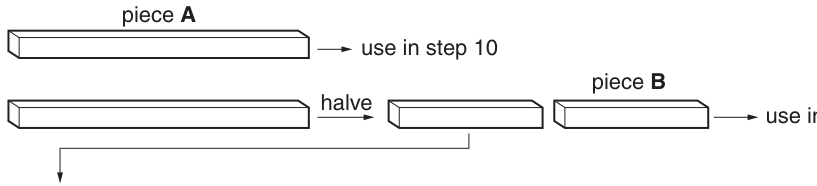
Complete the table to show for each piece in (b)(i):
- the dimensions of the piece of plant tissue
- the surface area of each piece.
| piece | dimensions / mm | surface area / |
|---|---|---|
| A | 850 | |
Proceed as follows:
Always use blunt forceps when handling the plant tissue to avoid contact with the methylene blue solution.
- Remove the pieces of plant tissue from the container, labelled P, and place them onto a white tile.
- Prepare the pieces of plant tissue as stated in (b)(ii).
- Any pieces of plant tissue which you do not need should be put into the beaker labelled 'For waste'.
You will need to prepare a number of pieces of plant tissue to enable you to have confidence in your results.
- Empty the coloured water from the container labelled P.
- Put the pieces of plant tissue into the empty container labelled P and cover with water from the beaker labelled 'Tap Water'.
- Change the tap water five times, either using a syringe or by pouring off the water.
Fig. 1.2 shows how you will set up the apparatus for each piece of plant tissue.
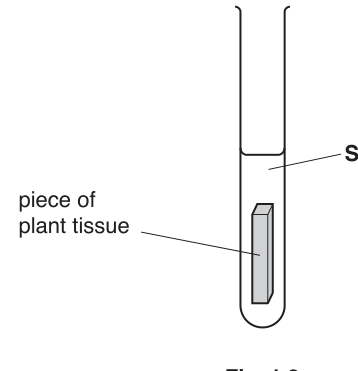
Describe how you will standardise the volume of S for each piece of plant tissue.
- Label one test-tube as 850 (surface area in of piece A).
- Repeat step 7 for each of the other surface areas as in (b)(ii).
- Put the volume of S into each of the test-tubes as described in (b)(iii).
- Put piece A into the test-tube labelled 850.
- Repeat for the other pieces of plant tissue, matching the surface area to the label on the test-tube.
- Leave for 5 minutes.
While you are waiting continue with Question 1.
After 5 minutes you will need to remove the plant tissue from each test-tube so that the colour of each solution can be recorded.
- After 5 minutes, pour the solution and the piece of plant tissue from one of the test-tubes into the beaker labelled R.
- Put the piece of plant tissue into the container labelled 'For waste'. Put the solution back into the test-tube.
- Rinse beaker R with tap water.
- Repeat step 13 to step 15 with each of the remaining test-tubes.
- Put the test-tubes into the test-tube rack in the order of the intensity (quantity) of blue colour from lowest intensity to highest intensity.
- Observe the colour in the test-tubes and use the number scale below to match each test-tube to an intensity of colour.

- Record the results in (b)(iv) on page 6.
Prepare the space below and record your results.
A student suggested:
'The ruler used to measure the pieces of plant tissue resulted in both systematic error and random error.'
State which type of error, systematic or random, could affect the trend in the results. Give a reason for your answer.
type of error ______
reason ______
Explain how the methylene blue solution was released from the stained plant tissue.
This procedure investigated the effect of different surface areas of stained plant tissue when placed into a salt solution.
To modify this procedure for investigating another variable, the independent variable (surface area) would need to be standardised.
Describe how the independent variable (surface area) would be standardised.
Consider how you would modify this procedure to investigate the effect of temperature on the stained plant tissue.
Describe how the independent variable, temperature, will be investigated.
The rest of this paper
1 more questions- Q2—23M