Biology 9700/33 — May/June 2015
Cambridge AS Level · Advanced Practical Skills · worked solutions for every part, with the mark scheme
Topics Manipulation, Measurement and Observation · Presentation of Data and Observations · Analysis, Conclusions and Evaluation · Use of the Light Microscope
When onion cells are placed into a solution, water will move depending on the water potential inside the cells and the water potential of the surrounding solution.
The water potential of a solution depends on both the concentration and the type of molecule dissolved.
You are required to:
- identify S1, S2 and S3 by carrying out tests for carbohydrates, using the reagents provided
- investigate the effect of water and each of the solutions S1, S2 and S3 on onion cells.
You are provided with:
| labelled | contents | hazard |
|---|---|---|
| S1, S2 and S3 | see below | none |
| W | water with one piece of onion tissue | none |
Each of S1, S2 and S3 contains a piece of onion tissue and one of the following:
- a mixture of sucrose solution and glucose solution
- sodium chloride solution
- starch solution.
By using only two of the biological molecule tests for carbohydrates, you should be able to identify the solutions, S1, S2 and S3.
Identify S1, S2 and S3 by carrying out tests using the apparatus and reagents provided.
Decide which biological molecule to identify in the first test.
Complete the following:
First test: Test for ______
Describe how you will use the reagent(s) to carry out this test.
Decide which biological molecule to identify in the second test.
Complete the following:
Second test: Test for ______
Describe how you will use the reagent(s) to carry out this test.
Prepare the space below and record your observations for each test.
Complete the table to identify S1, S2 and S3.
| molecule(s) | solution |
|---|---|
| mixture of sucrose and glucose | |
| sodium chloride | |
| starch |
When carrying out a practical procedure, the hazards of the use of all the apparatus and all of the reagents need to be considered, then the level of risk needs to be assessed as low or medium or high.
State the hazard with the greatest level of risk when using the apparatus and reagents to test S1, S2 and S3 for biological molecules.
State the level of risk of the procedure: low or medium or high.
hazard ______
level of risk ______
You are required to investigate the effect of water, W, and each of the solutions, S1, S2 and S3, on the cells of the epidermis of onion.
Complete the sentence below by choosing from the following words:
enters leaves plasmolysed turgid
You may use each word once or more than once or not at all.
When onion cells are placed into a solution with a more negative water potential than the cells, water ______ the vacuoles and the cells become ______ .
You are required to investigate the effect of water and each of the solutions on the onion cells by:
- observing 10 cells in one field of view
- counting and recording the number of these cells which are plasmolysed
- making a drawing of one typical cell from each of W and S1.
Proceed as follows:
- Label one clean, dry microscope slide ‘W’ and put the slide on a paper towel.
- Put a few drops of W onto the slide.
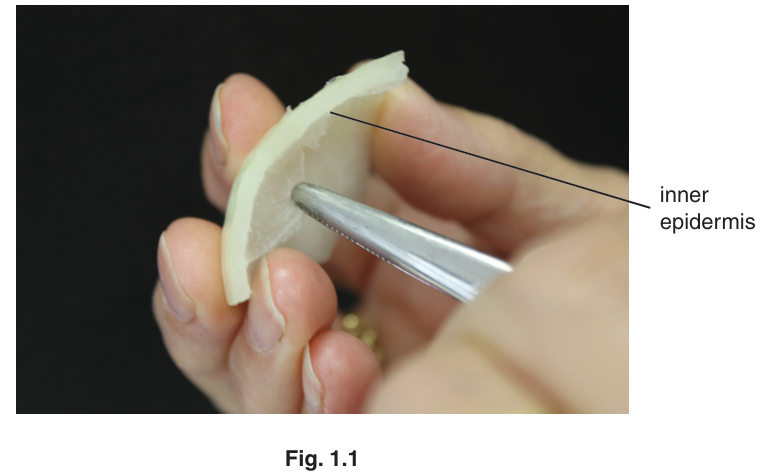
- Remove a piece of the onion tissue from W and, using forceps or fingers, peel off the inner epidermis, as shown in Fig. 1.1.
- Cut one piece of the epidermis that will fit under a coverslip. Replace the remaining epidermis into W.
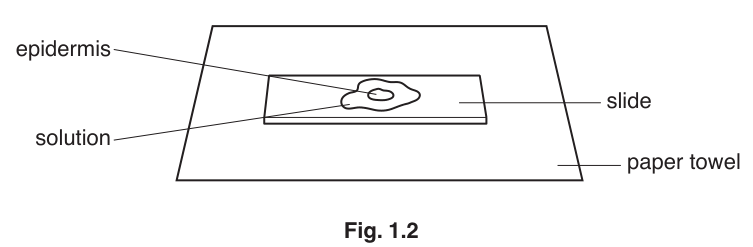
- Place the epidermis on the slide as shown in Fig. 1.2. If the epidermis is folded, you may need to add more drops of W so that it floats and uncurls.
- It is important to prevent the epidermis from drying out so add more drops of W if needed.
- Cover the epidermis with a coverslip and use a paper towel to remove any excess liquid that is outside the coverslip.
- Select an area of cells which show the effect of W. Observe 10 cells and record in (b)(ii) the number of these cells which show signs of plasmolysis.
- Repeat step 8 for a different field of view.
You may need to reduce the amount of light entering the microscope to observe cells clearly.
- Repeat steps 1 to 9 using the piece of onion from S1 and mounting the piece of epidermis in the solution from S1.
- Repeat steps 1 to 9 using the piece of onion from S2 and then the piece of onion from S3.
Prepare the space below and record your results.
Identify one significant error in measuring the dependent variable.
You are required to use a sharp pencil for drawings.
Make a drawing of one cell from the epidermis in W and one cell from the epidermis in S1. The cells you choose must show the effect of W and S1.
Use one ruled label line and label to identify the cytoplasm in each cell.
cell from epidermis in W
\n\n\n\n
cell from epidermis in S1
Explain, using your knowledge of the movement of water, the effect of S1 and S3 on the cells of the epidermis.
S1
\n\n\n
S3
The rest of this paper
1 more questions- Q2Manipulation, Measurement and Observation · Presentation of Data and Observations · Analysis, Conclusions and Evaluation · Use of the Light Microscope21M