Biology 9700/31 — May/June 2015
Cambridge AS Level · Advanced Practical Skills 1 · worked solutions for every part, with the mark scheme
Topics Presentation of Data and Observations · Manipulation, Measurement and Observation · Analysis, Conclusions and Evaluation · Use of the Light Microscope
Before you proceed, read carefully through the whole of Question 1 and Question 2.
Plan the use of the two hours to make sure that you finish all the work that you would like to do.
If you have enough time, consider how you can improve the accuracy of your results, for example by obtaining one or more additional measurements.
You will gain marks for recording your results according to the instructions.
Starch is the substrate of enzyme E. When they are mixed, a reaction takes place and a biological molecule is produced, the product.
You are required to investigate the effect of enzyme E on starch.
You are provided with:
| labelled | contents | hazard |
|---|---|---|
| S | 1% starch solution | none |
| E | enzyme solution | harmful irritant |
| W | distilled water | none |
| iodine | iodide solution | harmful |
| Benedict’s | Benedict’s solution | harmful |
Proceed as follows:
- Set up a water-bath to heat to boiling (approximately ) ready for step 9.
- Test a drop of solution S for starch and record your observations in (a)(i).
- Put of S into a test-tube.
- Put of E into the same test-tube.
- Shake the test-tube gently to mix the contents.
- Leave the test-tube for 5 minutes, shaking it occasionally.
- After 5 minutes, test a drop of the mixture from the test-tube for starch and record your observations in (a)(i).
Prepare the space below and record your observations.
Answer
| solution | observation (colour with iodine) |
|---|---|
| S | blue-black |
| S + E (after 5 min) | orange / brown / yellow |
The iodine test was repeated on each solution to confirm the observation.
S: blue-black; S + E: orange / brown / yellow.
Background Concept
Iodine solution (iodine dissolved in potassium iodide) is the standard qualitative reagent for starch. The polyiodide ions slot into the helical coil of amylose and form a charge-transfer complex that absorbs strongly in the visible region, producing the characteristic blue-black colour. If starch is absent, the iodine stays in its native yellow-brown/orange colour. The test is therefore effectively a yes/no test for the presence of intact starch.
In this practical, S is a 1% starch solution and E is an enzyme solution. When the two are mixed and left for 5 minutes, the enzyme hydrolyses starch into smaller sugars (maltose and/or glucose). By step 7 there should be little or no intact starch left, so the second iodine test will not turn blue-black.
Understanding the Question
Steps 2 and 7 ask the candidate to take a drop of solution, add iodine, and record the colour. The command word is "record your observations", so what is being marked is the actual colour seen (not an interpretation such as "starch present").
The mark scheme requires (i) a table with the correct two headings, (ii) the correct colour for S alone and the correct non-blue-black colour for the S + E mixture after incubation, and (iii) evidence that the test was repeated. Repeating the qualitative test on more than one drop is good practice in any practical, and the mark scheme awards a point for it.
Approach
- Draw a two-column table. Head the columns solution (or sample) and observation (colour with iodine) – both headings are needed for the first marking point.
- Test a drop of S with iodine on a white tile or in a test-tube. Record the colour (blue-black).
- Test a further drop to confirm – the colour should be the same. Record again if any difference.
- After the 5-minute incubation, take a drop of the S + E mixture, add iodine and record the colour (orange / brown / yellow). Repeat to confirm.
Step-by-Step Reasoning
- S alone: the helical starch polymers are intact, so iodine forms the starch–iodine complex and the drop turns blue-black. The colour is written into row 1 of the table.
- S + E (after 5 min): the enzyme has hydrolysed the starch, so there is no helical polymer left to complex with iodine. The drop stays the colour of dilute iodine – any of orange, brown or yellow is acceptable. This is written into row 2.
- A single test of each is risky because the colour change can be missed or misread; repeating the test (the third marking point) gives the candidate confidence that what they record is what they actually saw.
Key Takeaways
- Iodine in KI gives a blue-black colour with intact starch; otherwise it is orange/brown/yellow.
- A clear two-column table is the conventional way to record paired observations in Paper 3.
- Qualitative tests should be repeated to confirm before being written down.
Common Mistakes
- Writing only one row (the result for the S + E mixture) and forgetting to test and record the S alone control.
- Using vague language such as "no change" or "clear" – the mark scheme requires an actual colour.
- Writing the colour of the mixture itself instead of the colour seen when iodine is added.
- Omitting the reagent from the column heading – the examiner needs to know that the colour is with iodine.
Things to Be Careful About
- "Blue-black" (one hyphen, both words) is the accepted spelling; "blue/black" or "dark blue" will not score.
- The colour should be read against a white background in good light – reflected colour from the bench can give a misleading tint.
- The "repeats the experiment" point is for the candidate to demonstrate they tested more than once; a written note ("test repeated") is sufficient.
The rate at which enzyme E catalyses a reaction with S can be investigated by measuring the rate at which the products of the reaction are produced.
You are required to identify the type of biological molecule produced (the product) when S and E are mixed.
- Put of Benedict’s into the test-tube containing the mixture of S and E. This will inhibit enzyme E.
- Put this test-tube into the boiling water-bath and immediately start timing.
Record the time taken for the first appearance of any colour change. If there is no colour change after 180 seconds remove the test-tube from the water-bath and record your result.
Answer
Time for first appearance of colour change (Benedict's test on S + E) = 35 s (example; the candidate records the actual time they observe).
35 s (representative; the candidate's own whole-number reading in s).
Background Concept
Benedict's reagent is a copper(II) citrate solution in alkali. When it is heated with a reducing sugar, the blue Cu²⁺ ions are reduced to red Cu₂O, giving a colour change blue → green → yellow → orange → brick-red. The product of the starch-hydrolysing enzyme is a reducing sugar (maltose and/or glucose), so the Benedict's test will go positive. The shorter the time taken for the first appearance of any colour change, the faster the enzyme-catalysed reaction has produced reducing sugar.
Understanding the Question
Step 9 asks the candidate to put the S + E test-tube (now with 4 cm³ of Benedict's added) into a boiling water-bath and time the first appearance of any colour change. If nothing has changed after 180 s the test-tube is removed and "more than 180" is recorded. The single mark is for stating this time as a whole number, with the unit (seconds / s / sec(s)).
Approach
- Have a stopwatch (or use the timer on a phone / clock) ready before putting the test-tube into the water-bath.
- Start timing the instant the tube goes into the boiling water.
- Watch the upper part of the liquid where the colour change is most visible, and stop the timer the moment any non-blue colour appears.
- Record the time as a whole number in seconds.
Step-by-Step Reasoning
- 1% starch is the highest substrate concentration in this investigation. With ample substrate the enzyme should be working close to its maximum rate, so the time for the first appearance of any Benedict's colour is relatively short – typically around 30–60 s for a 1% starch + enzyme mixture.
- A representative value of 35 s is used here; the actual time in the lab will depend on the activity of the enzyme, the age of the Benedict's reagent and the temperature of the water-bath. The candidate's own reading, expressed as a whole number in seconds, is what scores the mark.
- If no change is seen by 180 s the procedure says to record "more than 180". This is an unlikely outcome for the 1% tube, but is the expected outcome for the most dilute tubes in (b).
Key Takeaways
- A shorter time = a faster rate of reducing-sugar production.
- The mark is for a whole number plus the correct unit (s / seconds / sec(s)).
- The result recorded here is reused in the (b)(ii) results table as the 1% time.
Common Mistakes
- Writing the time in minutes or as a decimal (e.g. "0.58 min" or "35.5 s") – the mark scheme requires a whole number of seconds.
- Forgetting the unit, or writing "seconds" without a number.
- Including the time for the test-tube to heat up in the water-bath before the colour appears (the timer starts when the tube enters the bath, not when colour appears).
Things to Be Careful About
- A stopwatch that records to 0.01 s should still be read to the nearest whole second for this record.
- The colour change begins at the meniscus where the liquid is hottest; watch there.
- The 180 s cut-off is the practical end-point; do not keep the tube in longer than the procedure allows.
- Turn off the Bunsen burner.
Explain the effect that enzyme E has on starch, using your observations from (a)(i) and the result from (a)(ii).
Answer
The enzyme E hydrolyses (digests) starch, breaking it down into smaller sugars (which give a positive Benedict's test).
Enzyme E hydrolyses (digests) starch.
Background Concept
Starch is a polymer of α-glucose linked mainly by 1,4-glycosidic bonds (with 1,6 branch points in amylopectin). It is hydrolysed by amylase-type enzymes at the glycosidic bonds, releasing maltose (a disaccharide) and ultimately glucose. The iodine test detects the intact helical polymer of starch; once the polymer is broken into short fragments or single sugars, the helix no longer forms and the blue-black colour is lost. Benedict's reagent detects the products of hydrolysis – reducing sugars (maltose, glucose) – via reduction of Cu²⁺ to red Cu₂O on heating.
Understanding the Question
The candidate is given two pieces of evidence: (1) the iodine test goes from blue-black to non-blue-black after incubation with E (from (a)(i)), and (2) Benedict's reagent gives a positive (colour-changing) result on the incubated mixture (from (a)(ii)). The command word is "explain", so the candidate must link the two observations to what the enzyme has done to the starch.
Approach
- Recognise that loss of the blue-black colour = starch is no longer present in its intact form.
- Recognise that a positive Benedict's test = a reducing sugar is now present.
- Combine these into one statement: the enzyme has converted the starch into reducing sugar(s). The single marking point is awarded for any wording that captures "hydrolysis" or "digestion" of starch.
Step-by-Step Reasoning
- The blue-black colour in (a)(i) shows that S contains intact starch, and its absence after incubation with E shows that the starch has been broken down.
- The colour change with Benedict's in (a)(ii) shows that a reducing sugar is present in the mixture. The reducing sugar has to have come from the starch (the only other reagent is the enzyme itself, which is not a reducing sugar in this context), so the starch has been converted into a reducing sugar.
- Putting these together: the enzyme has hydrolysed (digested) the starch into a reducing sugar. Any of "hydrolyses", "digests", "breaks down" or "splits" the starch scores the mark.
Key Takeaways
- Loss of iodine colour + gain of Benedict's colour = starch → reducing sugar.
- "Hydrolyses" is the precise word; "digests" is also accepted.
- This part is testing the candidate's ability to combine two observations into a single biological conclusion.
Common Mistakes
- Restating the observations without explaining the enzyme's action (e.g. "the iodine went brown and Benedict's went orange") – this is description, not explanation.
- Saying the enzyme "destroys" starch without saying what it has been converted into.
- Stating only that the enzyme "reacts with starch" – this is too vague and does not capture hydrolysis or the formation of product.
Things to Be Careful About
- "Hydrolysis" is the technical word; spelling counts and "hydrolosis" / "hydrolises" will lose the mark.
- One well-formed sentence is enough; do not pad the answer.
Suggest the name of a biological molecule that could have been produced when S and enzyme E were mixed.
Answer
Maltose (glucose is also accepted).
Maltose (or glucose).
Background Concept
Starch is a polymer of α-glucose. Hydrolysis by an amylase-type enzyme cleaves the 1,4-glycosidic bonds and releases the disaccharide maltose (two glucose units joined by an α-1,4 bond). Maltose is a reducing sugar (its C1 anomeric carbon is free), which is why it gives a positive Benedict's test. With prolonged hydrolysis (or with a maltase present as a contaminant) the maltose can be further hydrolysed to free glucose, which is also a reducing sugar.
In this practical, the enzyme is supplied as a single solution and its identity is not specified, so the examiner accepts either product – both are reducing sugars and both fit the positive Benedict's test.
Understanding the Question
The candidate is asked to name a biological molecule that could have been produced when S and E were mixed. The single mark is for one of the two reducing sugars formed when starch is hydrolysed.
Approach
Recognise that starch is a polymer of glucose, so the hydrolysis products must be glucose-containing fragments. The most likely short product is maltose (the disaccharide repeated unit of starch); free glucose is also possible if hydrolysis is more complete.
Step-by-Step Reasoning
- Starch = (glucose) polymer.
- Hydrolysis of α-1,4 bonds gives maltose (and, with further hydrolysis, glucose).
- Both maltose and glucose are reducing sugars that give a positive Benedict's test, so either is consistent with the observation in (a)(ii).
- The mark scheme accepts maltose or glucose; other sugars (sucrose, lactose, fructose) are not produced by starch hydrolysis and would be rejected.
Key Takeaways
- The hydrolysis of starch by an amylase-type enzyme yields maltose (and ultimately glucose).
- Both are reducing sugars, so both produce a positive Benedict's test.
- This is recall of a single piece of factual knowledge; the answer should be one word.
Common Mistakes
- Writing "sugar" unqualified – too vague; a specific sugar is required.
- Writing "starch" (the substrate, not the product).
- Writing "sucrose" or "lactose" – these are not produced by amylase hydrolysis of starch.
- Spelling "maltose" as "maltose" with one t – correct spelling is m-a-l-t-o-s-e.
Things to Be Careful About
- Either maltose or glucose is acceptable – pick one and write it.
- The mark is for the name only; no explanation is needed or credited.
When carrying out a practical procedure, the hazards of the use of all the apparatus and all of the reagents need to be considered, then the level of risk needs to be assessed as low or medium or high.
State the hazard with the greatest level of risk when carrying out steps 8 to 10.
State the level of risk of the procedure: low or medium or high.
hazard = ______
level of risk = ______
Answer
hazard = boiling water (water-bath at 100 °C)
level of risk = medium
Boiling water; medium.
Background Concept
In Paper 3, candidates are expected to consider the hazards of all the apparatus and reagents they use, then judge the level of risk (low, medium or high) for each. The level of risk takes into account both the severity of the harm (e.g. a small burn vs a large one) and the likelihood of it happening with sensible lab technique (e.g. with water at 100 °C, a splash is possible but a candidate is unlikely to immerse a hand).
Steps 8–10 of this question involve: (8) pipetting Benedict's solution (harmful, irritant), (9) putting a test-tube into a boiling water-bath, starting timing, then (10) turning off the Bunsen burner. The Bunsen flame is the source of heat; the boiling water transfers that heat to the test-tube; a slip or splash from the water-bath would cause a scald.
Understanding the Question
The candidate must (i) name the hazard with the greatest level of risk across steps 8–10, and (ii) state its level of risk as low / medium / high. The mark scheme awards the mark for the correct level (medium or high) provided the named hazard is consistent with that level.
Approach
- List the candidate hazards across steps 8–10: Benedict's solution (harmful, irritant), boiling water in the water-bath (scalds), Bunsen flame (burns), hot glass test-tube (burns on contact).
- Judge which of these carries the greatest level of risk when sensible lab technique is followed. Benedict's is in small volume, used with care, and is harmful rather than corrosive – its risk is low. Boiling water is in an open beaker, can splash when the tube is inserted, and causes immediate scalds – its risk is medium.
- State the dominant hazard and its level.
Step-by-Step Reasoning
- Benedict's solution is labelled harmful and irritant. Used as 4 cm³ in a test-tube with a teat pipette, the most likely exposure is a small splash to skin. The volume is small and the reagent is not corrosive, so the level of risk is low.
- Boiling water is at approximately 100 °C. Inserting a cold test-tube can cause a small splash, and removing the test-tube to read the colour requires handling hot glassware near the bath. A splash of boiling water on skin causes an immediate scald. The likelihood is moderate (occasional splashes do occur in real labs) and the severity is moderate-to-high (scalds are painful and take time to heal), so the level of risk is medium.
- The Bunsen flame is the heat source but is unlikely to be touched; its risk is lower than the boiling water it produces.
- The most defensible answer is therefore boiling water at medium level of risk. The mark scheme accepts any well-justified hazard paired with the correct level (medium or high).
Key Takeaways
- The level of risk combines severity and likelihood, not severity alone.
- For an open boiling water-bath, "medium" is the appropriate level of risk with sensible lab technique.
- Candidates should always identify a specific hazard, not just say "careful" or "lab safety".
Common Mistakes
- Stating the level of risk as "low" for boiling water – this understates the risk and loses the mark.
- Stating the level of risk as "high" without justification – hot water at 100 °C is not normally classed as a high risk with sensible technique (it would be high if the water were at much higher pressure, e.g. an autoclave).
- Naming a hazard that is not present in steps 8–10 (e.g. the iodine from earlier steps, or the enzyme E), which is outside the scope of the question.
- Writing "the Bunsen" without specifying the hazard it poses (e.g. "Bunsen flame – burn").
Things to Be Careful About
- The question restricts the assessment to steps 8–10; do not include hazards from earlier steps.
- The level of risk is medium or high to score; "low" for any hazard in this part is unlikely to be correct.
A student investigating the effect of enzyme E on starch suggested the hypothesis:
“lowering the concentration of starch below 1% will have no effect on the rate at which the product is produced.”
You are required to investigate this hypothesis by:
• carrying out a serial dilution of S
• investigating the effects of different concentrations of starch solution on the rate at which the product is produced.
You are required to make a serial dilution of the 1% starch solution, S, which reduces the concentration of the starch solution by half between each successive dilution.
You will need to prepare of each concentration.
You should use the beakers shown in Fig. 1.1 to show how you will prepare the serial dilutions.
For each beaker, complete Fig. 1.1 to show how you will dilute the solution by:
• stating, under the beaker, the concentration and volume of the starch solution available for use in the investigation
• using one arrow, with a label above the beaker, to show the concentration and volume of starch solution added to prepare the concentration
• using another arrow, with a label above the beaker, to show the volume of W added to prepare the concentration.
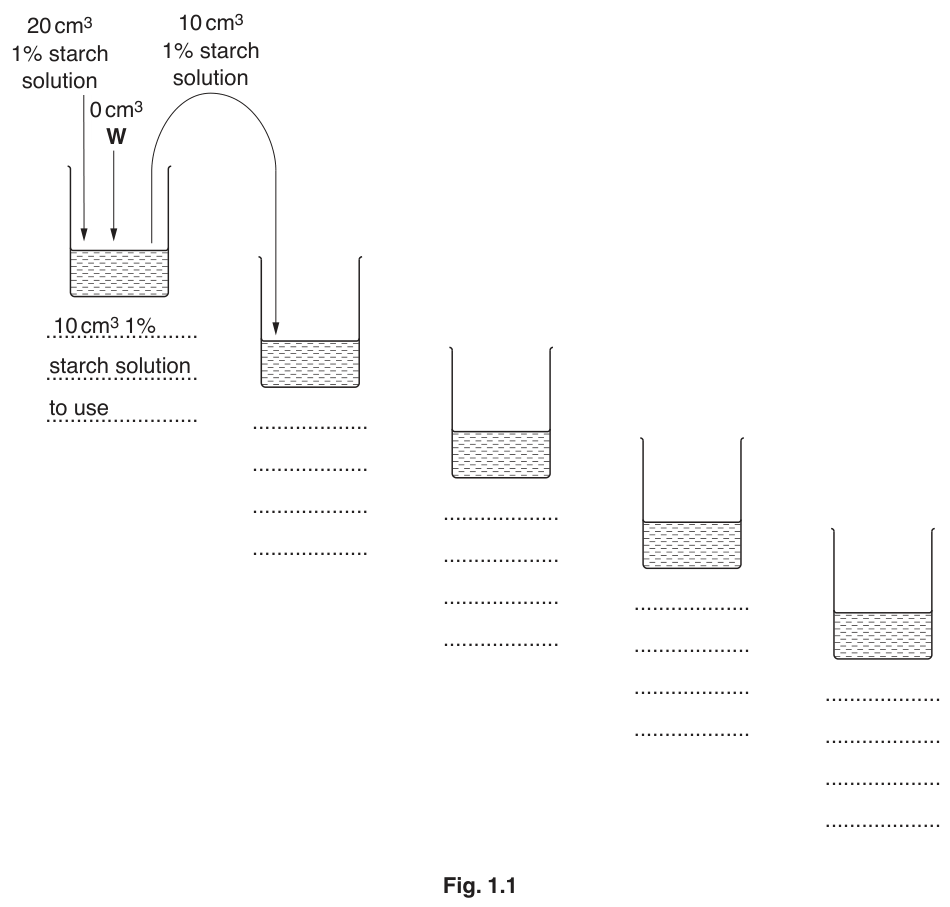
Fig. 1.1
Answer
Completed Fig. 1.1 (beakers 2–5, left to right):
| Beaker | Added from previous beaker | Added W | Concentration available to use | Volume available to use |
|---|---|---|---|---|
| 2 | of 1% starch | 0.5% | ||
| 3 | of 0.5% starch | 0.25% | ||
| 4 | of 0.25% starch | 0.125% | ||
| 5 | of 0.125% starch | 0.0625% |
(Beaker 1 is given in the printed figure: 20 cm³ of 1% starch, 0 cm³ of W, 10 cm³ transferred to beaker 2, leaving 10 cm³ of 1% starch to use.)
0.5%, 0.25%, 0.125%, 0.0625% in beakers 2–5; 10 cm³ transferred from each beaker to the next; 10 cm³ of W added to each of beakers 2–5.
Background Concept
A serial dilution is a stepwise dilution in which each new concentration is made from the previous one, rather than by diluting the original stock each time. The advantage is that a wide range of concentrations can be made accurately with few stock solutions, using only one concentration of stock.
In this dilution the concentration is to be halved at each step. To halve a concentration by mixing two equal volumes: take a fixed volume of the current concentration and add an equal volume of diluent (here distilled water, W). Because the dilution factor is , halving the concentration requires . A convenient choice is giving a total of in each beaker, of which is then transferred to the next beaker.
Understanding the Question
The candidate is given a printed Fig. 1.1 showing five beakers. Beaker 1 is already filled in: it contains of 1% starch solution, has of W added, is transferred to beaker 2, and of 1% starch solution is left to use. The candidate must complete beakers 2–5 by writing the concentration and volume under each beaker, and by adding arrows above each beaker showing what was added to make that concentration.
The mark scheme awards three points: (1) the correct halving sequence of concentrations under the beakers (0.5, 0.25, 0.125, 0.0625, all in %); (2) the transfer of from the previous beaker shown for at least three beakers; (3) the addition of of W to four beakers.
Approach
- Recognise that a halving dilution can be done by mixing equal volumes of stock and water. Choose to keep volumes manageable and to give in each beaker, of which is transferred onwards.
- Apply the halving sequence: 1% → 0.5% → 0.25% → 0.125% → 0.0625%.
- On the diagram, draw an arrow into each of beakers 2–5 from the previous beaker labelled " of [previous concentration]", and a second arrow from a water source labelled " of W".
- Under each of beakers 2–5 write the resulting concentration and the volume available to use ( each, since is transferred out leaving to use – beaker 5 has no transfer out so still has to use, but more could be left in the beaker; the wording in the printed beaker 1 says " ... to use").
Step-by-Step Reasoning
- Halving maths: if , the new concentration is exactly half the old one. So .
- Volumes: to keep every beaker at a convenient working volume, mix of the previous concentration with of W to make . Then transfer of this new concentration to the next beaker, leaving available for use in the investigation (beaker 1 shows this format). For the last beaker (5), the is not transferred onwards but is left to use.
- Arrows: above each of beakers 2–5 the candidate must add an arrow from the previous beaker labelled " of [concentration]" and a second arrow labelled " of W". These two arrows together describe how the contents of the beaker were prepared.
- Concentrations written under each beaker: the new concentration followed by the % sign, and the volume available to use ( of that concentration).
Key Takeaways
- Serial dilution saves stock and gives a wide range of concentrations.
- Equal volumes of stock and water → concentration halves.
- The transfer of a fixed volume from one beaker to the next is the unifying step; the volume of water added at each step is constant.
Common Mistakes
- Adding different volumes at each step (e.g. then ) – this would not produce a clean halving series and would not give equal volumes to use.
- Writing the wrong concentrations (e.g. 0.5, 0.10, 0.05 ... instead of halving each time).
- Forgetting to label the arrows with both the concentration being added and the volume.
- Writing the volume under the beaker as the total in the beaker () instead of the volume available to use ().
- Putting the % sign in the wrong place – it should be next to the concentration number, not next to the volume.
Things to Be Careful About
- The question says "prepare of each concentration" – this is the volume prepared, but the candidate will only need per concentration in step 14, so available to use is more than enough.
- Beaker 1 in the printed figure is the template – match its layout exactly so the examiner can read the answer at a glance.
- Use the same units (cm³) and the same shorthand (W for water, S for starch solution) as the printed figure.
Proceed as follows:
- Prepare the concentrations of starch solution as stated in (b)(i).
- Label test-tubes with the concentrations of starch solution you have prepared.
- Put of the lowest concentration of starch solution into the labelled test-tube.
- Repeat step 13 with each of the other concentrations of starch solution.
- Put of E into each of the test-tubes.
- Shake each test-tube gently to mix the contents.
- Leave the test-tubes for 5 minutes, shaking them occasionally. Relight the Bunsen burner to prepare a boiling water-bath ready for step 19.
- After five minutes, put of Benedict’s into each of the test-tubes.
- Put the test-tubes containing the two lowest concentrations of starch solution into the boiling water-bath and immediately start timing.
- Record in (b)(ii) the time taken for the first appearance of any colour change.
If there is no colour change after 180 seconds, remove the test-tubes from the water-bath and record ‘more than 180’. - Repeat steps 19 and 20 with the remaining test-tubes.
Prepare the space below and record your results, including the result from (a)(ii).
Answer
| concentration of starch solution (%) | time for first appearance of colour change / s |
|---|---|
| 1.0 (from (a)(ii)) | 35 |
| 0.5 | 50 |
| 0.25 | 80 |
| 0.125 | 130 |
| 0.0625 | more than 180 |
(Times are representative – the candidate records the actual whole-number seconds they observe; the trend – 1% faster than 0.0625% – must be visible in the recorded values.)
Five whole-number times (s), with 1% the fastest, increasing as the starch concentration falls; the lowest concentration may be 'more than 180'.
Background Concept
A results table in Paper 3 must have:
- a clear heading for the independent variable (here, concentration of starch solution in %);
- a clear heading for the dependent variable (time for the first appearance of colour change) with units (s, seconds, or sec(s) are all accepted);
- a sensible number of decimal places (here, whole numbers of seconds – the candidate should not write 35.0 s or 35.00 s);
- all the data the candidate has collected, including any reused readings (here, the 1% time from (a)(ii) goes in the top row).
The investigation is testing how substrate concentration affects the rate of an enzyme-catalysed reaction. At low substrate concentrations, fewer enzyme active sites are occupied at any instant, so the rate of product formation is lower – this translates to a longer time for Benedict's to give a positive result. At higher substrate concentrations the rate increases until the enzyme is saturated, after which further increases make little difference. Over the range used here (1% down to 0.0625%), the rate is expected to fall roughly in line with the falling concentration.
Understanding the Question
The candidate has carried out steps 11–21: prepared five concentrations of starch (1%, 0.5%, 0.25%, 0.125%, 0.0625%), mixed each with enzyme E, incubated for 5 minutes, then timed the first appearance of a colour change with Benedict's reagent in a boiling water-bath (180 s cut-off). The question asks the candidate to record these results, including the result from (a)(ii), in a table.
The mark scheme awards four points: (1) a heading for concentration; (2) a heading for time with units; (3) at least five whole-number results for five different concentrations; (4) the 1% result lower (faster) than the lowest concentration result.
Approach
- Draw a two-column table before starting the timing, with headings ready.
- After each timed test, enter the whole-number time in the appropriate row, alongside the concentration.
- Include the (a)(ii) reading in the row for 1% – it is the same procedure, so it is the most reliable value for that concentration.
- If no colour change is seen within 180 s, record "more than 180" in the appropriate row.
- The trend should be visible in the table: times get longer as concentration gets lower (rate decreases).
Step-by-Step Reasoning
- Heading for concentration: the table needs a column (or row) headed concentration of starch solution with the unit (% or % starch solution) given. The mark scheme insists on the % sign or the word "percentage".
- Heading for time: the second column should be headed time for first appearance of colour change and the unit must be s, second(s) or sec(s). Without a unit the column heading loses the mark.
- Five whole-number results: the table should contain five rows (one for each concentration), each with a whole number in the time column. "More than 180" is acceptable for any tube that failed to change colour within 180 s.
- Reused (a)(ii) value: the 1% tube in this part is the same as the tube in (a)(ii), so the candidate should reuse the (a)(ii) time rather than re-time it. (If the candidate did re-time it and got a slightly different value, that is also acceptable as long as it is a whole number of seconds.)
- Trend visible: times should be longer at lower concentrations; the 1% time must be the lowest (or among the lowest). Representative values: 1% = 35 s; 0.5% = 50 s; 0.25% = 80 s; 0.125% = 130 s; 0.0625% = more than 180 s. The exact values depend on the candidate's own observations; the trend is what is being marked.
Key Takeaways
- A results table needs a heading for every column, with units where appropriate.
- The (a)(ii) reading is the 1% point of this part and must be carried over.
- The expected trend in this experiment is that time increases as substrate concentration falls (rate decreases).
Common Mistakes
- Omitting the unit in the time column heading.
- Recording times as decimals (e.g. 35.5 s) when the procedure only allows whole-second precision.
- Recording times in minutes or as fractions of a minute.
- Failing to include the (a)(ii) value as the 1% row.
- Not writing "more than 180" for any tube that did not change within 180 s, or writing just "180" which implies a change exactly at 180 s.
- Reversing the trend (1% slower than dilute tubes) – this would indicate a procedural error and loses the trend mark.
Things to Be Careful About
- The 180 s cut-off is a one-way door: once the timer reaches 180 s, the tube is removed and "more than 180" is recorded. The candidate should not keep the tube in longer to see if a change eventually appears.
- The order in which tubes are heated matters for fairness; the procedure says to start with the two lowest concentrations (which are the slowest) so they have time to react while the others are done. Following the procedure order keeps the results comparable.
- Use the same unit (s) and the same number of significant figures down the column.
Using your results, calculate the rate at which the product is produced when the concentration of starch is 1%.
______
Working
For (the 1% reading from (a)(ii)):
Answer
rate ≈ (for a 1% time of 35 s; the candidate substitutes their own reading from (a)(ii)).
rate ≈ 0.03 s⁻¹ (for a 1% time of 35 s; the candidate uses their own value).
Background Concept
The rate of a reaction is the amount of product formed per unit time. Here the amount of product is fixed – it is the smallest amount that gives a visible Benedict's colour change. So the time taken to reach that fixed amount is inversely proportional to the rate:
A short time means a fast rate; a long time means a slow rate. The reciprocal therefore gives a direct measure of rate, and the unit becomes the reciprocal of the time unit, here (per second).
Understanding the Question
The candidate is asked to use their 1% result (the time recorded in (a)(ii)) to calculate the rate at which product is produced when the starch concentration is 1%. The single mark is for the correct numerical answer using the candidate's own reading.
Approach
- Take the time from (a)(ii) – call it seconds.
- Calculate using a calculator.
- Round to an appropriate number of significant figures (2 s.f. is fine for a value of order ).
- Write the answer with the unit .
Step-by-Step Reasoning
- For a representative 1% time of : .
- Rounded to 2 s.f. this is , or to 1 s.f. . Either is acceptable; the mark scheme awards the mark for a correct calculation from the candidate's own time.
- The unit (per second) is the reciprocal of seconds and must be quoted. A bare number without the unit loses the mark.
- If the candidate's 1% time was, say, , the rate would be . The candidate's own value determines the numerical answer.
Key Takeaways
- When the amount of product is fixed, the rate is (and the unit is the reciprocal of the time unit).
- The (a)(ii) reading is reused here – the same tube, the same time, the same rate.
- The answer is student-dependent; the mark is for the correct manipulation of the student's own data.
Common Mistakes
- Writing the time itself (35 s) as the rate – the question asks for the rate, not the time.
- Writing the unit as s (seconds) instead of – rate is per second, not seconds.
- Computing the rate from the wrong tube (e.g. from a 0.5% time) – the question specifies the 1% concentration.
- Using an inappropriate number of significant figures (e.g. to 7 s.f.) – 2 s.f. is plenty for a practical reading.
Things to Be Careful About
- The mark scheme awards the mark for a correct answer calculated from the candidate's results – so an error in (a)(ii) carries forward. If the (a)(ii) reading is, say, 30 s, the rate is and that is what scores the mark.
- Do not average the 1% reading with anything else; it is a single time for a single concentration.
- Show the working (1/35) so the examiner can see what the candidate has done, even though only the final number is being marked.
The student’s hypothesis stated that “lowering the concentration of starch below 1% will have no effect on the rate at which the product is produced”.
State whether you support or reject this hypothesis. Explain how your results provide evidence for this decision.
support/reject ______
explanation ______
Answer
Reject.
The colour change was fastest (shortest time) at 1% starch, and the time increased as the starch concentration decreased, so the rate of product formation is lower at lower concentrations – therefore the concentration of starch does affect the rate of product production.
Reject. The colour change was fastest at 1% and slower at lower concentrations, so the rate of product production decreases as the starch concentration is lowered.
Background Concept
A hypothesis is a testable statement about the relationship between two variables. To support or reject a hypothesis using experimental data, the candidate must:
- decide which way the evidence points (does it match the prediction?);
- cite the specific data that supports the decision;
- use the data to justify the conclusion.
Here the hypothesis is: "lowering the concentration of starch below 1% will have no effect on the rate at which the product is produced." This predicts that the rate (and therefore the time for the Benedict's colour change) will be the same at all starch concentrations below 1%. The data either support this (all times roughly equal) or reject it (times differ systematically with concentration).
Understanding the Question
The candidate is asked to state whether they support or reject the hypothesis, and to explain using their results. The mark scheme awards one mark for the decision (reject) and one mark for the evidence (the colour change was fastest at 1%, i.e. shortest time at 1% and longer times at lower concentrations).
Approach
- Look at the results table: do the times for the different concentrations agree within experimental error, or do they differ?
- Decide: if times differ systematically with concentration → reject the hypothesis; if they are similar → support it.
- State the decision first ("support" or "reject"), then the evidence.
Step-by-Step Reasoning
- In the expected outcome of this experiment, time increases as starch concentration falls (1% fastest, 0.0625% slowest). This is because at lower substrate concentration fewer active sites are occupied at any instant, so the rate of product formation is lower and it takes longer to accumulate the threshold amount of reducing sugar needed to give a visible Benedict's colour change.
- The candidate's own table should show this trend: the 1% time is the lowest (or among the lowest) and the times rise as the concentration falls. Representative values: 1% = 35 s; 0.5% = 50 s; 0.25% = 80 s; 0.125% = 130 s; 0.0625% = more than 180 s.
- Because the times differ (and the rate of product production therefore depends on the starch concentration), the hypothesis ("lowering the concentration of starch below 1% will have no effect on the rate") is rejected.
- The candidate should write: "reject" and then a one-sentence explanation that names the trend – the colour change was fastest at 1% and slowest at the lowest concentration.
Key Takeaways
- To reject a hypothesis, give the data that contradicts the prediction.
- Here the data are the times in the (b)(ii) table; the relevant comparison is 1% (fastest) vs lower concentrations (slower).
- A correct conclusion is one well-supported sentence; no further discussion is needed.
Common Mistakes
- Writing "support" because the data "show a trend" – the trend contradicts the hypothesis, not supports it.
- Citing only one concentration (e.g. "0.5% was slower than 1%") without mentioning the overall trend.
- Restating the hypothesis instead of citing the data.
- Using imprecise wording such as "the results were different" without saying which way the difference went.
Things to Be Careful About
- The mark scheme awards the two marks for "reject" plus "colour change fastest at 1%". Both must be present.
- The candidate's own data may show some scatter; the explanation should describe the overall trend, not every individual point.
- A short, well-formed sentence scores both marks; do not pad with background biology.
Identify one significant source of error in the procedure you carried out between steps 18 and 21.
Answer
The colour change (end-point) is difficult to judge – it is subjective and the first appearance of any non-blue colour can be missed or recorded late.
The colour change / end-point is difficult to judge.
Background Concept
Any practical that depends on a person deciding when a colour change has happened is subject to a judgement error. Different observers (or the same observer on different days) will record slightly different times for the first appearance of a colour, because the human eye cannot detect the very faintest tint. The error is also called a subjective or end-point error.
In the Benedict's test the colour change goes from blue (negative) through green, yellow and orange to brick-red (strongly positive). The "first appearance of any colour change" is a very pale green or yellow tint that is easy to miss, especially against a fluorescent bench lamp or in dim light. The error is therefore significant because the entire dependent variable (time) is defined by this judgement.
Understanding the Question
Steps 18–21 are: add Benedict's to each tube, heat in the boiling water-bath, time the first appearance of any colour change. The question asks for one significant source of error in this part of the procedure. The mark scheme awards the mark for any wording that captures the difficulty of judging the colour change / end-point.
Approach
- Think about where the time measurement could go wrong in steps 18–21.
- The timer itself is accurate to the nearest second, and the start of timing is well-defined (the moment the tube enters the bath). The weak point is the human judgement of when a colour change has occurred.
- State this as the significant source of error.
Step-by-Step Reasoning
- The procedure asks the candidate to watch a boiling tube and stop a timer when a colour change appears. The first appearance of any colour is a faint tint that is subjective and hard to pin down precisely.
- Two candidates timing the same tube could record times differing by 5–10 s purely because of this judgement error, which is large compared with the difference between, say, the 0.25% and 0.5% tubes.
- Other possible sources of error in steps 18–21 (variation in the time taken to insert the tube, variation in water-bath temperature, bubbles being mistaken for colour change) are all smaller or are not the most significant. The mark scheme credits the end-point judgement as the canonical answer.
Key Takeaways
- Subjective end-point judgements are a common and significant source of error in colour-change practicals.
- An "error" in this context is anything that makes the recorded value less accurate or less precise; it does not have to be a mistake by the experimenter.
- One well-chosen, specific error is enough for the mark.
Common Mistakes
- Vague answers like "human error" or "the results might be wrong" – these are too vague to score.
- Citing the Bunsen burner or the syringe – these are hazards or relate to different steps, not the colour-change judgement.
- Citing "the Benedict's solution is harmful" – a safety issue, not a measurement error.
- Naming an error in a different part of the procedure (e.g. in the serial dilution), not in steps 18–21.
Things to Be Careful About
- The error must be significant – i.e. it should make a real difference to the result, not be a trivial concern.
- "Subjective" is the technical word; spelling it "subjektive" or similar loses marks.
- One error is enough; do not list three and hope one of them scores.
The student also stated that “the use of the syringe affected the accuracy of the serial dilutions produced.”
State whether the error when using the syringe is systematic or random and give a reason for your answer.
systematic or random ______
reason ______
Answer
Systematic – the same syringe is used for all the dilutions, so any inaccuracy in its volume (e.g. a small bubble, or the graduations being slightly off, or the same small amount of liquid left on the walls each time) affects every reading in the same direction, shifting all the concentrations by a consistent amount.
Systematic – the same syringe is used for every transfer, so any inaccuracy affects all the dilutions in the same way.
Background Concept
Experimental errors are classified in two ways:
- Random errors cause readings to scatter around the true value (some too high, some too low); they reduce precision and are reduced by repeating and averaging.
- Systematic errors shift every reading in the same direction by a roughly constant amount (or by a constant proportion); they reduce accuracy and are not reduced by repeating. They are usually caused by a mis-calibrated or consistently misused piece of equipment.
The same syringe used for every transfer in a serial dilution is a classic systematic error source: any inaccuracy in the volume it delivers (because of bubbles trapped in the tip, liquid clinging to the walls, a miscalibrated scale, or a slight bias in how the plunger is read) will affect every concentration in the same way, so all the prepared concentrations will be slightly higher (or all slightly lower) than intended.
Understanding the Question
The student being quoted says "the use of the syringe affected the accuracy of the serial dilutions produced". The candidate is asked whether this error is systematic or random, and to give a reason. The mark scheme awards the mark for either: (systematic + reason about the same syringe) or (random + a reason that fits a random error, e.g. variation between transfers, parallax when reading the meniscus, bubbles of variable size).
Approach
- Identify whether the syringe error shifts every reading in the same direction (systematic) or scatters them (random).
- The same syringe used for every transfer is most naturally interpreted as a systematic error – any consistent fault in the syringe (e.g. a slightly sticky plunger, or a small dead volume) introduces the same shift in every concentration.
- State "systematic" and give the reason in one sentence.
Step-by-Step Reasoning
- The serial dilution requires the same volume () to be transferred between beakers using the same syringe.
- If the syringe is faulty in a way that always delivers slightly less (or slightly more) than , every concentration in the series will be off in the same direction. The pattern of concentrations (each being half the previous) is preserved, but every concentration is shifted from the intended value. This is the definition of a systematic error.
- A random-error reading of the same situation would be: the candidate reads the meniscus differently each time, or bubbles form unpredictably, so the actual volumes transferred vary around . The mark scheme accepts either reading, but the systematic one is the more natural and the more common answer.
- Either way, the reason must be specific to the type of error named.
Key Takeaways
- A single piece of equipment used the same way for every measurement is the hallmark of a systematic error.
- Random errors come from variation between measurements; systematic errors come from a consistent shift in all of them.
- The reason is what scores the mark – a bare "systematic" with no explanation does not.
Common Mistakes
- Writing "systematic" but giving a reason that fits a random error (or vice versa) – the mark scheme requires a consistent pair.
- Citing an irrelevant reason (e.g. "because the syringe is plastic") – the material is not the source of error.
- Just saying "the syringe is inaccurate" – this is the student's claim, not the candidate's classification.
- Writing "random" with a reason like "the syringe was used many times" – frequency of use does not on its own make an error random.
Things to Be Careful About
- "Systematic" and "random" are technical terms in Paper 3; using everyday language ("a mistake", "not very accurate") loses the mark.
- The reason must be specific to the type of error named.
Fruit juice X contains an inhibitor of enzyme E. Consider how you would modify the procedure you have just carried out to investigate the effect of the concentration of X on the activity of enzyme E.
Describe how the independent variable in the procedure you have just carried out would be standardised in the new investigation.
Describe how the independent variable, concentration of X, will be investigated.
Answer
Standardising the existing independent variable (concentration of starch):
Use the same concentration of starch solution in every test-tube (e.g. 1%, the concentration used in (a)), and add the same volume (e.g. ) of it to every tube.
Investigating the new independent variable (concentration of fruit juice X):
- Prepare at least five different concentrations of fruit juice X by serial (or simple) dilution with water W.
- Add the same volume of each concentration of X (e.g. ) to a labelled test-tube, followed by the same volume of enzyme E and the same volume of starch solution. Mix and incubate for 5 minutes.
- Then add the same volume of Benedict's solution to each tube, heat in a boiling water-bath (or to ), and record the time taken for the first appearance of any colour change (with a 180 s cut-off as before).
Standardise the starch concentration (same concentration and volume in every tube); prepare at least five concentrations of X by serial/simple dilution; add Benedict's, heat to 80 °C / boil, and record the time for the first appearance of any colour change.
Background Concept
When an existing protocol is modified to investigate a new variable, the candidate must think like a planner:
- decide which variable to vary (the independent variable);
- decide what to measure (the dependent variable);
- decide which variables to keep the same so the test is fair (the controlled variables).
Here the new investigation is the effect of fruit juice X on the activity of enzyme E. The independent variable is the concentration of X; the dependent variable is the time for the first appearance of colour change with Benedict's (a proxy for the rate of product formation); the controlled variables include the concentration and volume of starch, the volume and activity of enzyme E, the temperature, the incubation time, and the volume of Benedict's.
Understanding the Question
The question has two parts. (1) Describe how the independent variable in the procedure you have just carried out – the concentration of starch – would be standardised in the new investigation. (2) Describe how the new independent variable, concentration of X, will be investigated.
The mark scheme awards: (a) 1 mark for stating the same concentration of starch is used; (b) 1 mark for at least five different concentrations of X, prepared by serial or simple dilution; (c) 1 mark for adding Benedict's, heating to 80 °C / boiling, and recording the time for the first appearance of any colour change.
Approach
- Standardise the starch concentration: fix the concentration of starch used (e.g. 1%) and the volume added (e.g. ) for every tube. This is the controlled variable.
- Vary the concentration of X: prepare at least five different concentrations of X by serial or simple dilution, e.g. 100%, 50%, 25%, 12.5%, 6.25% (serial, halved at each step) or 100%, 75%, 50%, 25%, 0% (simple).
- Measure the response: add a fixed volume of each concentration of X to a test-tube along with a fixed volume of enzyme E and a fixed volume of starch, incubate, add Benedict's, heat to at least 80 °C (or boil), and time the first appearance of any colour change.
Step-by-Step Reasoning
- Standardising the starch: the original procedure had starch concentration as the independent variable. In the new investigation starch is a controlled variable, so the candidate must say it is held constant. Stating "use the same concentration of starch in every tube" (with a value, e.g. 1%) is sufficient for the first mark.
- Varying X: the new independent variable is the concentration of X. To test it properly, the candidate needs a range of concentrations – at least five values. The mark scheme accepts either a serial dilution (each concentration made from the previous one) or a simple dilution (each concentration made directly from the stock). The candidate should say which.
- Measuring the response: the dependent variable is still the time for the first appearance of colour change with Benedict's. The candidate must describe the test: add Benedict's, heat to 80 °C (or boil in a water-bath), record the time for the first appearance of any colour change. The mark scheme insists on the heating step (Benedict's only works when hot) and on the timing of the first appearance.
Key Takeaways
- Modifying a protocol means identifying which variable to standardise, which to vary, and how to measure the response.
- A range of at least five concentrations is needed to see a trend.
- The Benedict's test requires heating; "add Benedict's and observe" on its own is not enough.
Common Mistakes
- Failing to identify that the concentration of starch should be kept the same (and instead describing a new serial dilution of starch).
- Using only two or three concentrations of X – the mark scheme requires at least five.
- Omitting the heating step (Benedict's does not work at room temperature).
- Forgetting to specify that the time is for the first appearance of any colour change, and not the time to reach a particular shade.
- Describing a procedure that would not work (e.g. adding X after Benedict's, or adding X to a tube that contains no enzyme).
Things to Be Careful About
- The word "standardised" means kept the same in every tube – not just "measured carefully".
- The heating temperature "80 °C" is a commonly used working temperature for Benedict's (and a boiling water-bath is a convenient way to reach it); the mark scheme accepts either phrasing.
- The new investigation is about the concentration of X, not its identity or source – the candidate should not waste time describing what X is.
The rest of this paper
1 more questions- Q2Use of the Light Microscope · Presentation of Data and Observations18M