Biology 9700/21 — May/June 2015
Cambridge AS Level · AS Level Structured Questions · worked solutions for every part, with the mark scheme
Topics Biological Molecules · The Mitotic Cell Cycle · (outdated) Ecology · Gas Exchange · Cell Structure · Immunity · +6 more
A student investigated growth in the roots of broad bean, Vicia faba. The student cut sections of the root tip of this plant and viewed them with a light microscope.
Fig. 1.1 is a photomicrograph of one of the sections. The cell labelled D is in interphase.
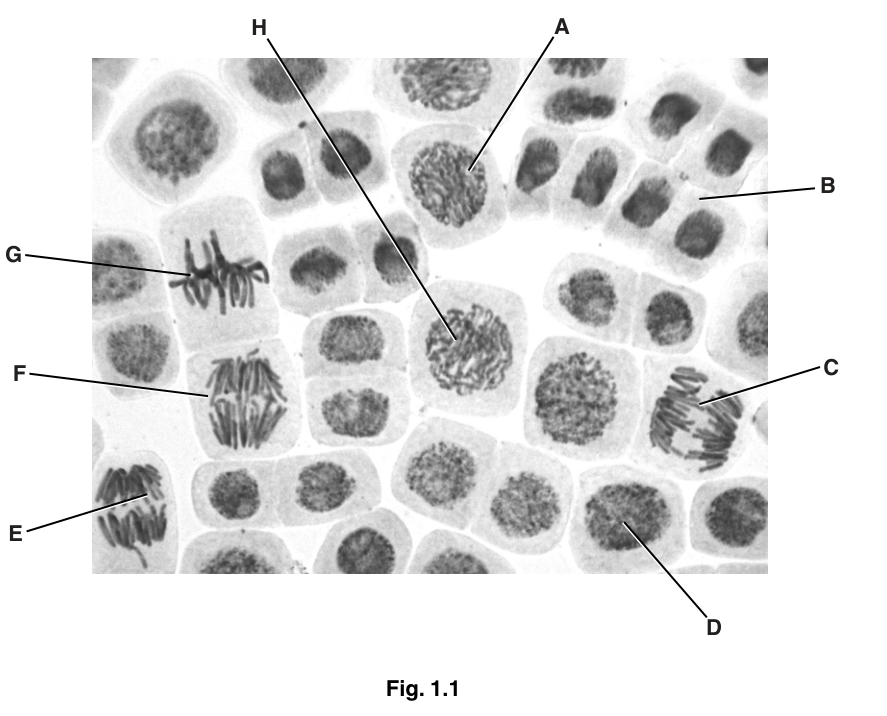
Complete the table below by:
- naming the stages of mitosis in the correct sequence following interphase
- identifying one example from the cells labelled A to H that is in each stage of mitosis that you have named.
| stage of mitosis | label from Fig. 1.1 |
|---|---|
Answer
| Stage of mitosis | Label from Fig. 1.1 |
|---|---|
| Prophase | A or H |
| Metaphase | G |
| Anaphase | C, E or F |
| Telophase | B |
Prophase – A or H; Metaphase – G; Anaphase – C, E or F; Telophase – B.
Background Concept
Mitosis is the division of a nucleus into two genetically identical daughter nuclei, followed by cytokinesis. It is conventionally divided into four stages that follow interphase:
- Prophase – chromatin condenses into visible chromosomes (each with two sister chromatids joined at a centromere); the nuclear envelope breaks down and the spindle forms.
- Metaphase – chromosomes, attached to spindle fibres at their centromeres, line up on the equator (metaphase plate).
- Anaphase – sister chromatids separate at the centromere and are pulled to opposite poles by the shortening spindle fibres.
- Telophase – chromatids arrive at the poles, decondense, new nuclear envelopes form, and cytokinesis begins (in animal cells a cleavage furrow; in plant cells a cell plate).
Understanding the Question
Fig. 1.1 is a photomicrograph of a Vicia faba root tip, a classic preparation because root tips contain a meristem with many cells actively dividing. Eight cells are labelled A–H, and the candidate must (i) write the four stages of mitosis in the correct order after interphase, and (ii) match each stage to one of the labelled cells. The cell D is given as being in interphase.
Approach
Work through the labelled cells systematically, identify the key visual cue for each stage, then match it to the stage name. Use the cellular features that survive fixation and squashing in a root-tip preparation: degree of chromosome condensation, presence/absence of a nuclear envelope, and — most diagnostically — the position of the chromosomes.
Step-by-Step Reasoning
- Prophase (A or H): chromosomes have condensed but are still scattered within the cell — no equator alignment and no separation into two groups. Cells A and H show dark, thread-like condensing chromatin consistent with prophase.
- Metaphase (G): chromosomes are aligned in a single row across the middle (equator) of the cell. Cell G clearly shows chromosomes lined up on a central plate — the hallmark of metaphase.
- Anaphase (C, E or F): sister chromatids have separated and are moving towards (or have reached) opposite poles, giving the cell a clear two-grouped, V-shaped appearance. Cells C, E and F all show chromatid groups at opposite ends of the cell — the defining feature of anaphase.
- Telophase (B): two distinct, separate daughter nuclei are reforming at each pole and the cell is undergoing cytokinesis. Cell B shows two reforming nuclear regions in a dividing cell — telophase.
Key Takeaways
- The position of the chromosomes is the single most useful diagnostic feature in a root-tip squash: scattered = prophase, equatorial line = metaphase, two opposite groups = anaphase, two reforming nuclei = telophase.
- Root tips of Vicia faba (broad bean) are a textbook source of dividing cells because of the apical meristem.
- The mark scheme accepts more than one cell per stage where cells genuinely look the same — pick the one you are most confident about and write the alternative in brackets only if you wish.
Common Mistakes
- Confusing telophase with anaphase: anaphase still shows individual chromatids; telophase shows two reforming nuclei.
- Confusing prophase with interphase: prophase chromosomes are visibly condensed (dark threads), whereas interphase shows a uniformly granular nucleus with an intact envelope.
- Writing stages in the wrong order (e.g. metaphase before prophase) — the order must be prophase → metaphase → anaphase → telophase.
- Matching the same cell to two different stages, which the mark scheme does not allow.
Things to Be Careful About
- Do not invent a fifth stage; there are exactly four stages of mitosis.
- The mark scheme accepts A or H for prophase, and C, E or F for anaphase — any one of these is correct, but you must only write one letter per row.
In animal cells, centrioles are responsible for assembling microtubules to make the spindle at the beginning of mitosis.
Describe the role of the spindle during mitosis.
Answer
- Spindle (microtubules) attach to the centromere / kinetochore of each chromosome and align the chromosomes at the equator / metaphase plate.
- The spindle fibres shorten, pulling the sister chromatids to opposite poles, so that each daughter nucleus receives an equal (identical) set of chromosomes.
Spindle fibres attach to centromeres, align chromosomes at the equator, then shorten to pull sister chromatids to opposite poles, giving each daughter cell an equal set of chromosomes.
Background Concept
The spindle apparatus is built from microtubules, which are dynamic polymers of tubulin that grow from organising centres (centrosomes containing centrioles in animal cells). The spindle has three classes of microtubules: astral, polar (interpolar) and kinetochore. Only the kinetochore microtubules attach to chromosomes — they connect from a pole to a protein structure on the chromosome called the kinetochore, which is assembled on the centromeric DNA.
Understanding the Question
The stem reminds you that animal cells use centrioles to organise the spindle. The question asks you to describe the role of the spindle during mitosis. It is a 2-mark question, so you need two distinct, well-stated points.
Approach
Think of the spindle's job in two phases: (1) capturing and arranging the chromosomes, then (2) separating and delivering them. Each phase gives one mark.
Step-by-Step Reasoning
- Point 1 (capture/arrange): Spindle microtubules attach to the kinetochore at the centromere of each chromosome and align the chromosomes on the metaphase plate at the cell's equator.
- Point 2 (separate/deliver): The kinetochore microtubules shorten (by depolymerising at the pole end), pulling the sister chromatids apart and moving them to opposite poles of the cell. This guarantees that each daughter nucleus receives an equal and identical set of chromosomes.
Key Takeaways
- The spindle does three distinct jobs: attach, align, separate. Any two of these earn the available marks.
- "Centromere" and "kinetochore" are both accepted by the mark scheme — the kinetochore is the protein structure assembled on the centromere.
- Spindle action produces genetic stability: because each chromatid is pulled to a different pole, daughter cells are genetically identical.
Common Mistakes
- Saying the spindle "pulls the chromosomes apart" without specifying which chromosomes (the sister chromatids).
- Saying the spindle "moves the chromosomes to the poles" without first describing how they are captured and aligned at the equator.
- Confusing the spindle with the centrioles — the centrioles organise the spindle, they are not the spindle itself.
Things to Be Careful About
- Use the precise term sister chromatids (or daughter chromosomes) rather than just "chromosomes".
- "Equal number of chromosomes in each daughter cell" is a creditable mark — it expresses the outcome of spindle action even if the mechanism is not described.
State two roles of mitosis in plants and animals other than growth.
1 ______
2 ______
Answer
- Replacement of (worn out / dead / damaged) cells / repair of tissues.
- Asexual reproduction (e.g. vegetative reproduction in plants, budding in Vicia faba's relatives; or cloning of lymphocytes during an immune response).
- Replacement of worn-out / damaged cells and tissue repair. 2. Asexual reproduction.
Background Concept
Mitosis produces two daughter cells genetically identical to the parent, with the same chromosome number. This makes it the ideal mechanism wherever an organism needs to increase cell number without changing the genetic make-up of the cells produced. Although the question excludes growth, the underlying principle — producing identical copies — underpins the other roles too.
Understanding the Question
A 2-mark "state" question asking for two roles of mitosis in plants and animals other than growth. One mark is awarded per correct, distinct role. The list of creditable answers in the mark scheme is wide, so pick two you are confident about and write them as short, complete statements.
Approach
Recall the canonical list of mitosis roles beyond growth:
- Repair of tissues / replacement of worn-out or damaged cells (e.g. skin, gut lining, blood cells).
- Asexual reproduction (vegetative propagation in plants, budding in animals such as Hydra).
- Clonal expansion of lymphocytes during an immune response (B- and T-cells multiplying after antigen recognition).
- Regeneration of lost tissues or organs (e.g. in amphibians, some invertebrates).
- Maintaining chromosome number and genetic stability across cell generations.
- Gamete production in plants (where the gametophyte stage is produced by mitosis).
Any two of these is a strong answer.
Step-by-Step Reasoning
- Role 1 — repair/replacement. Skin, gut lining and blood all lose cells constantly; mitosis replaces them. In wound healing, mitosis lays down new tissue.
- Role 2 — asexual reproduction. Many plants reproduce vegetatively (runners in strawberry, bulbs in daffodils, tubers in potato). The new individual is a genetic clone of the parent because mitosis preserves chromosome number and identity.
(Alternative strong pairings: clonal expansion of lymphocytes + repair; regeneration + asexual reproduction.)
Key Takeaways
- Mitosis is the engine of continual renewal in multicellular organisms — not just for getting bigger.
- "Cloning of lymphocytes" is a syllabus-specific role you should know for immunology.
- The mark scheme rejects vague answers like "copying of cells" or "repair of cells" — specify tissues for repair, and use the term asexual reproduction (or vegetative reproduction in plants) rather than just "reproduction".
Common Mistakes
- Writing "reproduction" unqualified — this is not credit-worthy unless qualified as asexual.
- Writing "growth" or any variant — the question explicitly excludes it.
- Confusing mitosis with meiosis: gamete production in animals is by meiosis, not mitosis. (Gamete production in plant gametophytes is by mitosis, but students often say it loosely.)
- Saying "repair of cells" — cells are not "repaired"; tissues are.
Things to Be Careful About
- Two clearly different roles must be stated to earn both marks — "replacement of cells" and "tissue repair" count as the same idea and would only earn one mark.
- Use precise, single-clause statements; the mark scheme credits concise biological terminology.
V. faba is a legume. Roots of legumes often have swellings at intervals known as nodules. Cells within the nodules contain nitrogen-fixing bacteria.
Explain the role of nitrogen fixation in the nitrogen cycle.
Answer
- Nitrogen-fixing bacteria (e.g. Rhizobium) in the root nodules of Vicia faba convert atmospheric nitrogen () into ammonia () / ammonium ions ().
- This makes nitrogen available to other organisms in the community (for synthesising amino acids and proteins) and increases soil fertility, balancing the fixed nitrogen lost by denitrification.
Nitrogen fixation converts atmospheric into ammonia/ammonium, supplying other organisms with usable nitrogen, raising soil fertility and balancing the loss of fixed nitrogen through denitrification.
Background Concept
The nitrogen cycle describes the movement of nitrogen through the living (biotic) and non-living (abiotic) components of an ecosystem. The atmospheric pool of dinitrogen () is enormous but chemically inert because of the strong triple bond. Most organisms cannot use directly; they require fixed nitrogen in a reduced form (ammonia/ammonium) or oxidised form (nitrite/nitrate). Only a few prokaryotes — collectively called diazotrophs — can reduce to ammonia. The two most important routes are:
- Biological nitrogen fixation by bacteria such as Rhizobium (in legume root nodules) and free-living genera such as Azotobacter and cyanobacteria.
- Industrial / Haber–Bosch fixation, which produces the fertiliser that drives modern agriculture.
Atmospheric fixation by lightning is minor but real.
Understanding the Question
The stem tells you that V. faba is a legume whose root nodules contain nitrogen-fixing bacteria. The question asks you to explain the role of nitrogen fixation in the nitrogen cycle — i.e. why it matters, not just what it is.
Approach
State the chemical conversion in one mark, then state the consequence (input of fixed nitrogen into the ecosystem, replenishing the pool lost by denitrification) in the second mark.
Step-by-Step Reasoning
- Mark 1 — the chemical step: bacteria reduce to / , breaking the triple bond. (Lightning is an acceptable alternative only if no mark has already been awarded for nitrification in a later part.)
- Mark 2 — the cycle-level role: the fixed nitrogen becomes available to legumes and (when they die or are eaten) to the rest of the community, raising soil fertility. This input balances the loss of fixed nitrogen through denitrification (where nitrate is reduced back to by anaerobic bacteria), keeping the global nitrogen budget roughly in equilibrium.
Key Takeaways
- Nitrogen fixation is the only major input of fixed nitrogen into the biosphere; without it, the nitrogen available to make proteins and nucleic acids would run out.
- Legumes are central to sustainable agriculture precisely because their Rhizobium symbionts fix nitrogen for free.
- The mark scheme rejects the answer "fixes nitrogen into nitrate" — the direct product is ammonia/ammonium, not nitrate. Nitrate is produced later by nitrification.
Common Mistakes
- Saying the bacteria "fix nitrogen into nitrates" — biologically incorrect; the product of fixation is ammonia.
- Confusing fixation with nitrification: fixation = ; nitrification = .
- Only describing the chemistry and not the role in the cycle — without the ecosystem-level point, the answer is incomplete.
Things to Be Careful About
- Lightning-based "fixation" of nitrogen by atmospheric electricity is acceptable, but only before any nitrification mark is credited (the mark scheme's note "not to be awarded if it follows nitrification" means: pick one pathway, not both).
- Mentioning Rhizobium (or "nitrogen-fixing bacteria in the nodules") adds precision; generic "bacteria" is acceptable but less informative.
Farmers in some parts of the world grow legume crops together with cereal crops in the same field. This is known as intercropping.
Explain how intercropping results in an increase in the yield of the cereals when the legumes die.
Answer
- When the legume plants die, saprophytic bacteria and fungi decompose their tissues, releasing proteases that hydrolyse proteins into amino acids.
- The amino acids are deaminated to ammonia () / ammonium ions (); nitrifying bacteria (Nitrosomonas) then oxidise ammonium to nitrite, and Nitrobacter oxidise nitrite to nitrate.
- The cereal crop takes up the nitrate ions and uses them to synthesise amino acids and proteins, increasing its growth and yield.
Decomposers hydrolyse legume protein to amino acids, which are deaminated to ammonium; nitrifying bacteria (Nitrosomonas, then Nitrobacter) convert this to nitrate, which the cereal absorbs to make amino acids and proteins, increasing yield.
Background Concept
The legume is a nitrogen-rich crop because of its Rhizobium symbionts. When it dies (or its leaves/roots are shed), the organic nitrogen locked in its proteins must be re-mineralised before other plants can use it. Three microbial processes accomplish this, in order:
- Decomposition by saprophytic bacteria and fungi. They secrete extracellular proteases that hydrolyse peptide bonds, releasing amino acids.
- Ammonification — the amino acids undergo deamination (removal of the amino group as ammonia) producing ammonia/ammonium.
- Nitrification — chemoautotrophic bacteria oxidise the ammonium in two steps:
- Nitrosomonas: (nitrite)
- Nitrobacter: (nitrate)
- The nitrate is then taken up by plant roots and reduced back to ammonium inside the plant, where it is used to make new amino acids and proteins.
Understanding the Question
Intercropping — growing legumes and cereals together — exploits the legume's nitrogen-fixing symbiosis. While both crops are alive, the benefit is modest (the legume does not share its fixed nitrogen directly). The major benefit arrives after the legume dies: its nitrogen-rich tissues enter the decomposition pathway and eventually become nitrate that the cereal can absorb. The question asks for the chain of events that links the death of the legume to increased cereal yield.
Approach
Write the answer as a clear linear pathway: dead legume → protein → amino acids → ammonium → nitrite → nitrate → cereal growth. The mark scheme allows credit at each transition, so any two or three well-stated steps earn the available marks.
Step-by-Step Reasoning
- Step 1 (decomposition): Saprophytic bacteria and fungi break down the dead legume tissue. Their proteases hydrolyse proteins into amino acids. (Mark-scheme points 1, 3, 4.)
- Step 2 (ammonification): Amino acids are deaminated, releasing ammonia () / ammonium ions (). (Mark-scheme points 5, 6.)
- Step 3 (nitrification): Nitrosomonas oxidises ammonium to nitrite; Nitrobacter oxidises nitrite to nitrate. (Mark-scheme points 7, 8, 9.)
- Step 4 (uptake and use by cereal): The cereal absorbs the nitrate via root hair cells and uses it to make amino acids and proteins, increasing its growth and grain yield. (Mark-scheme point 10.)
A complete answer links these steps so the agronomic outcome (higher yield) is explained, not just described.
Key Takeaways
- Decomposition and nitrification together turn organic nitrogen into inorganic nitrate — a process called mineralisation + nitrification.
- Cereal crops (and most crop plants) prefer nitrate as their nitrogen source because uptake is energetically cheaper than reducing or ammonium assimilation.
- Intercropping is a low-input way to fertilise soil: the legume's death is the "delivery mechanism" for the fixed nitrogen it accumulated while alive.
Common Mistakes
- Skipping the decomposition step and jumping straight to "nitrogen is released into the soil" — the proteins must be broken down first.
- Saying "bacteria fix nitrogen from the dead legume" — fixation only operates on atmospheric ; dead-plant nitrogen is already fixed and must be mineralised.
- Naming only one nitrifying bacterium and crediting both steps to it — the two steps are carried out by different genera.
- Not closing the loop: failing to state that the cereal uses the nitrate (the question specifically asks how cereal yield increases).
Things to Be Careful About
- Use the precise word deamination (not just "breakdown of amino acids").
- Nitrosomonas and Nitrobacter are the genus names accepted by the mark scheme; Nitrobacter may also be written as Nitrobacter winogradskyi if you want to be thorough.
- The mark scheme credits the bare statement that "nitrifying bacteria convert ammonium to nitrate" if the two genera are not separated, but you get more credit for naming both genera.
The rest of this paper
5 more questions- Q2Gas Exchange · Cell Structure · Immunity · Infectious Diseases14M
- Q3Transport in Plants6M
- Q4Enzymes · Biological Molecules · Transport in Mammals10M
- Q5Biological Molecules · Cell Membranes and Transport9M
- Q6Nucleic Acids and Protein Synthesis7M