Biology 9700/33 — October/November 2014
Cambridge AS Level · Advanced Practical Skills · worked solutions for every part, with the mark scheme
Topics Analysis, Conclusions and Evaluation · Presentation of Data and Observations · Manipulation, Measurement and Observation · Use of the Light Microscope
Plants translocate sap through phloem sieve tubes. Scientists discovered that aphids feed by pushing their stylet into a single phloem sieve tube as shown in Fig. 1.1.
By using stylets it is possible for scientists to collect the sap from a single phloem sieve tube.
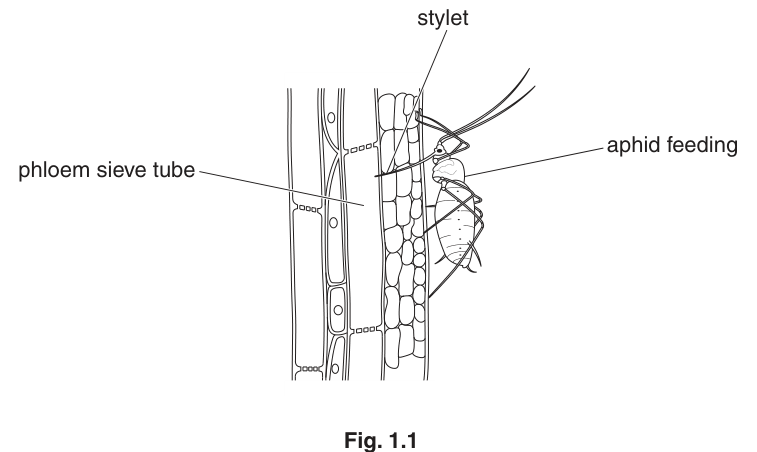
You are required to estimate, as accurately as possible, the concentration of sucrose in a sample of sap, P, by:
- carrying out a trial using the concentrations of sucrose solutions S1 and S2
- using the results of the trial to prepare further concentrations of sucrose solution
- obtaining more readings, so that you can estimate more accurately the concentration of sucrose in P.
A drop or small volume of P is placed into a known concentration of sucrose solution.
Fig 1.2 shows how the drop or small volume of P is released.
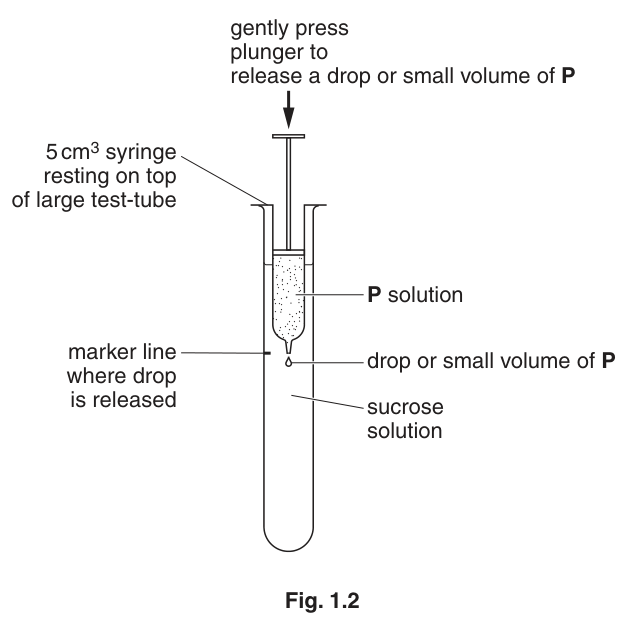
Immediately the drop or small volume of P is released, the syringe is removed.
The drop of P may move up, move down or remain at the same level depending on the difference in the concentration between P and the sucrose solution.
Show clearly on the diagrams below, using the key, how you would expect to see the drop or small volume of P move if:
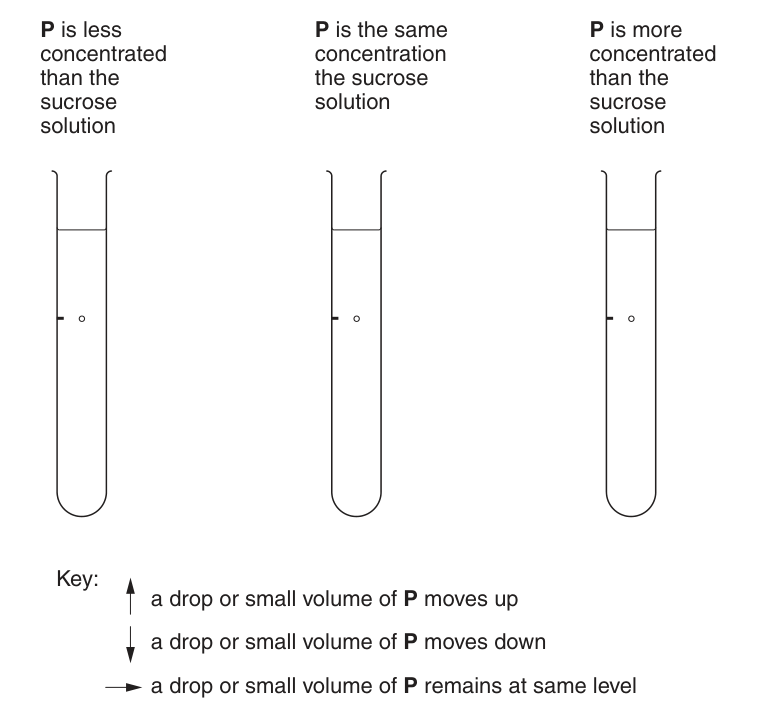
Key:
- a drop or small volume of P moves up
- a drop or small volume of P moves down
- a drop or small volume of P remains at same level
You are provided with:
| labelled | contents | hazard | volume / |
|---|---|---|---|
| S1 | sucrose solution | none | 200 |
| S2 | sucrose solution | none | 200 |
| P | coloured sample of sap | none | 20 |
| W | distilled water | none | 200 |
Read step 1 to step 8 before proceeding.
Proceed as follows:
You are required to estimate the concentration of P using S1 and S2.
- Place the syringe on top of the large test-tube and use the marker pen to draw a line on the test-tube at the same height as the end of the syringe nozzle as shown in Fig. 1.2 (page 4).
- Use the same syringe to suck up of P.
- Put of S1 into the test-tube.
- As shown in Fig. 1.2, release one drop or a small volume of P and remove the syringe from the sucrose solution.
Note: P may come out without pushing the plunger, observe and record the direction of movement.
- Immediately observe the movement of the drop or small volume of P.
- Record your observations.
- Wash out this test-tube.
- Repeat steps 3 to 7 using S2.
Prepare the space below to record your observations.
Complete the following by using one of the words ‘more’ or ‘less’.
You may use each word once or more than once.
P is ______ concentrated than (S1).
P is ______ concentrated than (S2).
Use your results to estimate the concentration of sucrose in P.
estimate of concentration of sucrose in P = ______
State which solution, S1 or S2, you will dilute to prepare further concentrations.
Use your results to explain the reason for your decision.
You are required to prepare further concentrations of sucrose solution by simple dilution, using the solution stated in (a)(iv).
Decide on the further concentrations of sucrose solution you will use in your investigation.
You will need of each sucrose solution.
Prepare the space below to show:
- the concentration of each sucrose solution
- the volumes of sucrose solution
- the volumes of W.
- Prepare all the concentrations of sucrose solution you have listed in (a)(v) in the containers provided.
- Repeat steps 3 to 7 with each of the solutions.
Prepare the space below to record your observations.
Using these additional results from (vi) state a more accurate estimate of the concentration of sucrose in P than in (iii).
Describe how you would modify this procedure to investigate the concentration of sucrose in P, using Benedict’s solution.
The rest of this paper
1 more questions- Q2Analysis, Conclusions and Evaluation · Presentation of Data and Observations · Use of the Light Microscope23M