Biology 9700/23 — May/June 2014
Cambridge AS Level · AS Level Structured Questions · worked solutions for every part, with the mark scheme
Topics Nucleic Acids and Protein Synthesis · Transport in Mammals · Biological Molecules · Immunity · Infectious Diseases · Enzymes · +5 more
Fig. 1.1 shows the structures of four biological molecules A, B, C and D.
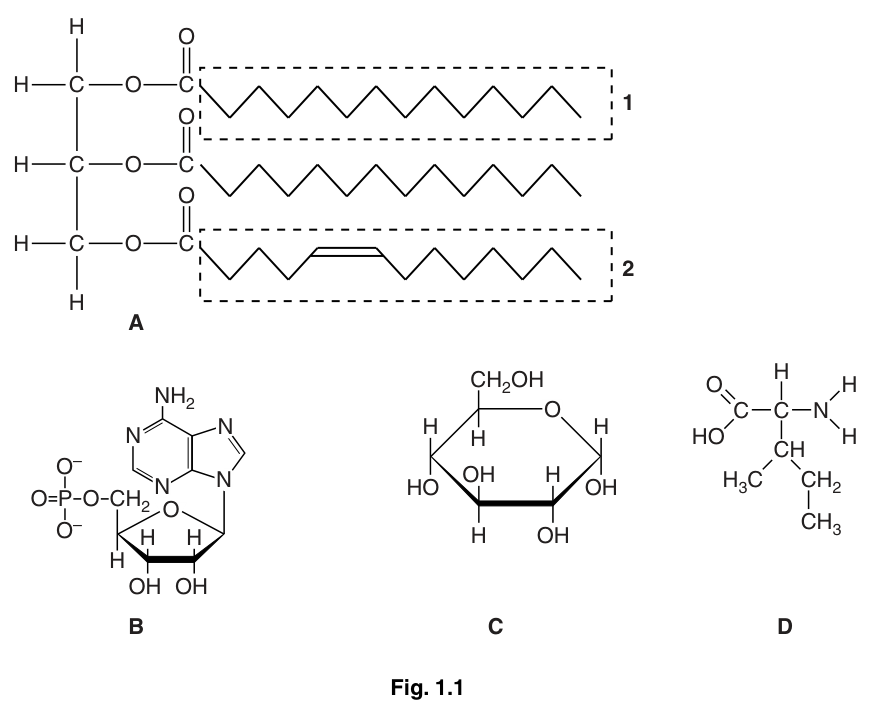
Fig. 1.1
Give the letter, A to D, of the molecule in Fig. 1.1 which:
is a nucleotide ...........................
Answer
B
B
Background Concept
A nucleotide is the monomer from which the nucleic acids DNA and RNA are built. Each nucleotide contains three components covalently joined together: a nitrogenous base (a purine with two fused rings — adenine or guanine — or a pyrimidine with one ring — cytosine, thymine or uracil), a pentose sugar (deoxyribose in DNA, ribose in RNA), and a phosphate group.
Understanding the Question
The question asks which of the four molecules A–D in Fig. 1.1 is a nucleotide. Looking at the figure: A is a triglyceride (glycerol with three fatty acid chains), B is adenosine monophosphate, C is α-glucose (a hexose sugar), and D is the amino acid leucine.
Approach
A nucleotide is recognised by its three-part structure: phosphate–sugar–base. Look for the molecule that contains all three of these components joined together.
Step-by-Step Reasoning
Molecule B clearly shows a phosphate group (–PO₄) attached to a five-carbon sugar (ribose, identifiable by the –OH on the 2′ carbon) attached to an adenine base (a purine with two rings containing four nitrogen atoms). This is the textbook structure of the nucleotide adenosine monophosphate (AMP). The other molecules do not contain all three of these components.
Key Takeaways
A nucleotide = phosphate + pentose sugar + nitrogenous base.
Common Mistakes
Confusing a nucleoside (base + sugar, no phosphate) with a nucleotide; confusing ATP (a nucleotide with three phosphates) with just the adenine base.
Things to Be Careful About
The phosphate must be bonded to a sugar that is in turn bonded to a base — the phosphate alone, or a sugar alone, does not make a nucleotide.
can form peptide bonds ...........................
Answer
D
D
Background Concept
An amino acid has a central (α) carbon atom bonded to four different groups: an amino group (–NH₂), a carboxyl group (–COOH), a hydrogen atom (–H), and a variable R-group that determines the identity of the amino acid. Amino acids link together by condensation reactions in which the –NH₂ of one joins the –COOH of another, releasing water and forming a peptide bond (–CO–NH–) between them.
Understanding the Question
The question asks which molecule in Fig. 1.1 can form peptide bonds. Peptide bonds form between amino acids, so the answer must be the amino acid shown.
Approach
Look for the molecule displaying the –NH₂ and –COOH groups attached to the same central carbon, the defining feature of an amino acid.
Step-by-Step Reasoning
Molecule D shows a central carbon bonded to an –NH₂ group, a –COOH group, an –H, and a branched hydrocarbon R-group — the structure of the amino acid leucine. Only amino acids carry the functional groups needed to form peptide bonds during protein synthesis.
Key Takeaways
Peptide bonds form only between amino acids (–NH₂ of one + –COOH of another, with loss of water). Triglycerides, sugars and nucleotides do not form peptide bonds.
Common Mistakes
Picking molecule C (glucose) by mistake — sugars form glycosidic bonds, not peptide bonds.
Things to Be Careful About
Use the precise term "peptide bond"; do not write "protein bond" or "amino bond".
contains ester bonds. ...........................
Answer
A
A
Background Concept
A triglyceride is formed when three fatty acid molecules react with glycerol (a trihydric alcohol) in three condensation reactions. Each condensation produces an ester bond (–COO–) between the –OH of glycerol and the –COOH of a fatty acid, releasing a molecule of water. Triglycerides are therefore also called triacylglycerols and are the main form of lipid storage in animals and plants.
Understanding the Question
The question asks which molecule contains ester bonds. Ester bonds occur between an organic acid and an alcohol, so we look for a molecule showing this linkage.
Approach
Identify the –C(=O)–O– linkage in the diagram, which is the characteristic ester group.
Step-by-Step Reasoning
Molecule A shows glycerol (the three-carbon backbone at the left) joined to three fatty acid chains by three –O–C(=O)– groups. Each of these is an ester bond formed between a fatty acid –COOH and a glycerol –OH. Molecule B contains a phosphoester bond but the question requires the molecule whose dominant feature is multiple ester bonds (the triglyceride). Molecule D contains no ester bond. Only A clearly contains the ester bonds characteristic of a triglyceride.
Key Takeaways
Triglycerides contain three ester bonds, formed by condensation between glycerol and three fatty acids.
Common Mistakes
Confusing ester bonds with peptide bonds (different functional groups, different linkage atoms) or with glycosidic bonds (sugars only).
Things to Be Careful About
The mark scheme accepts A because the molecule is dominantly a triglyceride; remember to distinguish an ester bond (–C(=O)–O–) from a peptide bond (–C(=O)–N(H)–).
Some of the molecules in Fig. 1.1 can form polymers.
Name a polymer which can be formed only from many molecules of C.
Answer
starch (amylose or amylopectin) or glycogen
starch
Background Concept
Glucose exists in two ring forms that differ only in the orientation of the –OH group on carbon 1: α-glucose (–OH below the ring) and β-glucose (–OH above the ring). The form of the monomer dictates the polymer that can be made:
- α-glucose → starch (amylose + amylopectin) in plants; glycogen in animals
- β-glucose → cellulose in plants
These polymers are not interchangeable because glycosidic bonds can only form between specific orientations of the –OH on C1 and C4.
Understanding the Question
Molecule C in Fig. 1.1 is α-glucose. The question asks for a polymer that can be formed only from many α-glucose molecules.
Approach
Recall which polysaccharides are built exclusively from α-glucose. Rule out cellulose (β-glucose only) and rule out anything containing both forms.
Step-by-Step Reasoning
α-glucose monomers are joined by 1,4-glycosidic bonds (with 1,6-branches in amylopectin and glycogen) to form:
- amylose (unbranched) and amylopectin (branched) — together making starch in plants
- glycogen (highly branched) — the storage polysaccharide in animals
Cellulose cannot be made from α-glucose because it requires β-glucose. The mark scheme accepts any of: amylose, amylopectin, glycogen, or starch as the umbrella term.
Key Takeaways
α-glucose forms starch and glycogen; β-glucose forms cellulose. The orientation of the –OH on C1 is the only structural difference but it determines which polymer is made.
Common Mistakes
Writing "cellulose" (wrong — cellulose is built from β-glucose, not α-glucose).
Things to Be Careful About
The question says "formed only from many molecules of C", so the answer must be a polymer of α-glucose exclusively. "Starch" or any of its two components qualifies, as does glycogen.
State one way, visible in Fig. 1.1, in which the part labelled 1 of molecule A differs from the part labelled 2.
Answer
Part 1 is saturated (no double bonds) whereas part 2 is unsaturated (has one C=C double bond visible in the chain).
Part 1 is saturated / has no double bond(s); part 2 is unsaturated / has one C=C double bond
Background Concept
Fatty acids are long hydrocarbon chains ending in a carboxyl group (–COOH). A saturated fatty acid has only single bonds between its carbon atoms and is therefore "saturated" with hydrogen; it forms a straight chain. An unsaturated fatty acid contains one (monounsaturated) or more (polyunsaturated) carbon–carbon double bonds (C=C). Each C=C introduces a kink in the chain because the carbons cannot rotate freely.
Understanding the Question
The question asks for one visible difference, in Fig. 1.1, between the part labelled 1 (top fatty acid) and the part labelled 2 (bottom fatty acid) of molecule A.
Approach
Compare the two chains drawn in the diagram and identify the structural feature that distinguishes them.
Step-by-Step Reasoning
Part 1 is drawn as a smooth zigzag with no double bond — it is a saturated fatty acid. Part 2 contains a C=C double bond, visible as a parallel-line kink in the middle of the chain — it is a (mono)unsaturated fatty acid. The double bond also reduces the number of hydrogens on that chain (part 1 has 27 H; part 2 has 25 H, as the mark scheme records). Any of these visible features earns the mark.
Key Takeaways
Saturated vs unsaturated fatty acids can be distinguished by the presence or absence of C=C double bonds, by chain shape (straight vs kinked), and by hydrogen count.
Common Mistakes
Writing only that part 2 "is bent" without naming the double bond, or stating a vague difference such as "different lengths" (the chains in the figure are drawn the same length).
Things to Be Careful About
The question asks for a feature "visible in Fig. 1.1", so an answer such as "different melting points" would not score. State either the bond difference, the chain shape, or the hydrogen count.
Molecule D can form macromolecules with other similar monomers.
These macromolecules have three dimensional shapes held in place by interactions or bonds other than those between adjacent monomers.
Name two of these interactions or bonds.
-
______
-
______
Answer
- Hydrogen bonds
- Disulfide bonds
(Other acceptable answers: ionic bonds; hydrophobic interactions; Van der Waals' forces.)
Any two from: hydrogen (bond), ionic (bond), disulfide (bond), hydrophobic (interaction), Van der Waals' (forces)
Background Concept
The primary structure of a protein is the linear sequence of amino acids linked by peptide bonds. The tertiary structure is the way this polypeptide folds into a specific three-dimensional shape, held in place by interactions between the R-groups of amino acids that are not adjacent in the chain. The four main interactions/bonds responsible are:
- Hydrogen bonds — between polar R-groups (e.g. –OH, –NH₂)
- Ionic (electrovalent) bonds — between charged R-groups (e.g. –COO⁻ and –NH₃⁺)
- Disulfide bonds — covalent S–S bridges between two cysteine –SH groups
- Hydrophobic interactions — non-polar R-groups clustering together away from water
A weaker fifth contribution comes from Van der Waals' forces between closely packed non-polar groups.
Understanding the Question
The question asks for two of these interactions or bonds (other than the peptide bonds between adjacent monomers) that hold the 3-D shape of a macromolecule formed from amino acid D.
Approach
Recall the standard list of tertiary-structure stabilisers and pick any two.
Step-by-Step Reasoning
The mark scheme accepts any two from: ionic (electrovalent) bond; hydrophobic interaction; hydrogen bond; disulfide bond; Van der Waals' forces. The most commonly cited pair is hydrogen bonds and disulfide bonds; ionic bonds and hydrophobic interactions are equally correct.
Key Takeaways
Tertiary structure is stabilised by R-group interactions, not by the peptide bonds of the backbone. The types are: hydrogen, ionic, disulfide, hydrophobic (and Van der Waals').
Common Mistakes
Writing "peptide bond" (this is the bond between adjacent monomers, explicitly excluded by the question). Writing vague terms such as "weak bonds" or "chemical bonds" — the mark scheme requires a named type.
Things to Be Careful About
Use the precise terminology: "hydrogen bond", "ionic bond", "disulfide bond", "hydrophobic interaction" (not "hydrophobic bond" — it is technically an interaction between non-polar groups, not a chemical bond).
The rest of this paper
5 more questions- Q2Immunity · Infectious Diseases11M
- Q3Enzymes · Cell Membranes and Transport · (outdated) Ecology12M
- Q4Transport in Plants · Cell Structure9M
- Q5Transport in Mammals · Nucleic Acids and Protein Synthesis14M
- Q6Gas Exchange · Transport in Mammals7M