Biology 9700/21 — May/June 2014
Cambridge AS Level · AS Level Structured Questions · worked solutions for every part, with the mark scheme
Topics Cell Membranes and Transport · Cell Structure · Infectious Diseases · (outdated) Ecology · Biological Molecules · Enzymes · +4 more
Vibrio cholerae is a prokaryotic organism.
Fig. 1.1 shows the structure of a cell of V. cholerae.
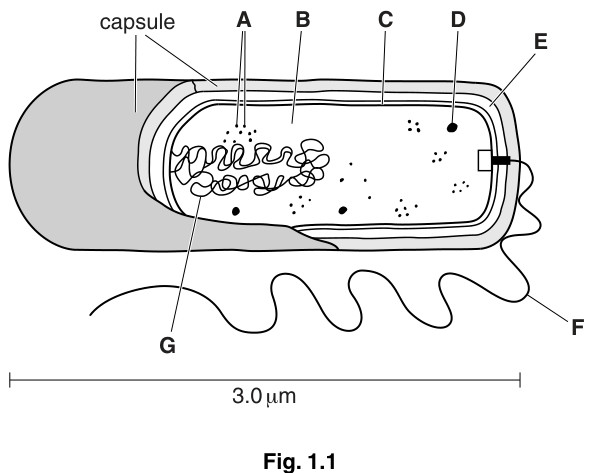
Calculate the magnification of Fig. 1.1.
Show your working and give your answer to the nearest whole number.
magnification ______
Working
Measure the scale bar on Fig. 1.1 with a ruler.
- Image length of scale bar = 90 mm
- Actual length = 3.0 µm
Convert both to the same unit (metres):
Answer
magnification = ×30000
×30000
Background Concept
The magnification of a microscope image tells you how many times bigger the printed image is than the real specimen. The defining formula is:
For the formula to work, both lengths must be in the SAME units. Scale bars are printed on micrographs so the magnification can be recovered even after the figure has been resized for the paper.
Understanding the Question
Fig. 1.1 carries a scale bar labelled 3.0 µm, representing the true length of the bacterium. We need to measure how long that bar is in the printed image (in mm) and divide by 3.0 µm to get the magnification. The mark scheme allows a reading tolerance of ±3 mm, which is why answers between 29000 and 31000 all credit.
Approach
- Measure the printed scale bar with a ruler (in mm).
- Convert both lengths to the same unit — metres handles the very different magnitudes cleanly.
- Substitute into magnification = image / actual.
Step-by-Step Reasoning
- Measured image length: ~90 mm = 90 × 10⁻³ m = 9.0 × 10⁻² m.
- Given actual length: 3.0 µm = 3.0 × 10⁻⁶ m.
- Apply the formula:
The answer to the nearest whole number is ×30000.
Key Takeaways
- The magnification formula only works when both quantities share the same unit.
- A 90 mm printed bar representing 3.0 µm gives ×30000 — typical of an electron micrograph.
- The mark scheme accepts any answer in the range 29000–31000 to allow for ruler-reading error.
Common Mistakes
- Dividing 90 mm by 3.0 µm without converting (gives 30, not 30000).
- Forgetting to convert either the mm or the µm into metres.
- Attaching a unit (e.g. "×30000 mm") to the magnification number.
- Leaving an unrounded figure (e.g. 30000.0) where a whole number is asked for.
Things to Be Careful About
- The scale bar is labelled 3.0 µm — µm, not mm or nm.
- The final answer is just a number with the × symbol; no unit belongs on the number.
- Read the bar carefully: ±3 mm tolerance means a small reading error is acceptable.
Locate the structures in Fig. 1.1 that apply to each of the features shown in Table 1.1.
Complete Table 1.1 by writing the appropriate letter and the name of the structure.
You must only give one letter in each case. You may use each letter once, more than once or not at all. The first answer has been completed for you.
Table 1.1
| feature | identity | name |
|---|---|---|
| provides motility | F | flagellum |
| stores genetic information | ||
| partially permeable | ||
| composed of murein (peptidoglycan) | ||
| site of translation |
Answer
| feature | identity | name |
|---|---|---|
| stores genetic information | G | DNA |
| partially permeable | C | cell surface / plasma membrane |
| composed of murein (peptidoglycan) | E | cell wall |
| site of translation | A | ribosome(s) |
G – DNA; C – cell surface/plasma membrane; E – cell wall; A – ribosome(s)
Background Concept
Vibrio cholerae is a Gram-negative bacterium, so although it is a prokaryote it has the typical bacterial envelope: an outer capsule, a cell wall of murein (peptidoglycan), and a plasma membrane around the cytoplasm. Inside the cytoplasm lie ribosomes (70S, smaller than eukaryotic) and a single circular DNA molecule that occupies a nucleoid region — there is no nuclear membrane.
Key functions to attach to each structure:
- Ribosomes carry out translation.
- DNA stores the genetic information (as a single circular molecule, not a chromosome with histones).
- Plasma (cell surface) membrane is a phospholipid bilayer that is selectively/partially permeable.
- Cell wall is made of murein (peptidoglycan).
- Flagellum provides motility.
Understanding the Question
Fig. 1.1 labels seven structures with letters A–G. Each row of Table 1.1 names a feature and we must write the appropriate letter and the structure's biological name. The first row (motility = F = flagellum) has already been completed for us; we must complete the other four.
Approach
For each row: identify the feature's role in the cell, then locate that role on the diagram and read off the letter and biological name.
Step-by-Step Reasoning
- Stores genetic information → G → DNA. The genetic material of a bacterium is its single circular DNA molecule, located in the nucleoid and labelled G.
- Partially permeable → C → cell surface / plasma membrane. The phospholipid bilayer around the cytoplasm is the partially permeable barrier; it is letter C.
- Composed of murein (peptidoglycan) → E → cell wall. Only the bacterial cell wall is made of murein; cellulose cell walls (plant) are rejected. Letter E.
- Site of translation → A → ribosome(s). Translation occurs on ribosomes; bacterial ribosomes are 70S (~18 nm), so do not call them 80S or 22 nm. Letter A.
Key Takeaways
- Each letter in the diagram points to a structure with one main role — match role to structure.
- Murein (peptidoglycan) is the giveaway for a bacterial cell wall.
- A partially permeable boundary around the cytoplasm is the membrane, not the cell wall.
Common Mistakes
- Calling the genetic material "a plasmid" — the mark scheme rejects plasmids here (the question wants the main DNA).
- Saying "80S ribosome" or "22 nm ribosome" — those are eukaryotic.
- Calling the cell wall "cellulose cell wall" — that is a plant wall.
- Confusing the membrane (C) with the cytoplasm — only the membrane is partially permeable.
Things to Be Careful About
- "Partially permeable" must be answered with the membrane, not the cell wall.
- Each letter may be used more than once in this type of question, although here every row takes a different letter.
- The first row (F = flagellum) was already given — do not repeat it.
State three structural features that are present in a mesophyll cell in a leaf that are not present in a prokaryotic cell such as that of V. cholerae.
Answer
Any three of the following (one mark each):
- Nucleus (with nuclear envelope) — present in mesophyll cells, absent in V. cholerae.
- Chloroplast — present in mesophyll cells (site of photosynthesis), absent in V. cholerae.
- (Permanent) vacuole / tonoplast — present in mesophyll cells, absent in prokaryotes.
Other credit-worthy answers: mitochondrion, Golgi (body / apparatus / dictyosome), rough endoplasmic reticulum, smooth endoplasmic reticulum, nucleolus, linear chromosomes, cellulose cell wall, starch grain / amyloplast, plasmodesma(ta), 80S ribosomes.
- nucleus; 2. chloroplast; 3. (permanent) vacuole
Background Concept
Mesophyll cells are eukaryotic plant cells in the leaf. Like all eukaryotes they possess membrane-bound organelles (nucleus, mitochondria, ER, Golgi, lysosomes/vacuoles); as plant cells they additionally possess chloroplasts, a cellulose cell wall, a large permanent vacuole bounded by the tonoplast, and plasmodesmata connecting adjacent cells.
V. cholerae is a prokaryote: it has no nucleus, no membrane-bound organelles, no chloroplasts, no vacuole, and its DNA is a single circular molecule free in the cytoplasm. Its ribosomes are 70S (about 18 nm) rather than the eukaryotic 80S (about 22 nm).
Understanding the Question
The question asks for three STRUCTURAL features present in a mesophyll cell but absent in V. cholerae. Each feature must be a structure (an organelle or a cell component), not a function or a process.
Approach
Pick three features that are uniquely eukaryotic or specifically plant, and clearly structural.
Step-by-Step Reasoning
Three strong mark-scheme-credited answers:
- Nucleus — surrounded by a nuclear envelope (double membrane). Prokaryotes have no such compartment.
- Chloroplast — double-membraned organelle with thylakoids/grana, site of photosynthesis; only in plant cells.
- Permanent vacuole with tonoplast — large fluid-filled organelle in mature plant cells.
Other valid choices include: mitochondrion, Golgi apparatus, RER, SER, nucleolus, linear chromosomes (with histones), cellulose cell wall, starch grain / amyloplast, plasmodesmata, and 80S ribosomes.
Key Takeaways
- The biggest difference between prokaryotes and eukaryotes is the presence/absence of membrane-bound organelles and a true nucleus.
- Plant cells additionally carry chloroplasts, cellulose cell walls, a permanent vacuole and plasmodesmata.
- Only STRUCTURAL features earn marks — functions ("carries out photosynthesis") do not.
Common Mistakes
- Giving a function ("does photosynthesis") instead of a structure ("chloroplast").
- Listing features that prokaryotes DO have (ribosomes, cell wall, DNA, cytoplasm) — these are not credited.
- Writing "well-defined nucleus" — the mark scheme explicitly ignores this wording.
- Saying "vesicles" — only the permanent vacuole counts.
Things to Be Careful About
- Membrane-bound organelles are the headline answer; include at least one.
- Plant-specific features (chloroplast, cellulose wall, vacuole, plasmodesmata) are also strong.
- Three marks = three different structures, each independent.
Describe how V. cholerae is transmitted from an infected person to an uninfected person.
Answer
V. cholerae is transmitted by the faecal-oral route:
- Faeces (or diarrhoea / sewage) from an infected person contaminate drinking water, cooking utensils, vegetable plots or food.
- An uninfected person becomes infected by drinking the contaminated water or eating the contaminated food.
("Faecal-oral route" on its own earns both marks.)
Faeces of an infected person contaminate water/food; an uninfected person then drinks the contaminated water or eats the contaminated food.
Background Concept
Cholera is caused by Vibrio cholerae, a Gram-negative bacterium that secretes an enterotoxin in the small intestine, producing the profuse watery "rice-water" diarrhoea that defines the disease. The very diarrhoea that makes the patient ill is also the vehicle by which the bacterium leaves the body — large numbers of vibrios are shed in the stool.
Transmission is therefore described as faecal-oral: pathogens leave one host in faeces and enter the next through the mouth, almost always via contaminated water or food.
Understanding the Question
The question asks how V. cholerae moves from an infected person to an uninfected one. We need BOTH halves of the route:
- The exit — how the bacterium leaves the infected host and reaches the environment.
- The entry — how the bacterium gets into the uninfected host.
Two marks: one for each half (or both for the phrase "faecal-oral route").
Approach
Trace the route: infected person → contaminated environment → uninfected person. Use the precise faecal-oral terminology.
Step-by-Step Reasoning
- Exit: V. cholerae leaves the infected person in their faeces (or diarrhoea/sewage). These faeces contaminate drinking water, food, cooking utensils or vegetable plots. Houseflies that land on faeces can also act as mechanical carriers.
- Entry: an uninfected person becomes infected by drinking the contaminated water or eating the contaminated food / using contaminated utensils.
- The whole route can be summarised as the faecal-oral route — a phrase that on its own earns both marks.
Key Takeaways
- Cholera is a water-borne disease of poor sanitation.
- Two marks require two halves of the route (or the term "faecal-oral" covers both).
- There is no insect vector and no airborne spread — that distinguishes cholera from malaria and from many respiratory infections.
Common Mistakes
- Saying only "dirty water" without naming the source (faeces) — the mark scheme rejects "human waste unqualified".
- Writing "infected water" — the water is contaminated, not infected.
- Mentioning mosquitoes — this would be malaria, not cholera.
- Giving only the uninfected-person side and forgetting the contaminated-source side.
Things to Be Careful About
- Mention both halves of the route: contaminated AND ingested.
- Use "faeces" or "sewage" rather than the vague "waste".
- The route is faecal-oral; there is no vector involved.
It is important to know how pathogens are transmitted in order to develop effective control methods.
Explain how this knowledge is used to control the spread of V. cholerae in the human population.
Answer
-
The pathogen is at its most vulnerable when moving between hosts, so breaking the transmission cycle is the most efficient way to control cholera.
-
Specific control measures (any two of the following):
- Sewage treatment / effective sanitation so faeces do not contaminate water or crops (e.g. latrines sited away from water sources).
- Do not use human faeces as fertiliser on vegetable plots.
- Provide clean drinking water — treated, piped, boiled, chlorinated or purified (UV / ozone), or supply bottled water.
- Site water treatment plants upstream of sewage disposal.
- Treat infected people with antibiotics and oral / intravenous rehydration therapy (ORT) to reduce the pool of people shedding the bacterium.
Break the transmission cycle; sanitation/sewage treatment/no faeces as fertiliser; clean drinking water; treat infected people with antibiotics and oral rehydration therapy.
Background Concept
The most effective way to control an infectious disease is to interrupt the route by which the pathogen moves from one host to the next. For cholera, that route is faecal-oral — so control measures cluster around three ideas:
- Sanitation — stop faeces getting into the environment.
- Safe water — stop contaminated water reaching people's mouths.
- Treating cases — reduce the number of people shedding the bacterium and so shrink the reservoir of infection.
Understanding the Question
The question opens with a general statement: "It is important to know how pathogens are transmitted in order to develop effective control methods." It then asks us to APPLY that idea to V. cholerae. Three marks are available — one for the general principle, and two for specific measures.
Approach
Lead with the principle (1 mark), then give two control measures that each block a specific link in the faecal-oral chain (2 marks).
Step-by-Step Reasoning
- Principle (1 mark). The pathogen is at its most vulnerable when in transit between hosts. Breaking the transmission cycle is therefore the most efficient way to control the spread.
- Measure 1 — sanitation (1 mark). Sewage treatment, correct siting of latrines, and not using human faeces on crops all stop the bacterium leaving an infected person and contaminating the environment.
- Measure 2 — safe water (1 mark). Piped, treated, boiled, chlorinated or bottled drinking water stops the bacterium being ingested by an uninfected person. Water-treatment plants should be sited upstream of sewage outlets.
- Alternative measure — case management (1 mark). Antibiotics and (especially) oral rehydration therapy (ORT) cut the case-fatality rate and shorten the period of bacterial shedding, shrinking the reservoir of infection.
Key Takeaways
- Knowing the transmission route (faecal-oral) directly tells you the control methods (sanitation + clean water).
- One mark for the principle of breaking transmission; up to two marks for specific methods.
- All the methods listed in the mark scheme have a clear link to a weakness in the faecal-oral chain.
Common Mistakes
- Listing only the principle without any concrete methods — loses two marks.
- Listing methods without linking them to the transmission route.
- Vague answers such as "better hygiene" or "clean water" without being specific (e.g. "chlorinated drinking water", "sewage treatment").
- Suggesting a vaccine — there is no widely deployed cholera vaccine credited at AS level.
Things to Be Careful About
- One mark for the principle + two marks for specific methods (max 3).
- "Boil drinking water" or "bottled water" are acceptable; "cook food thoroughly" is explicitly ignored by the mark scheme.
- Antibiotics help but oral rehydration therapy is the mainstay of treatment because most cholera deaths are due to dehydration.
The rest of this paper
4 more questions- Q2(outdated) Ecology7M
- Q3Biological Molecules · Enzymes · Cell Membranes and Transport12M
- Q4Immunity · Nucleic Acids and Protein Synthesis · Cell Membranes and Transport · The Mitotic Cell Cycle18M
- Q5Transport in Mammals9M