Biology 9700/33 — May/June 2013
Cambridge AS Level · Advanced Practical Skills · worked solutions for every part, with the mark scheme
Topics Presentation of Data and Observations · Analysis, Conclusions and Evaluation · Manipulation, Measurement and Observation · Use of the Light Microscope
Enzyme, E hydrolyses (breaks down) one substrate (biological molecule) present in one of the solutions S1, S2 or S3.
You are required to:
- identify which biological molecule may be present in each solution, S1, S2 and S3
- identify which of the biological molecules in the solutions S1, S2 and S3 can be hydrolysed by E.
The solutions contain one type of biological molecule which may be:
- glucose
- starch
- sucrose.
Each solution contains one type of biological molecule, but the same type of biological molecule may be present in more than one of S1, S2 and S3.
For example glucose may be present in S1 AND S2.
You are provided with:
| labelled | hazard | volume / |
|---|---|---|
| S1, S2 and S3 | none | 25 |
| E | irritant | 15 |
Read to the end of page 6 before proceeding.
Proceed as follows:
As you carry out each test to identify the presence or absence of the biological molecule in S1, S2 and S3, complete the following:
Decide which biological molecule to identify in the first test.
First test: Test for ______
Describe how you used the reagents to carry out this test.
Carry out the first test and record your observations.
| solutions tested | observations of colour |
|---|---|
Use these observations to complete the sentence.
Solution(s) ______ contain(s) the biological molecule ______ .
Decide which biological molecule to identify in the second test.
Second test: Test for ______
Describe how you used the reagents to carry out this test.
Carry out the second test and record your observations.
| solutions tested | observations of colour |
|---|---|
Use these observations to complete the sentence.
Solution(s) ______ contain(s) the biological molecule ______ .
Decide which test you will use to check the identity of the third biological molecule.
Third test: Test for ______
Describe how you used the reagents to carry out this test.
Carry out the third test and record your observation.
| solution tested | observation of colour |
|---|---|
Use this observation to complete one of the following sentences.
Solution(s) ______ contain(s) the biological molecule ______ .
OR
Solution ______ does not contain any of these biological molecules, glucose, starch or sucrose.
First test: Test for glucose (reducing sugar)
Method
- Add of Benedict's reagent to of each solution (S1, S2 and S3) in three separate test tubes.
- Heat the mixtures in a boiling water bath () for 2–3 minutes.
- Observe and record the colour of any precipitate that forms.
Representative observations
| solutions tested | observations of colour |
|---|---|
| S1 | blue (no change) |
| S2 | blue (no change) |
| S3 | orange / red precipitate |
Solution(s) S3 contain(s) the biological molecule glucose.
Second test: Test for sucrose (non-reducing sugar)
Method
- Add of dilute hydrochloric acid (HCl) to of each of the remaining solutions (S1 and S2) in two separate test tubes.
- Boil for about 1 minute.
- Neutralise by adding sodium hydrogencarbonate (NaHCO₃) until effervescence stops.
- Add of Benedict's reagent and re-heat in a boiling water bath for 2–3 minutes.
- Observe and record the colour of any precipitate that forms.
Representative observations
| solutions tested | observations of colour |
|---|---|
| S1 | orange / red precipitate |
| S2 | blue (no change) |
Solution(s) S1 contain(s) the biological molecule sucrose.
Third test: Test for starch
Method
- Add a few drops of iodine solution to of the remaining solution (S2) in a test tube.
- Observe and record the colour change.
Representative observation
| solution tested | observation of colour |
|---|---|
| S2 | blue-black |
Solution(s) S2 contain(s) the biological molecule starch.
S1 contains sucrose; S2 contains starch; S3 contains glucose.
Background Concept
Three standard biochemical tests identify which carbohydrate is in an unknown solution:
- Benedict's test detects reducing sugars (monosaccharides and some disaccharides such as maltose). On heating, reducing sugars reduce the blue Cu²⁺ in Benedict's reagent to brick-red Cu₂O. A negative result stays blue.
- Iodine test detects starch. The triiodide ion slips inside the helical amylose coil and forms a blue-black charge-transfer complex; without starch the iodine stays its original yellow/brown colour.
- Non-reducing sugars such as sucrose have no free aldehyde or ketone group, so they give a negative Benedict's result directly. They must first be hydrolysed by boiling with dilute hydrochloric acid (which splits the glycosidic bond) and then the acid must be neutralised with NaHCO₃ before Benedict's reagent will work — otherwise the acidic conditions prevent the test.
Understanding the Question
You have three solutions S1, S2 and S3, each containing one of glucose, starch or sucrose (the same molecule may be present in more than one solution). You must (i) decide which biological molecule to test for in each round, (ii) describe the method you used, (iii) record your observations and (iv) write a one-line conclusion for each test. Enzyme E is the substrate for part (b), not part (a).
The command word is essentially "identify" — your decision about which test to do first and which solutions to include is part of what earns marks.
Approach
Test for the simplest molecule first, then use the result to narrow down what to test next:
- Test for glucose (Benedict's) on all three solutions in one go. Any solution that goes orange/red contains a reducing sugar; any that stay blue do not.
- The solution(s) that stayed blue cannot contain glucose, so test only those for sucrose (acid-hydrolyse, neutralise, then Benedict's). If sucrose is present, hydrolysis releases glucose + fructose and Benedict's turns orange/red.
- Any solution still unidentified is tested with iodine for starch.
This strategy minimises the number of tests and uses only the solutions that still need identifying.
Step-by-Step Reasoning
Test 1 — Glucose (reducing sugar) on S1, S2, S3
- Mix equal volumes () of Benedict's reagent and each solution; heat to for 2–3 minutes.
- Positive = colour change from blue to green, yellow, orange, red or brown.
- Negative = stays blue.
- In a typical paper, S3 turns orange/red while S1 and S2 stay blue → S3 contains glucose.
Test 2 — Sucrose (non-reducing sugar) on S1 and S2
- Test only S1 and S2; S3 has already been identified.
- Add HCl to of each, boil for ~1 min to hydrolyse sucrose → glucose + fructose.
- Neutralise with NaHCO₃ (or any named alkali) until bubbling stops.
- Add Benedict's reagent and re-heat.
- In a typical paper, S1 turns orange/red while S2 stays blue → S1 contains sucrose.
Test 3 — Starch on S2
- Test only S2 (the only solution still unidentified).
- Add a few drops of iodine solution. Positive = blue-black; negative = stays yellow/brown.
- In a typical paper, S2 turns blue-black → S2 contains starch.
All three solutions are now identified.
Key Takeaways
- Benedict's identifies reducing sugars directly; non-reducing sugars need acid hydrolysis + neutralisation first.
- Iodine is specific to starch.
- Strategic test ordering: glucose first (single direct test), sucrose second (acid hydrolysis), starch third (iodine) — testing only the solutions still unidentified at each stage.
- Always specify volumes, temperature ( for Benedict's) and the named reagent (HCl, NaHCO₃, Benedict's, iodine).
Common Mistakes
- Saying "heat" without giving a temperature for Benedict's — the mark scheme credits heat only when a temperature (, or "boil") is stated.
- Forgetting to neutralise the HCl before adding Benedict's — the acid stops the test working.
- Testing all three solutions for sucrose after the glucose test, including the one already shown to be glucose — wastes reagent and risks a false positive.
- Writing "brick red" as the positive colour for sucrose — the mark scheme ignores "brick" for the sucrose test; use orange/red/green/yellow/brown.
Things to Be Careful About
- The first Benedict's test must record results for all three solutions (S1, S2, S3).
- Volumes of Benedict's and the test solution should be equal; of each is the standard.
- The iodine test must NOT be heated — iodine sublimes on boiling.
- E is an irritant — avoid skin/eye contact and wash hands after use.
Enzyme, E hydrolyses (breaks down) one biological molecule (substrate) present in one of the solutions S1, S2 or S3.
State which of the biological molecules, glucose, starch or sucrose cannot be hydrolysed by the enzyme, E.
Answer
Glucose.
Glucose.
Background Concept
Hydrolysis is a reaction in which the covalent bond between two subunits of a molecule is broken using a molecule of water. Carbohydrate polymers and dimers can therefore be hydrolysed into their monomers, but a monomer (a single sugar unit) cannot be hydrolysed further because there are no internal glycosidic bonds to break.
- Glucose is a monosaccharide (C₆H₁₂O₆) — a single hexose ring with no glycosidic bond.
- Sucrose is a disaccharide: glucose + fructose joined by an α-1,2-glycosidic bond. Hydrolysis yields glucose + fructose.
- Starch is a polysaccharide: long chains of α-glucose joined by 1,4-glycosidic bonds (amylose/amylopectin). Hydrolysis yields maltose, then glucose.
Understanding the Question
You are asked which of glucose, starch or sucrose cannot be hydrolysed by enzyme E. The question is testing your grasp of carbohydrate structure.
Approach
Decide the chemical class of each candidate:
- Glucose = monosaccharide → no internal bond → cannot be hydrolysed.
- Sucrose and starch = (di/poly)saccharide → contain glycosidic bonds → can be hydrolysed.
Step-by-Step Reasoning
- Enzymes that hydrolyse carbohydrates break the glycosidic bond between sugar units.
- Glucose has no such internal bond — it is already a single unit.
- Therefore glucose cannot be hydrolysed by E.
Key Takeaways
- Monosaccharides are the end products of hydrolysis; they cannot be hydrolysed further.
- Disaccharides (sucrose, maltose, lactose) and polysaccharides (starch, glycogen, cellulose) all contain glycosidic bonds and can be hydrolysed.
Common Mistakes
- Saying "glucose is too small to be hydrolysed" — the real reason is that there is no glycosidic bond inside the molecule.
- Confusing hydrolysis with condensation (which joins monomers into polymers, releasing water).
Things to Be Careful About
- Sucrose itself gives a negative Benedict's result because its glycosidic bond locks the reducing groups of glucose and fructose together; hydrolysis unlocks them — so a sucrose-positive sample needs acid hydrolysis before Benedict's will detect it.
You are required to identify which of the other two biological molecules is hydrolysed by the enzyme, E using the procedure shown in Fig. 1.1 on each solution.
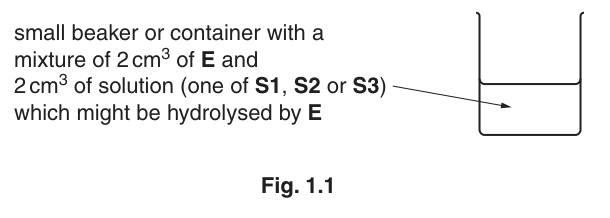
Set up two beakers as shown in Fig. 1.1.
Leave the mixtures for 5 minutes so that E can carry out the hydrolysis.
After 5 minutes, test the mixtures to find out whether E has hydrolysed the biological molecule to its products.
Prepare the space below to record:
- the biological molecule tested for
- the observations.
Procedure
- Set up two small beakers as shown in Fig. 1.1.
- To beaker 1, add of enzyme E and of S1 (sucrose).
- To beaker 2, add of enzyme E and of S2 (starch).
- Leave both mixtures to stand for 5 minutes at room temperature so that any hydrolysis can proceed.
- After 5 minutes, transfer of each mixture into a separately labelled test tube.
- To each test tube add of Benedict's reagent and heat in a boiling water bath for 2–3 minutes.
- Observe and record the colour of any precipitate that forms.
Results
| solution tested | observation of colour |
|---|---|
| S1 (sucrose) + E | blue (no change) |
| S2 (starch) + E | orange / red precipitate |
S1 + E: blue (no change); S2 + E: orange / red precipitate.
Background Concept
If enzyme E hydrolyses a carbohydrate, the products are smaller sugars. For sucrose the products are glucose + fructose (both reducing sugars); for starch the products include maltose (a reducing sugar). Detecting these products therefore tells you which substrate has been broken down. Benedict's reagent is the standard test for reducing sugars; a positive result is a colour change to green/yellow/orange/red/brown on heating.
Understanding the Question
You already know that glucose cannot be hydrolysed, so testing S3 with E is pointless. The candidates left are S1 (sucrose) and S2 (starch). You mix each with E in a small beaker (Fig. 1.1), wait 5 minutes for the reaction, then test for hydrolysis products. You must present your plan and a properly formatted results table for the candidate's own observations.
Approach
Set up two parallel reaction mixtures — E + S1 and E + S2 — under identical conditions (volumes, time, temperature). After incubation, sample each and run a Benedict's test (or an iodine test for starch). Record the colour in a table with the two columns "solution tested" and "observation". Do not include S3.
Step-by-Step Reasoning
- The beakers in Fig. 1.1 each contain E + of a single solution. Use S1 in one and S2 in the other.
- Wait 5 minutes at room temperature — long enough for any hydrolysis to proceed, short enough to keep the practical within the time available.
- Sample of each mixture and add Benedict's reagent, then heat to for 2–3 minutes.
- Record the colour in the table:
- S1 + E (sucrose): if E does not hydrolyse sucrose, no reducing sugars are produced and the Benedict's stays blue.
- S2 + E (starch): if E hydrolyses starch, maltose (a reducing sugar) is produced and the Benedict's turns orange / red (or any of green/yellow/orange/red/brown).
- The table needs:
- a heading for the solutions tested (e.g. "solution tested");
- a heading for the observations (e.g. "observation of colour");
- one row for each of S1 + E and S2 + E with the colour observed.
Key Takeaways
- Only test the substrates that can be hydrolysed (i.e. exclude the one already ruled out in (b)(i)).
- A results table for qualitative observations must have a heading for what was tested and a heading for the observation — these headings are explicit marking points.
- Positive Benedict's = reducing sugars present = hydrolysis occurred.
Common Mistakes
- Including S3 in the table — it cannot be hydrolysed and is irrelevant.
- Missing a heading on the "observations" column — the mark scheme requires an explicit label such as "observation" or "colour".
- Recording "no change" or "positive" without specifying the colour — only colour words (green/yellow/orange/red/brown) are credited.
- Drawing an incomplete table (missing cells or no ruled lines).
Things to Be Careful About
- Use exactly the volumes in the question ( of E and of each solution).
- Test for the products of hydrolysis (Benedict's for reducing sugars, or iodine for the disappearance of starch).
- Do not boil with iodine — it sublimes. If using iodine, add it cold to a sample of each mixture after the 5-minute incubation.
From your observations, state which of the solutions (S1, S2, S3) is hydrolysed by the enzyme, E. Explain the reason for your answer.
solution ______
reason ______
Answer
solution S2
reason: the Benedict's test on the S2 + E mixture turned orange / red (green / yellow / orange / red / brown), showing that reducing sugars (e.g. maltose) are now present and therefore starch has been hydrolysed by enzyme E.
S2, because the Benedict's test turned orange/red, showing reducing sugars are now present (starch hydrolysed).
Background Concept
A positive Benedict's test in a mixture that did not previously contain reducing sugars is direct evidence that a hydrolysis reaction has produced reducing sugars. In this experiment the only reducing sugar that can appear is the product of starch breakdown (maltose), because the original starch did not give a positive Benedict's test.
Understanding the Question
You must state which of S1, S2, S3 has been hydrolysed by E and explain your answer with reference to the observations made. The conclusion must be backed by a specific colour change.
Approach
Compare the two mixtures tested in (b)(ii):
- If the S1 + E mixture stayed blue → no hydrolysis of sucrose.
- If the S2 + E mixture turned orange/red → hydrolysis of starch (reducing sugars produced).
The substrate whose mixture gives a positive test is the one hydrolysed by E.
Step-by-Step Reasoning
- In the S1 + E beaker, the Benedict's reagent stays blue: no reducing sugars have been formed, so the sucrose has not been broken down.
- In the S2 + E beaker, the Benedict's reagent turns orange/red: reducing sugars are now present, which can only have come from the hydrolysis of starch to maltose (and onward to glucose).
- Therefore enzyme E hydrolyses the substrate in S2 (starch).
Key Takeaways
- The colour change is the evidence; state both the colour and what it means in biological terms.
- Only the solution whose Benedict's test becomes positive has been hydrolysed.
Common Mistakes
- Saying "S2 went orange" without linking it to hydrolysis / presence of reducing sugars.
- Naming the substrate (starch) without identifying the solution (S2).
- Saying "S2 turned red" without confirming that the original mixture was negative for reducing sugars (which is what makes the change diagnostic of hydrolysis).
Things to Be Careful About
- The conclusion needs both elements: the solution (S2) and a clear link from the colour change to the biological meaning (hydrolysis / reducing sugars produced).
Describe how you would modify this procedure to investigate the effect of temperature on the enzyme, E.
Answer
- Vary the temperature as the independent variable, using at least five different values within the range (e.g. 20, 30, 40, 50, ).
- Place each beaker (containing of E + of S2 / starch) in a thermostatic water bath (or use separate hot and cold water baths) and monitor the temperature with a thermometer.
- Keep the volumes of E and S2 / starch the same at every temperature.
- Equilibrate the enzyme and the substrate separately to the test temperature before mixing them.
- After 5 minutes, test each mixture with Benedict's reagent (heat and observe the colour change) to detect whether hydrolysis has occurred. Use the same substrate (S2 / starch) and the same enzyme E throughout.
Use ≥5 temperatures (5–100 °C), controlled with a thermostatic water bath + thermometer; keep volumes of E and substrate constant; equilibrate E and substrate separately before mixing; test with Benedict's after incubation.
Background Concept
To investigate the effect of temperature on enzyme E, temperature must be the independent variable (the only thing deliberately changed) and the degree of hydrolysis must be the dependent variable (what you measure). Everything else (volumes of enzyme and substrate, the substrate used, the incubation time, the detection test) must be kept constant so that any change in the result can be attributed solely to the change in temperature.
Enzyme activity typically rises with temperature up to an optimum, then falls as the enzyme denatures; you therefore need a spread of temperatures across the range to capture both the rising and the falling portions of the activity curve.
Understanding the Question
The question asks you to modify the procedure used in (b)(ii) so that it becomes a fair test of temperature. The substrate (S2 / starch) and the enzyme (E) must stay the same; only the temperature changes. The mark scheme explicitly rejects any modification that also changes the substrate or the volume of Benedict's test temperature.
Approach
Lay out the modified procedure in terms of:
- Independent variable — temperature, at least five values between and .
- Temperature control — thermostatic water bath (or hot and cold water baths) plus a thermometer; air-conditioned rooms and uncontrolled rooms are not credited.
- Standardised variables — same volumes of E and of substrate (S2 / starch); or equilibrate E and substrate separately to the test temperature before mixing.
- Dependent variable — test for hydrolysis after 5 minutes using Benedict's (for reducing sugars) or iodine (for remaining starch).
Step-by-Step Reasoning
- Choose a minimum of five temperatures spread across (e.g. 20, 30, 40, 50, ).
- For each temperature, place a beaker of E + S2 (starch) into a water bath pre-set to that temperature. The water bath is thermostatically controlled (or you use separate hot and cold baths to span the range); a thermometer verifies the actual temperature.
- Keep the volume of E and the volume of substrate the same at every temperature (e.g. of each). This ensures any difference in hydrolysis is due to temperature, not to concentration.
- To avoid the reaction starting before the substrate reaches the test temperature, equilibrate E and S2 separately in the bath for a minute or two, then combine them and start the 5-minute timer.
- After 5 minutes, sample each mixture and run a Benedict's test (or add iodine). Record whether hydrolysis has occurred; repeat at each temperature to obtain a temperature–activity profile.
Key Takeaways
- Only temperature is changed; substrate and enzyme are held constant.
- A thermostatic water bath + thermometer is the accepted way to control and verify the temperature.
- Equilibration of E and substrate separately, then mixing, is good practice — it prevents the cold/hot reactants from altering the bath temperature and ensures the reaction begins at the intended temperature.
- Use ≥5 temperatures to span the full activity range and reveal any optimum.
Common Mistakes
- Changing another variable as well as temperature (e.g. swapping substrates between trials) — the mark scheme rejects this because it invalidates the comparison.
- Mentioning an air-conditioned room or a general "temperature-controlled room" instead of a water bath — these do not give precise enough control and are not credited.
- Boiling the Benedict's reagent at different temperatures along with the experimental temperature — the mark scheme rejects changing temperature specifically in the context of the Benedict's test.
- Omitting the thermometer — a water bath on its own without a way to verify the temperature is not credited.
- Using glucose as the substrate — glucose cannot be hydrolysed so no temperature effect would be measurable.
Things to Be Careful About
- Keep the substrate the same throughout (S2 / starch, or sucrose if you choose S1).
- "Same volume" can be any value in the range to , but it must be the same at every temperature.
- The Benedict's test after incubation should be done in the standard way (heat to ), regardless of the experimental temperature — the experimental temperature affects only the enzyme reaction, not the detection test.
The rest of this paper
1 more questions- Q2Use of the Light Microscope · Presentation of Data and Observations · Analysis, Conclusions and Evaluation20M