Biology 9700/21 — May/June 2013
Cambridge AS Level · worked solutions for every part, with the mark scheme
Topics Cell Membranes and Transport · Infectious Diseases · Immunity · Transport in Mammals · Cell Structure · Transport in Plants · +4 more
Capillaries are known as exchange vessels. Substances are exchanged between blood and tissue fluid as the blood flows through the capillaries.
Fig. 1.1 is an electron micrograph of a section through a capillary with two red blood cells.
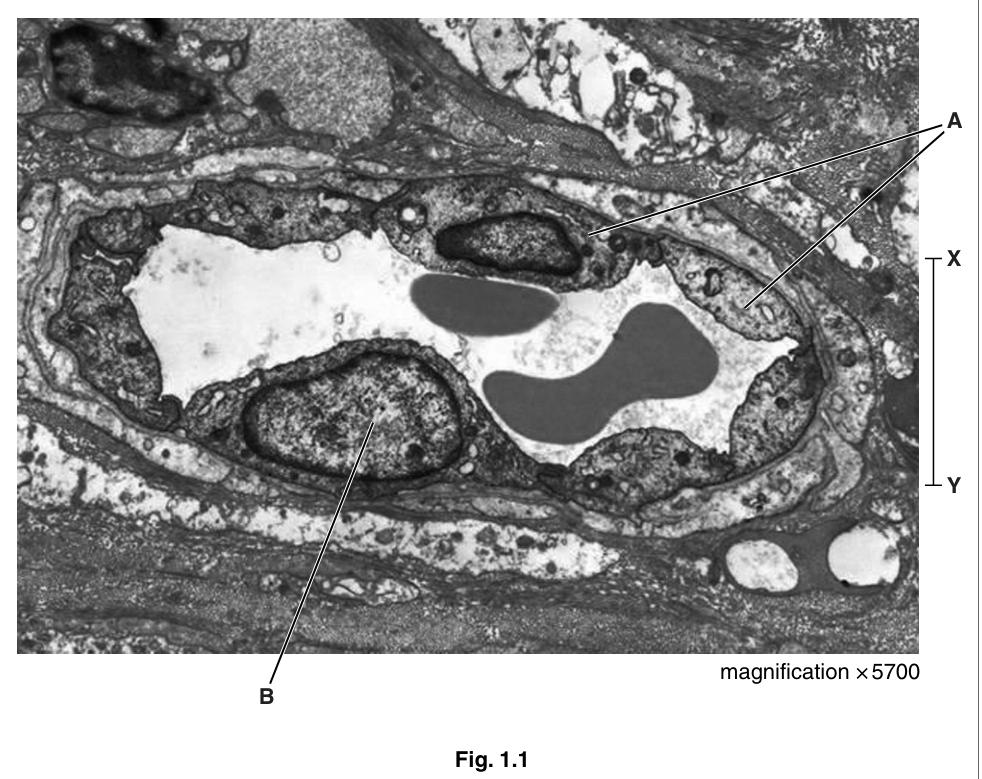
Name the cells labelled A and the structure labelled B.
A ______
B ______
Calculate the actual distance X – Y on Fig. 1.1.
Show your working and give your answer to the nearest micrometre ().
answer = ______
Explain how capillaries are adapted for their function as exchange vessels.
Table 1.1 shows the composition of blood, tissue fluid and lymph.
Table 1.1
| component | blood | tissue fluid | lymph |
|---|---|---|---|
| red blood cells / | 5.1 | 0.0 | 0.0 |
| white blood cells / | 9 000 | 75 | 1 000 000 |
| glucose / | 800 | 800 | 775 |
| protein / | 71 | 1 | 26 |
Explain the differences between the composition of blood, tissue fluid and lymph as shown in Table 1.1, for white blood cells, glucose and protein.
white blood cells
glucose
protein
Outline how red blood cells are involved in the transport of carbon dioxide.
The rest of this paper
5 more questions- Q2Infectious Diseases · Immunity6M
- Q3Transport in Plants11M
- Q4Nucleic Acids and Protein Synthesis · Enzymes · Infectious Diseases · Immunity11M
- Q5Cell Membranes and Transport9M
- Q6The Mitotic Cell Cycle · Gas Exchange9M