Biology 9700/22 — October/November 2012
Cambridge AS Level · AS Level Structured Questions · worked solutions for every part, with the mark scheme
Topics Biological Molecules · Cell Structure · Transport in Plants · Cell Membranes and Transport · (outdated) Ecology · Infectious Diseases · +6 more
Fig. 1.1 is a labelled diagram of a leaf palisade mesophyll cell, as seen with a high quality light microscope.
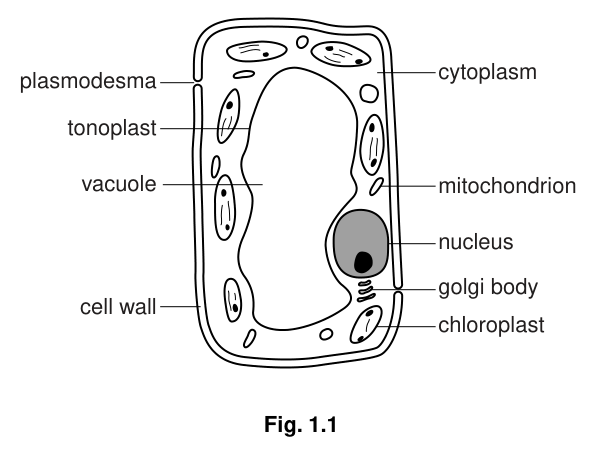
An electron micrograph of the same leaf mesophyll cell at the same magnification would show more detail than is shown in Fig. 1.1.
Explain why, at the same magnification, an electron micrograph is able to provide more detail than a light micrograph.
Describe three additional features that could be seen on an electron micrograph of the leaf mesophyll cell that are not seen in Fig. 1.1.
-
______
-
______
-
______
The length of the labelled chloroplast in Fig. 1.1 is . Calculate the magnification of the cell shown in Fig. 1.1.
Show your working.
magnification = ______
In Fig. 1.1, starch granules are visible within the chloroplasts. Starch is the most common storage compound of plants. It is composed of amylopectin and amylose.
Describe the structural differences between amylopectin and amylose.
State one role of magnesium ions within chloroplasts.
The rest of this paper
5 more questions- Q2Cell Membranes and Transport8M
- Q3(outdated) Ecology · Biological Molecules10M
- Q4Infectious Diseases · Immunity14M
- Q5Nucleic Acids and Protein Synthesis · The Mitotic Cell Cycle · Enzymes11M
- Q6Transport in Mammals · Gas Exchange7M