Biology 9700/35 — May/June 2012
Cambridge AS Level · Advanced Practical Skills · worked solutions for every part, with the mark scheme
Topics Presentation of Data and Observations · Analysis, Conclusions and Evaluation · Manipulation, Measurement and Observation · Use of the Light Microscope
When plant cells are placed into different concentrations of sodium chloride solution, water moves between the cells and the solutions. This will affect how much a piece of plant tissue can bend.
Fig. 1.1 shows how the angle of bend of a sample of plant tissue can be measured after you have pushed it until it will bend no further without breaking.
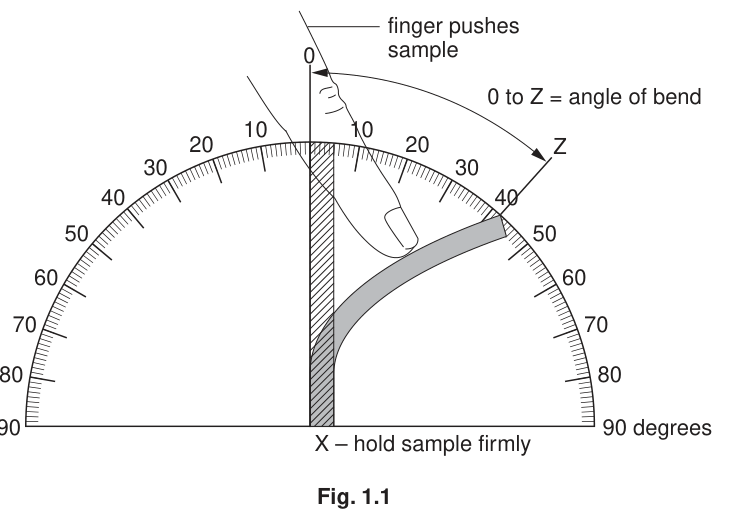
You are provided with eight pieces of plant tissue, each soaked in a different concentration of sodium chloride solution labelled P1, P2, P3 and P4.
P1, P2 and P3 each contain one of the concentrations of sodium chloride solution, , and but not necessarily in that order.
P4 has an unknown concentration of sodium chloride solution.
When samples of the plant tissue from each of the concentrations of sodium chloride solution are put into water, water will move.
Select the correct words from "least", "most", "same" to complete the sentence below.
You may use a word once, more than once or not at all.
The sample of plant tissue soaked in the highest concentration of sodium chloride solution will have the ______ bend at the start and when placed in water the bend will change the ______ .
The size of plant tissue is a variable which needs to be considered. Each piece of plant tissue should be a standard size.
Decide how you will make sure that the pieces of plant tissue are standard size.
State the size you will use.
Describe how you will obtain accurate results to record the angle of bend of the plant samples.
You are advised to read steps 1 to 5 before proceeding.
To observe the effect of putting samples of plant tissue from P1, P2, P3 and P4 into W for different times up to 10 minutes you need to decide the times you will use.
State the times at which you will measure the angle of bend.
Proceed as follows:
- Cut the pieces of plant tissue as stated in (a)(ii).
- Measure the angle of bend of the samples of plant tissue from P1, P2, P3 and P4 as shown in Fig. 1.1. Record your results in (b)(i).
- Put the samples from P1, P2, P3 and P4 into separate containers and add W to each container so that the samples are covered.
- Start timing.
- Measure the samples at each of the times that you decided in (a)(iv).
Prepare the space below and record your results.
Use your results in (b)(i) to identify the concentrations of the sodium chloride solutions.
Complete the diagram below to show the position of each of the concentrations P1, P2 and P3. Write "P4" where it fits in the series of sodium chloride concentrations.

Explain the effect of putting the plant tissue from P1 into water, W.
Identify two significant errors in this investigation.
A protractor was used to measure the angle of bend.
State the value of the smallest division on the protractor. ______
State the actual error in using the protractor to measure the angle of bend.
actual error = ______
Suggest how you would make this investigation as reliable as possible.
The rest of this paper
1 more questions- Q2Use of the Light Microscope · Presentation of Data and Observations · Analysis, Conclusions and Evaluation20M